Marks Madness: University (Basketball) Trademarks and TV

By: Angela Chung

Universities may be unhappy with how their brands are presented in television shows, but comparison and commentary does not necessarily produce consumer confusion. Where trademark law falls short, are there other legal avenues for universities to distance their marks from uses that are inconsistent with their values? 

Duke University recently criticized The White Lotus for depicting characters wearing Duke apparel in scenes involving suicidal ideation. Memes sprouting from these scenes in reference to Duke’s March Madness progression (and the later Final Four finish) prompted an official reply that the imagery “mistakenly suggests an endorsement or affiliation” with the show’s themes. This comes not long after Pepperdine University sued Netflix and Warner Bros. Entertainment for using “Waves” athletic branding in Mindy Kaling’s new show, Running Point. Pepperdine similarly asserted that the show’s depictions of identifiable branding created a false sense of endorsement by Pepperdine of the show’s suggestive themes, which are inconsistent with the university’s Christian values.

TV Does Not Dilute TMs

Trademark law is, at its core, intended to prevent consumer confusion. Facilitating distinctions and siloing off the rights to marks helps consumers and companies associate brand logos with particular values. For example, an Apple logo creates expectations of  sleek aesthetics and user interface while the Gucci logo communicates high status and product quality. When certain marks—like Apple or Gucci—are extremely well known, trademark law extends further protections for said ‘famous’ marks when they get linked to unsavory subject matter. This is called trademark dilution. Dilution can occur through blurring (chipping away at the distinction between brands in a way that harms brand reputation) or tarnishment (lowering brand reputation through association with subject matter or product quality in tension with actual values of mark owner). For instance, if a knockoff iPhone was being sold with glitchy and poor functionality, Apple may have a trademark dilution claim on the grounds that  the knockoff harms Apple’s reputation for creating smooth and reliable smartphones. 

At first glance, both universities appear to have an argument for trademark dilution, particularly via tarnishment. Associating university brand imagery with unsavory images that are contrary to university values could arguably imply inaccurate ideas about both schools. But the foundational goal of trademark law to prevent consumer confusion limits the protections these universities may seek. Context matters—seeing a particular university brand associated with products or services is very different from seeing that same brand within an expressive work on TV. 

Ultimately, viewers are unlikely to believe that university logos in creative works—like a TV show—indicate that the universities actually endorse ideas from the show itself. In fact, university branding can be a tool to express new commentary or criticism in themes across education, class, athletics, and more. Using a mark in a creative work fundamentally changes the way potential consumers view its associated ideas. Trademarks can therefore become independent vessels for communicating artistic expression, rather than identifiers of potential product or service origins.

Creative Expression > Commercial Identity

Trademark expressions in creative works are therefore explicitly protected through fair use exceptions to trademark infringement and dilution claims. The two-prong test from Rogers v. Grimaldi, 875 F.2d 994 (2d Cir. 1989) is used to determine if a trademark falls under fair use in a creative work. Under the Rogers test, courts assess if the use of a trademark (1) has artistic merit and (2) explicitly misleads a viewer as to the source of a work. Under 15 U.S.C. § 1125(c)(3)(A), if the mark has some artistic merit and does not mislead a user to believe the creative work originates from the trademark owner, there is no cause of action for trademark infringement. Ultimately, the Rogers test seeks to distinguish artistic expression from commercial products and protect free speech. Recent Supreme Court rulings have affirmed strong support for use of trademarks in creative / artistic works without permission from the mark owners.

Pepperdine’s temporary restraining order on Netflix was therefore denied because Netflix’s use of the Waves’ marks “does not explicitly mislead consumers as to the source of the work.” And Duke would not have a strong claim for trademark dilution because trademarks do “not give one control over how others reference one’s brand, including in critical ways.” (Duke Says ‘White Lotus’ Went ‘Too Far’ With School References – The New York Times). Under the Rogers test, the Duke logo likely has artistic merit for shaping out characters of the show, and does not explicitly mislead viewers into thinking The White Lotus is endorsed or produced by Duke. 

Ultimately, trademark laws protect companies where the use of their marks by others affect their commercial reputation and recognizability in the market. Trademarks do not protect brands from being referenced, criticized, or used as part of cultural /creative expression. So where can universities go from here if they sincerely wish to prevent the use of their logo in these shows? Does copyright or defamation law provide avenues for action?  

Probably not. 

Legal Limits of Brand Protection

Trademark law protects words, phrases, or designs used to identify goods and services. In order to help consumers identify the source of goods and services, mark owners are empowered to prevent others from using their marks without permission. Copyright law, on the other hand, prevents people from copying or reproducing a creative work without permission from the copyright holder. For brands, copyright law would only extend protections to creative elements of brand design, such as a logo illustration. But words, phrases, and common combinations of design are not protected because doing so would stump creativity. Because of this, copyright law would not block others from using the words “Waves” or “Duke,” for example.

A particular illustration of Duke’s mascot could be granted protections when reproduced or used in another copyrightable work, but protections over logo elements (like the combination of font styles with certain colors) would be very thin at best. In the case of Pepperdine, courts would be unlikely to prevent others from using a general combination of blue and orange with the word “Waves.” Even if Pepperdine could raise a claim for copyright infringement of their Waves logo imagery by showing substantial similarity between the show’s logo with Pepperdine’s , it probably would not entirely stop Running Point from using various brand design elements. Copyright therefore falls short of the more robust protections provided by trademark law over brand names and imagery. 

Defamation suits would not survive either. A defamation prima facie case requires a false statement about the defendant purporting to be fact and proof of damages or harm caused to the reputation of the defendant. Here, associating university brands with controversial subject matter in explicitly fictional shows does not qualify as false statements about those universities. Having a character wear a Duke sweater does not mean The White Lotus is factually stating that Duke supports or exacerbates suicide amongst its students or alum. In addition, neither Duke nor Pepperdine would likely be able to show actual damages or harm to their reputation as a result of their brand being used. While Pepperdine may dislike allusions to their sports logos alongside inappropriate scenes in Running Point, there is no evidence that the show’s airing reduced enrollment or otherwise affected the university’s reputation or funding. 

Legal action is generally sought in order to prevent or seek redress for harm. While unauthorized presentations of university brand logos in fictional shows may be strongly disliked by the respective universities,  it does not necessarily amount to harm under the law.  Further, the use does not harm viewers since there is no evidence that the use of university logos creates confusion about the show’s origins or misleads viewers into believing they are consuming something else. Creative contexts provide new meaning to protected marks outside of commercial identification, and fair use exceptions prioritize these expressive means. For now, where trademark law does not provide protections for distasteful themes in association with brand presentation, universities may just have to accept the discourse as is.

Studio Ghibli-Style AI Images and the Legal Questions They Raise

By: Esha Kher

In recent weeks, AI-generated images mimicking the iconic look of Studio Ghibli have gone viral across platforms like X and Instagram, sparking controversy. Selfies, family portraits, and memes have been transformed into soft, pastel-hued depictions that echo the dreamlike aesthetic of the legendary Japanese animation studio. Founded in 1985 by Hayao Miyazaki, Isao Takahata, and Toshio Suzuki, Studio Ghibli is renowned for its rich storytelling and distinctive, heartwarming visual style—now replicated widely through AI.

The recent trend in which users generate AI images using the latest version of OpenAI’s GPT-4o, mimicking Studio Ghibli’s aesthetic, has gained immense traction on social media, even causing server overloads. This emerging trend has sparked considerable debate, dividing public opinion into two camps: AI enthusiasts and staunch critics of AI-generated art. Supporters view the phenomenon as a tribute to Studio Ghibli’s influence and a democratization of creative tools. Critics, however, find this trend to be both a hollow and inauthentic imitation of Hayao Miyazaki’s distinct style—devoid of creative soul or artistic merit. An old clip of Miyazaki himself resurfaced during the controversy, in which he vehemently denounced AI-generated imagery as “an insult to life itself”. 

Regardless of one’s stance on the debate, the trend raises important legal questions. Do AI models rely on copyrighted material to replicate distinct visual styles? And when these outputs resemble a studio’s recognizable aesthetic, like that of Studio Ghibli, do they risk infringing on copyright or trademark protections?

How ChatGPT Generates “Stylized” Images

GPT-4o uses an autoregressive algorithm to generate images by breaking them down into visual “tokens,” which function like words in a sentence. Just as ChatGPT predicts the most likely sequence of words in a sentence, generative image models predict and assemble these visual tokens to form coherent images. Through training on large datasets of images and text, the model learns to associate certain patterns, like color palettes or brushstrokes, with specific words, encoding them as abstract “styles” within its neural network. So when a user references “Studio Ghibli,” the model doesn’t retrieve frames from actual films but instead draws on a learned mathematical representation of the studio’s aesthetic (otherwise known as “Ghibli-ness”). This ability to isolate and apply visual features across new images is known as a “style engine”. 

Copyright Law Implications 

The use of style engines has raised entirely new questions about copyright law and creative ownership. U.S. copyright law doesn’t protect certain artistic styles, the law only protects the unique ways those styles are expressed or, in other words, original works of authorship. 

However, legal experts caution that this distinction may not be sufficient. While “style” in the abstract is not copyrightable, what people casually refer to as “style” may include recognizable, discrete elements of a work of art. Therefore, the blanket statement that an artistic style isn’t protectable under copyright law may not be absolute. Courts may still find infringement if generated images include elements that are original, expressive, and substantially similar to the copyrighted works.

This legal ambiguity is at the heart of Andersen v. Stability AI, a landmark lawsuit filed in 2022 by three visual artists against AI companies Stability AI, Midjourney, and DeviantArt. The artists allege that these companies used their copyrighted artworks without consent to train AI models like Stable Diffusion, which can generate images that imitate their distinctive styles. The plaintiffs argue that such outputs constitute derivative works, and even if the results aren’t direct copies, the unauthorized use of their works in training data alone may amount to copyright infringement. Similar concerns have surfaced in other lawsuits, including Huckabee v. Meta and Millette v. Nvidia, where creators claim that their content was scrapped and repurposed by generative AI platforms, raising serious questions about how copyright applies in the context of machine learning.

Further, there is growing concern that OpenAI may have used Studio Ghibli’s films and artwork to train its generative image model without prior consent from the animation studio. This could constitute copyright infringement if the works were repurposed in a way that exceeds the scope of what is allowed under the fair use doctrine. The fair use doctrine permits the use of copyrighted material for specific purposes, such as academic research or the creation of an entirely new invention. OpenAI maintains that training its models is fair use under copyright law, but this defense is largely untested. 

Trademark Law Implications

Beyond copyright law, Studio Ghibli could assert that OpenAI’s generation of “Ghibli-style” images infringes upon its trademark rights under the Lanham Act. While an animation style—such as Studio Ghibli’s distinctive visual aesthetic—is not independently protected by trademark law and does not trigger the traditional “likelihood of confusion” test used in trademark infringement claims, other aspects of trademark law may still apply. 

When there is no registered trademark involved, Section 43(a) of the Lanham Act (15 U.S.C. § 1125(a)) provides broader protection by prohibiting false endorsement, sponsorship, or affiliation. Under this provision, a claim can arise when: (1) a defendant uses elements closely associated with a person or brand, such as names, visual likenesses, or identifying characteristics, and (2) this use creates a false impression in the minds of consumers that there is a connection, endorsement, or affiliation with the original brand. 

In this context, while Studio Ghibli may not have a registered trademark on its animation “style” per se, OpenAI’s promotion of “Ghiblification” experiments—along with OpenAI employees sharing Ghibli-style portraits of themselves on social media—could potentially give rise to a false endorsement claim under § 43(a). This is especially true if such references imply to the public that Studio Ghibli has authorized or collaborated with OpenAI in developing these tools. Even allowing prompts such as “in the style of Studio Ghibli” could lead consumers to mistakenly believe that Studio Ghibli has endorsed or is affiliated with the image generation process. While this may not amount to traditional trademark infringement, it opens the door to a false association claim under the broader protections of the Lanham Act. 

Conclusion

The rise of AI-generated art in the style of Studio Ghibli underscores the growing legal uncertainty surrounding copyright and trademark protections.​ As of now, Studio Ghibli has not initiated any legal action against OpenAI regarding the AI-generated images mimicking its distinctive animation style. Nonetheless, there might be grounds to pursue action under U.S. law. While U.S. copyright law does not formally protect artistic styles, the line becomes blurry when AI outputs closely resemble original works in expression and substance. At the same time, Studio Ghibli may have a claim under trademark law, particularly if the AI-generated images create consumer confusion or falsely present an endorsement by the studio. By capitalizing on Ghibli’s recognizable aesthetic, OpenAI risks infringing on the studio’s brand and artistic reputation. These unresolved legal questions underscore the need for updated legal frameworks that account for how AI systems produce and distribute creative content without prior consent from creators.

Can Torpedo Bats Be Patented?

By: Evan Stewart

Introduction of Torpedo Bats 

On March 29th, the New Yankees beat the Milwaukee Brewers 20-9, hitting a franchise record nine home runs, including three home runs on the first three pitches of the game. However, the story that took the baseball world by storm was not the franchise’s single-game home-run record, or the three-game sweep in which the Yankees hit 15 home runs and scored 36 runs. Instead, the national spotlight was on the new bowling-pin shaped bats that several of the Yankees players were using. These bats, dubbed “torpedo bats” have dominated baseball news for the first two weeks of the season, and are likely to impact the intellectual property world as well.

What Are Torpedo Bats

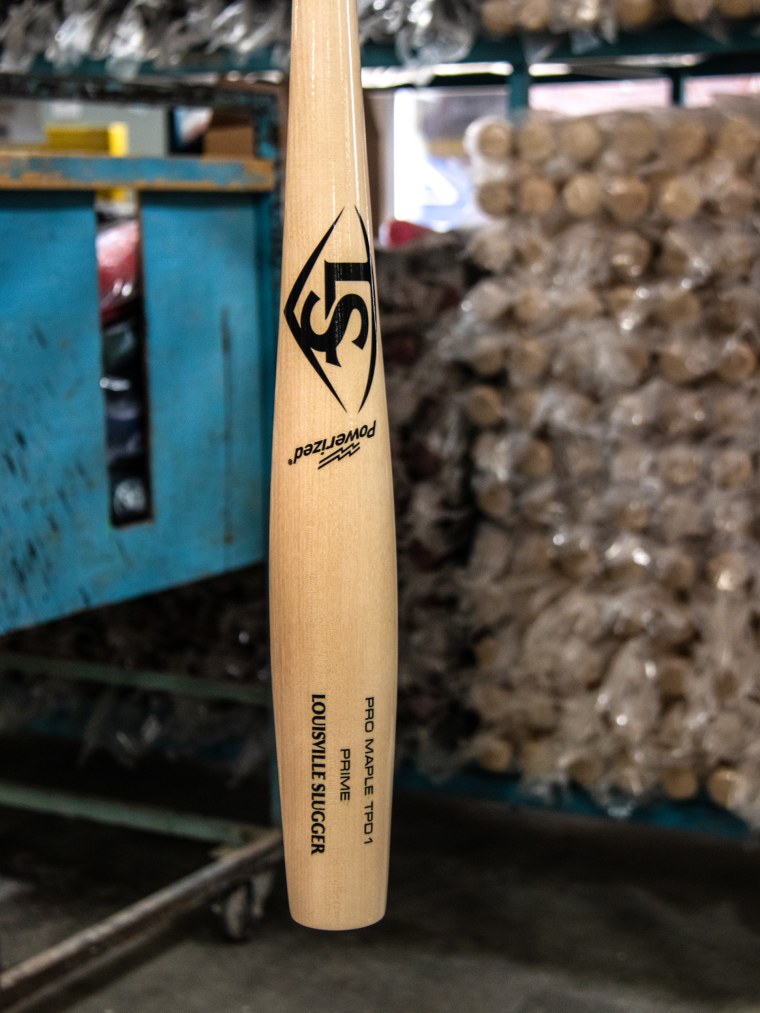
Torpedo bats differ from regular bats because the part of the bat with the widest diameter is lower on the bat. The lower sweet spot is meant to distribute the most mass of the bat to the “sweet spot”. The rationale for this change was very simple: put more wood in the area where the ball usually hits the bat. In the words of MIT physicist Dr. David Pritchard, “When you look at the design of a classic baseball bat, the physics just don’t add up. When the ball comes in and hits the sweet spot, it bends the bat so some of the energy goes into bending the bat.” With more wood in the sweet spot, there will be less energy lost by the bat bending back.

Who Created the Torpedo Bat

Credit for the creation of the torpedo bat goes to another MIT physicist turned baseball coach, Aaron Leanhardt. Leanhardt is currently a field coordinator for the Miami Marlins but previously worked as a Minor League hitting coordinator for the Yankees. Before beginning his career as a coach, Leanhardt earned a PhD in physics from MIT and was a physics professor at the University of Michigan. 

Leanhardt first began designing and testing the torpedo bat while working for the Yankees. In 2024, he first introduced the torpedo bat design to some Yankees players, including star hitter Giancarlo Stanton. There are even pictures of Stanton using a torpedo bat in the 2024 World Series. However, it was not until the opening weekend of the 2025 season, following the Yankees 3-game drubbing of the Milwaukee Brewers, when social media caught wind of the torpedo bats, and their popularity began to soar.

In the two weeks following the introduction of torpedo bats to the mainstream, baseball bat companies received thousands of preorders for torpedo bats. Two notable bat companies, Marucci and Victus, had models of the bats on their websites within a few days, trying to capitalize on the newest trend and had record sales. 

The requests for torpedo bats are also coming from MLB teams themselves. Hillerich & Bradsby, the company that is credited for creating the Yankees’ torpedo bats, received an influx of orders from MLB teams directly asking for torpedo bat models. Within a few days, there were MLB players across the league using torpedo bats, and it will be interesting to see if their popularity continues to grow among players.

Can Torpedo Bats Be Patented

Whenever there is a popular new invention, one of the first questions is whether it is eligible to receive patent protection. Patents offer inventors “the right to exclude others from making, using, offering for sale, or selling” their invention in the United States. The two main types of patents available to inventors are utility patents and design patents. Utility patents are granted to inventors of new and useful processes or machines. Design patents are granted to inventors of new, original, and ornamental designs for an article of manufacturing. 

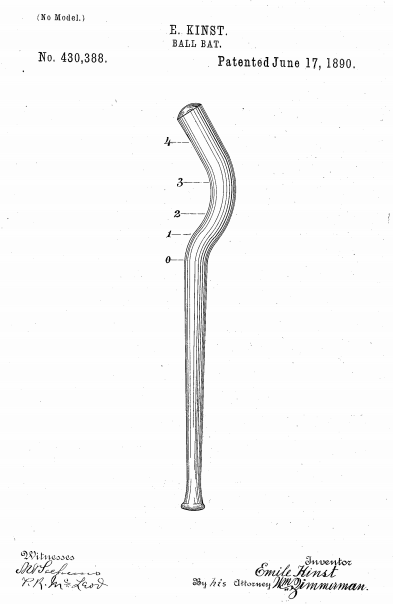
Although the general shape of baseball bats has stayed nearly the same for over 100 years, there have been some modifications that have received patents. The first, and goofiest, example of these was the banana bat. Banana bats, which had a curved barrel, received a patent in 1890, despite not catching on in professional baseball (for obvious reasons).

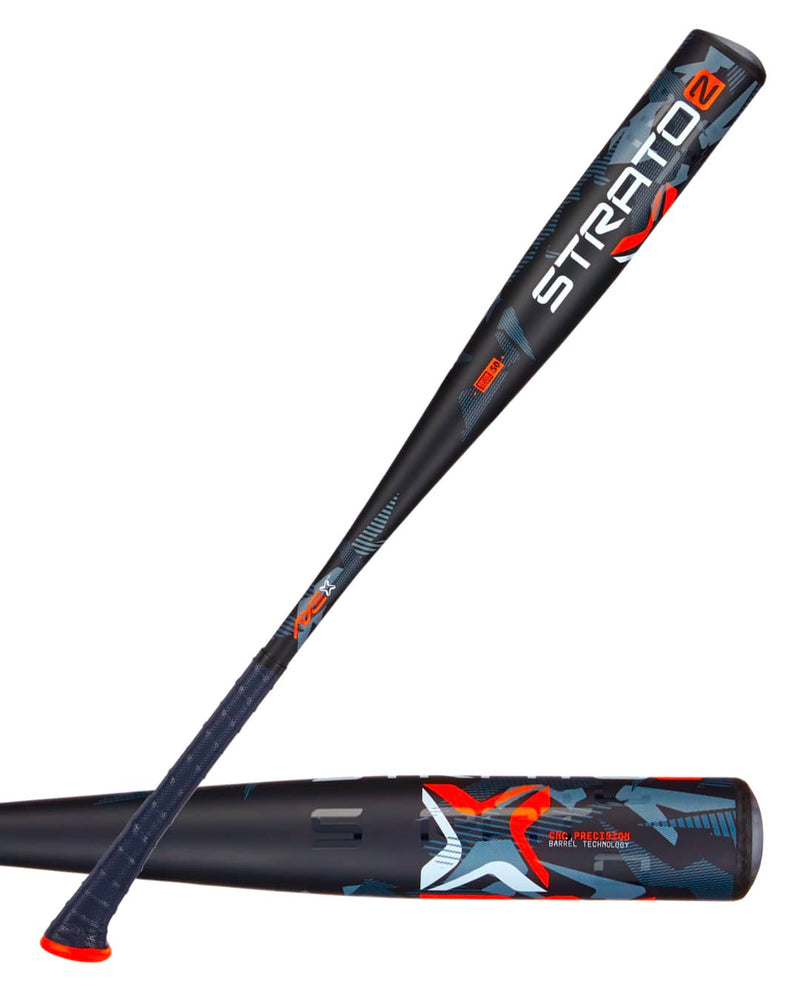
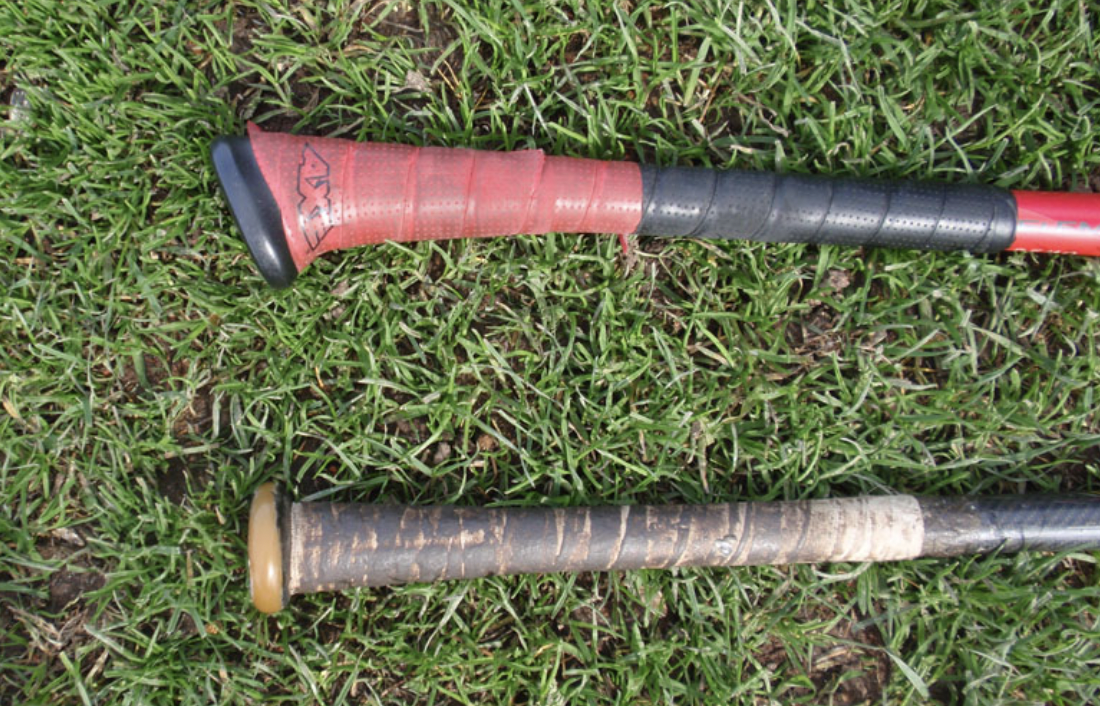
A modern example of a bat modification that received a patent is the “axe handle” bat. Axe bats, which grew in popularity around 2015, featured a bat handle that resembled an axe handle instead of the rounded handle that is usually used on a baseball bat. Axe bats received a design patent in 2013, as an ornamental change to the traditional baseball bat. Today, “axe bats” are sold exclusively by Baden Sports, but the company does license the axe handle design to other bat companies.

Based on the axe bat precedent, it seems like torpedo bats could eventually receive a design patent. Interestingly, Bob Hillercih, the vice president of the aforementioned bat manufacturer Hillerich & Bradley, does not believe that torpedo bats are eligible for a patent because the changed design for the bat is just a change in the shape

However, based on the description of design patents, this does not seem to be true. 

There are two factors in determining whether a design qualifies for a design patent. First, the design must be an integral aspect of the product that cannot be separated. The difference in barrel placement is the integral aspect of the design of torpedo bat, so it appears that this element would be met. Next, the design must have no bearing on the item’s functionality. The torpedo bat design would likely meet this element, because the new design does not alter the  baseball bat’s functionality. Rather, the torpedo bat just changes the amount of wood at the point of contact. Although some Yankee players had early success with the torpedo bats, it does not, on its own, make it easier to hit home runs. Torpedo bats are used just like regular baseball bats, the only difference is that it has a unique ornamentation with the location of the largest part of the ball being moved. 

Design patents also require that the new patent not be obviously derived or resembling other designs. While there may be an argument that the torpedo bat resembles other bats, the same argument could have been used for the axe bat handle resembling a baseball bat handle or an axe handle. When viewing all of these elements, and comparing torpedo bats to the patent that the axe handle received, there is a possibility that torpedo bats could receive a design patent, if Leanhardt chooses to do so. 

Conclusion

Time will tell if torpedo bats are the next big thing in baseball, or if they are just another banana bat. While more players have begun using them, other players tried them but returned to their old bats or refused to use them altogether. Regardless of their long-term impact on baseball, it will be very interesting to track whether the United States Patent and Trademark Office determines that torpedo bats can be patented. While historical precedent makes it seem like torpedo design can be patented, there seem to be concerns from people in the bat manufacturing business, who also may not want the bat design to be patented so they do not have to license the design to use it. 

Reel Rights: Copyright’s Collision With Documentaries

By: Alexander Tranquill

The Rise of Tiger King

Remember the start of the Covid-19 pandemic? Like myself, many Americans turned to TV to find comfort, and, in those first few surreal weeks, many found themselves watching one particularly enthralling, peculiar, and utterly outlandish story: Tiger King. Tiger King is a Netflix documentary series released in March 2020, which details the increasing tensions between rival big cat eccentrics, eventually culminating in Joe Exotic’s arrest in a murder-for-hire plot of rival Carole Baskin. While Tiger King initially generated massive media attention, it has more recently been the subject of intense copyright litigation.

If you are unfamiliar with this story, Joe Exotic was an internet personality long before Tiger King. With a substantial presence on YouTube, the Netflix documentary heavily relied on video footage originally created by Exotic and his employees. The suit now at issue, Whyte Monkee v. Netflix, centers on Netflix’s use of a video that shows Exotic giving an eulogy at his late husband’s funeral. The video was originally shot by Timothy Sepi, an employee and videographer at Exotic’s Gerald Wayne Zoo. However, Sepi now claims he never gave Netflix permission to use his footage, thus forming the basis for his copyright infringement claim.

During litigation, the district court originally found that Netflix’s use of the footage fell under the fair use exception to copyright infringement. This decision was later reversed by the Tenth Circuit, but, after a great deal of consternation and a flurry of amicus briefs, the Tenth Circuit later vacated its ruling and granted a petition for rehearing. Though the final decision is still pending, this case is significant because the decision has  major implications for documentary filmmakers, while also raising important questions about the rights of content creators in our age of smartphones and social media––where personal footage is often reused by others.

Copyright Protections and Fair Use

To understand the legal questions raised in Whyte Monkee, we must explore the interaction between copyright protections and the doctrine of fair use. Overall, copyright is a type of intellectual property that protects original works of authorship (i.e. paintings, photos, writings, movies) against use by others. However, authorship is a fairly low bar, requiring only a minimal level of creativity. If any creativity can be shown, copyright protections immediately attach when the work is fixed (published) in a tangible medium. As a result, recordings, much like Sepi’s home-video, are often considered copyrightable.

The fair use exception to copyright infringement allows a party to use a work without the permission of the creator if the copying is done for a limited or “transformative” purpose. While there are no hard and fast rules, courts will consider four factors in determining fair use: (1) the purpose and character of the use, (2) the nature of the copyrighted work, (3) the amount and substantiality of the portion used, and (4) the effect of the use on the market for the copyrighted work. Recently, courts have taken particular interest in the first factor, considering the significance of any changes made to the original while also assessing the purpose of the work.  

The Supreme Court’s Warhol Decision

Recently, the Supreme Court issued a detailed analysis of this first factor in Warhol v. Goldsmith. Here, Warhol was sued for a series of silkscreen prints he created of Prince, which he based on a copyrighted image captured by Goldsmith. Considering the purpose and character of Warhol’s silkscreens, the Court clarified that it is no longer sufficient for a work to simply add “new expression” to the original; the key question is whether the work serves “a purpose distinct from the original.” While purpose is not necessarily limited, derivative works should comment on, criticize, or provide otherwise unavailable information to the original. Therefore, although Warhol added new artistic expression to the original, his work did not constitute fair use because its purpose and character aligned with Goldsmith’s––both works were licensed to media companies, merely being used “to illustrate a magazine about Prince with a portrait of Prince.” Thus, because Warhol’s work simply used Goldsmith’s image as a template for the same commercial purpose, it failed to seriously comment on, criticize, or add information to the copyrighted image. 

Applying the Warhol Precedent

Following in the footsteps of Warhol, the Tenth Circuit overturned the district court’s decision in Whyte Monkee, relying on the purpose and character of the use. While the district court found Netflix’s use transformative as it incorporated the funeral clip into a broader narrative, the Tenth Circuit, citing Warhol, concluded that fair use requires the derivative work to serve a distinct purpose. Specifically, the court required the derivative work to critically comment “on the substance or style of the original composition.” With this backdrop, the court found that Netflix only used the funeral footage to show Exotic’s purported megalomania and showmanship. Accordingly, Netflix failed to seriously comment on the style of the video clip itself, instead using the video to “target[] a character in the composition.” Therefore, because Netflix used the funeral footage to detail Exotic’s life and not to comment on the style of the footage, the Tenth Circuit found that the first factor weighed against fair use. 

So, what is all the uproar about? The amicus briefs suggest that this decision will have a chilling effect on the documentary industry, confining filmmakers to commenting on the composition of footage itself (i.e. lighting, angles, editing). In the en banc rehearing, the court re-examined Netflix’s intent behind including the funeral clip in the documentary, focusing on Netflix’s use of the video to detail Exotic’s callous attitude. Thus, the court’s review likely reflects an effort to broaden the meaning of transformative purpose.

In its initial decision, the Tenth Circuit severely narrowed Warhol’s definition of distinctive purpose, requiring a derivative work to critically comment “on the substance or style of the original composition.” While this was an important factor in Warhol, it is not the only relevant factor in examining the purpose and character of a new work. First, the Court in Warhol explicitly looks to purposes outside critical commentary to determine fair use. For example, the Court found that Warhol and Goldsmith’s works shared the same commercial purpose—both were used to “illustrate a magazine about Prince with a portrait of Prince.” Furthermore, the Court in Warhol notes that the “degree of difference” between the works is relevant in the fair use analysis, being weighed together with purpose to determine whether the derivative work is transformative. Ultimately, the Tenth Circuit seems poised to consider other factors in its analysis of the purpose and character of the use. Such a decision would better support filmmakers by providing them greater access to material as they attempt to capture many of the compelling narratives in our world today. As a result, Netflix should continue to assert that its use of the video serves to illustrate Exotic’s personality—distinct from Sepi’s purpose of simply commemorating the funeral. Further, Netflix should revive its district court arguments, claiming the documentary is substantially different from Sepi’s video because it continually interrupts this video with comments from the deceased’s mother and ties the video into the broader story arc to highlight Exotic’s character. Ultimately, these arguments mirror the Supreme Court’s focus in Warhol, offering the Tenth Circuit a precedential foundation to recognize a broader interpretation of transformative use.

Competitive Cheer and Anticompetitive Practices: Varsity Spirit’s Antitrust Struggles

By: Hannah Gracedel

For decades, Varsity Spirit (“Varsity”) has been the undisputed champion of competitive cheerleading. They outfit teams, run camps, and, most importantly, control the biggest competitions in the industry. But while cheerleaders are trained to execute flawless routines, Varsity’s business decisions have drawn the attention of those who argue that its grip on the cheerleading world might be less about fair cheerleading competitions and more about unfairly dominating the competitive cheerleading market. Two recent class action suits, one in 2023 and another in 2024, claim that Varsity gained and maintained significant control of every aspect of the competitive genre, “All Star Cheer” through its anticompetitive practices. Both suits resulted in major settlements amounting to $126 million total.

What is All Star Cheerleading

Cheerleading has grown significantly since its inception in 1882, with an estimated 3.5 million athletes competing globally. While many Americans might be familiar with cheerleading, some might be surprised to learn about a subdivision called All Star Cheer. All Star Cheer focuses primarily on competition, whereas traditional school cheerleading involves crowd engagement, school spirit activities, as well as the option to compete. All Star teams are most often organized by private gyms, which form the teams based on skill and age level. At competitions, All Star Cheer teams perform a two and half minute routine composed of tumbling, stunting, pyramids, dance, and cheer segments. All Star Cheer is a notoriously expensive sport, where a full season can cost athletes around $8,000-$10,000 due to gym fees, uniform costs, travel expenses, competition fees, etc.

Who is Varsity Spirit

Varsity Spirit was founded in 1974 by Jeff Webb and started as a cheerleading camp company. The company later began manufacturing apparel for cheerleading teams, organizing competitions, and operating summer training camps. Today, Varsity runs the biggest and most prestigious cheerleading competitions and almost every single All Star Cheer competition as well. Varsity gained its dominant 90% share of the cheer competition market primarily by acquiring smaller competitors, including Jam Brands in 2015, Spirit Celebrations in 2016–2017, and Epic Brands in 2018. Essentially, if you are a competitive cheerleader, almost every competition you compete in is controlled by Varsity.

Antitrust Law

Varsity’s dominance in the competitive cheerleading industry has raised antitrust concerns. Antitrust law is about keeping the playing field fair by preventing businesses from using their power to stifle competition. Regulations like the Sherman Antitrust Act and the Clayton Act prohibit companies from monopolizing markets or using unfair practices, such as price-fixing, bid-rigging, or exclusive contracts, to restrict competition. The purpose of these laws is to safeguard consumers and other businesses from being coerced into bad agreements due to the excessive market power of a single company. However, not all monopolies are illegal. A company can gain dominance or a monopoly fairly by offering the best products or services at the best price, and that’s just healthy competition. But when a company reaches the top by stifling competition rather than fostering it, antitrust law will step in.

The Class Action Settlements

In March 2023, Varsity Brands agreed to pay $43.5 million to resolve allegations that it abused its market dominance to artificially inflate prices for private gyms and spectators. This action was brought by direct purchasers, which are those who paid registration and associated fees directly to Varsity to participate in Varsity competitions. Two markets were identified where Varsity exercised its monopoly power: the “competition” market and the “cheer apparel” market. The plaintiffs alleged that Varsity dominated 80% of the All Star cheerleading competition market and 90% of the All Star apparel market through a series of “exclusionary schemes.”

The alleged “exclusionary schemes” were the exclusionary contracts offered to All Star Gyms that were incentivized by the promise of rebates. A rebate is a partial refund given to a buyer after a purchase, which is different from a discount where the price reduction is applied at the time of purchase. The process to receive a rebate typically involves customers paying full price for an item and later submitting proof of purchase to the retailer, who then sends the customer the refund in the form of cash or future discounts on products. 

Varsity offered two rebate programs, the Network Agreement and the Family Plan. The Network Agreement, offered to large prestigious gyms widely known at their competitions, required a commitment to attending at least 5 of Varsity’s All Star Competitions and spending at least $30,000 per year on registration fees. Once gyms met this threshold, they earned increasing rebates for every dollar spent beyond it, creating a strong financial incentive to stay within the Varsity system. For smaller gyms that could not meet the spending threshold, Varsity offered a modified version called the Family Plan, which required attendance at 6 Varsity competitions in order to start receiving rebates. The rebates here were in the form of “Varsity Fashion Dollars,” which could only be used on varsity apparel purchases.

Because gyms and their teams can only attend a limited number of competitions each season, these agreements strongly incentivized All Star gyms to participate in Varsity events and purchase Varsity apparel exclusively. Attending a non-Varsity competition meant forfeiting the chance to earn higher rebates, which teams could not afford to do, when that money could then be used on Varsity competition uniforms. Once gyms were locked into Varsity’s exploitative ecosystem, Varsity was able to inflate its prices, thus possibly furthering demand for their rebate programs.

In May 2024, Varsity Spirit agreed to an $82.5 million settlement to resolve another class-action lawsuit. Unlike the 2023 case, this lawsuit was brought on behalf of indirect purchasers – those who paid competition registration fees, camp fees, or bought apparel through a gym or school. The lawsuit covered all the same issues as the previous, such as unlawful acquisitions of rivals, anticompetitive exclusive dealing agreements, and Varsity overcharging consumers.

In addition to the monetary settlements, Varsity agreed to end any rebate or discount program related to their cheer competitions.

Conclusion

What makes Varsity’s antitrust issues particularly interesting is how long these practices went unnoticed. Unlike tech monopolies or pharmaceutical price-fixing, competitive cheerleading is a relatively niche industry that does not draw much regulatory attention. But the consequence of Varsity’s practices going unchecked for so long has driven many working-class participants out of the sport simply because it is no longer affordable. Although both recent cases settled before reaching trial, they highlight how antitrust law can play a crucial role in curbing corporate abuses in power, ultimately safeguarding consumers and promoting fair competition for businesses.