Hide Your Info: Exploring the Lackluster Protection of HIPAA

By: Zach Finn

The Health Insurance Portability and Accountability Act (HIPAA) was enacted in 1996, and has since become a touchstone for the protection of confidentiality and security of personal health information in the United States.

Or, so we thought. The rise in technology has advanced the way information is stored and shared. Biomedical databases store high volumes of information, ranging from personal external identifiers such as medical reports, to even individual genetic sequencing, exemplified by 23andMe’s and Ancestry‘s storage of genetic information. Large data and biobanks (a collection of biological samples, like blood and health information) create access to a plethora of quality human data, which prove to be valuable in medical research, clinical trials, and understanding genomics. But at what cost?

HIPAA requires medical and genetic information to be anonymized before being distributed and shared to third parties outside the relationship of medical providers and patients. Technology has created a loophole in HIPAA, through re-identification processes, which allows individuals to match medical information back to specific individuals using open source data. Re-identification, as of now, disarms HIPAA, rendering de-identified (anonymized) medical information basically unprotected from parties who obtain personal biodata through re-identification.

HIPAA nationalizes standards for protecting the privacy and confidentiality of individuals’ personal health information (PHI). It requires covered entities to provide individuals with notice when sharing a person’s genetic information. HIPAA is violated when a covered entity discloses personal and identifiable health information without the consent of the patient. These covered entities include healthcare providers, health plans, and healthcare clearinghouses. Technology provides entities with the ability to de-identify and anonymize large data sets in order to share health information and be in compliance with HIPAA. Anonymization removes personal identifiers like names, addresses, date of birth, and other critical identifiers. HIPAA sets out requirements of what needs to be de-identified, and once anonymized, personal health information is shareable and HIPAA compliant.

Re-identification is the process to which materials and data stored in biobanks can be linked to the name of the individuals from which they were derived. This is done by taking public information and re-matching it the anonymized data. It sounds difficult, but a study concluded that 99.98% of Americans would be correctly re-identified in any dataset using 15 demographic attributes such as age, gender and marital status. For example, in the 1990s, one could purchase the Cambridge, MA voter registration list for $20, and link it to a public version of the state’s hospital discharge database to reveal persons associated with many clinical diagnoses.

HIPAA has yet to play catch up with the innovation of technology. The requirements for compliance in anonymization lack the sophistication and protective measures needed to combat the expanding use of re-identification practices. HIPAA’s privacy rule does not restrict the use or disclosure of de-identified health information, since it no longer is considered protected health information. This means that any re-identification of this earlier protected information is not subject to HIPAA. This ultimately demonstrates HIPAA’s weak protective measures, and the alarming concern of how easily accessible our genetic and medical information is to third parties.

Re-identification of HIPAA compliant anonymized information is not a violation of the statute. We must consider reforming HIPAA to acknowledge technology’s capabilities to bypass its security measures. One way an individual can ensure privacy of his or her genetic and medical information is by not consenting to sharing or storing this data. Covered entities must give notice and obtain consent before de-identifying and sharing biobanks. However, this comes with the price of stifling research, trials, and genomics. Hopefully we can figure out a balance between confidentiality and sharing private information, but it starts with drafting laws that actually protect our personal and most private information!

Regulating Emerging Technology: How Can Regulators Get a Grasp on AI?

By: Chisup Kim

Uses of Artificial Intelligence (“AI”), such as ChatGPT, are fascinating experiments that have the potential to morph their user’s parameters, requests, and questions into answers. However, as malleable these AIs are to user requests, governments and regulators have not had the same flexibility in governing this new technology. Countries have taken drastically different approaches to AI regulations. For example, on April 11, 2023, China announced that AI products developed in China must undergo a security assessment to ensure that content upholds “Chinese socialist values and do[es] not generate content that suggests regime subversion, violence or pornography, or disput[ions to] to economic or social order.” Italy took an even more cautionary stance, outright banning ChatGPT. Yet domestically, in stark contrast to the decisive action taken by other countries, the Biden Administration has only begun vaguely examining whether there should be rules for AI tools.

In the United States, prospective AI regulators seem to be more focused on the application of AI tools to a specific industry. For example, the Equal Employment Opportunity Commission (“EEOC”) has begun an initiative to examine whether AI in employment decisions comply with federal civil rights laws. On autonomous vehicles, while the National Highway Traffic Safety Administration (“NHTSA”) has not yet given autonomous vehicles the green light exemption from occupant safety standards, they do maintain a web page open to a future with automated vehicles. Simultaneously, while regulators are still trying to grasp this technology, AI is entering every industry and field in some capacity. TechCrunch chronicled the various AI applications from Y Combinator’s Winter Demo Day. TechCrunch’s partial list included the following: an AI document editor, SEC-compliance robo-advisors, Generative AI photographer for e-commerce, automated sales emails, an AI receptionist to answer missed calls for small companies, and many more. While the EEOC and NHTSA have taken proactive steps for their own respective fields, we may need a more proactive and overarching approach for the widespread applications of AI. 

Much like their proactive GDPR regulations in privacy, the EU proposed a regulatory framework on AI. The framework proposes a list of high-risk applications for AI, and creates more strenuous obligations for those high-risk applications and tempered regulations for the limited and no risk applications of AI. Applications identified as high-risk include the use of AI in critical infrastructure, education or vocational training, law enforcement, and administration of justice. High-risk applications would require adequate risk assessment and mitigation, logging of data with traceability, and clear notice and information provided to the user. ChatBots are considered limited risk but require that the user has adequate notice that they’re interacting with a machine. Lastly, the vast majority of AI applications are likely to fall under the “no risk” bucket for harmless applications, including applications such as video games or spam filters. 

If U.S. regulators fail to create a comprehensive regulatory framework for AI, they will likely fall behind on this issue, much like they have fallen behind on privacy issues. For example, with privacy, the vacuum of guidance and self-regulating bodies forced many states and foreign countries to begin adopting GDPR-like regulations. The current initiatives by the EEOC and NHTSA are applaudable, but these organizations seem to be waiting for actual harm to occur before taking proactive steps to regulate the industry. For example, last year, NHTSA found that the Tesla autopilot system, among other driver-assisted systems, was linked to nearly 400 crashes in the United States with six fatal accidents. Waiting for the technology to come to us did not work for privacy regulations; we should not wait for AI technology to arrive either.

Legend of Zelda Mod Drives Nintendo IP Lawyers Wild

By: Nick Neathamer

Has video game fandom gone too far? Despite developing some of the biggest games on the market, Nintendo seems to think it has (at least in a legal sense). The company has recently claimed copyright infringement on multiple YouTube videos that show the use of fan-made modifications (“mods”) for the game Legend of Zelda: Breath of the Wild. 

Breath of the Wild is one of the most popular open-world video games in recent memory. Created by Nintendo, the game was deemed Game of the Year in 2017 at The Game Awards. However, one notable element the game is lacking is any multiplayer capability. YouTuber Eric Morino, better known by his channel name PointCrow, aspired to change that. In November 2021, he tweeted out a request for anyone to create a multiplayer mod for the game, offering up $10,000 to whoever could send a functional version. Two members of the modding community were able to create a mod that runs on a Wii U emulator (software which enables Wii U console games to be played on a PC), allowing multiple players to travel throughout the game’s fantastical setting of Hyrule together. On April 4, 2023, PointCrow released the mod to the public through his Discord (however, it has since been removed). 

After the release, Nintendo claimed copyright infringement on PointCrow’s videos that feature any use of the mod, prompting YouTube to take down those videos. Due to Nintendo’s reputation for being a highly litigious company, the copyright claims against PointCrow’s videos are not a huge surprise. However, PointCrow has argued and appealed the copyright strikes, saying that he has “significantly transform[ed]” Nintendo’s work and that his videos constitute fair use. 

Copyright ownership grants the holder several exclusive rights in regard to their copyrighted work, as laid out in §106 of the Copyright Act of 1976. One of these rights is the right to create subsequent works derived from the original copyrighted work. If someone other than the copyright owner creates such a derivative work, they would infringe the copyright in the original work. Unfortunately for the Breath of the Wild modders, present-day mods have been considered derivative works since the 9th Circuit Court of Appeals’ ruling in Micro Star v. Formgen. While many game developers seldom pursue legal recourse against the majority of modders, and some have even started to embrace the modding community, this derivative work status bars modders from having any copyright of their own in the mods they create. Additionally, if Nintendo does choose to sue for copyright infringement in relation to the multiplayer mod itself, PointCrow and the other creators are likely to be held liable. 

Next comes the question of whether PointCrow’s videos about the mod qualify as fair use. Fair use analysis involves considering four factors in a balancing test. Set out in §107 of the Copyright Act, these factors are (1) the purpose and character of the use, including whether the use is commercial; (2) the nature of the copyrighted work; (3) the amount and substantiality of the portion used in relation to the copyrighted work as a whole; and (4) the effect of the use upon the potential market for or value of the copyrighted work. While courts must consider all four factors, the first and fourth factors are typically considered the most important in deciding whether an allegedly infringing work is a fair use. The first factor is more likely to weigh against fair use when the allegedly infringing work is commercial. However, commerciality may be overcome and the first factor may weigh towards fair use when the work in question has transformed the original, providing it with a new expression, purpose, or meaning. Here, PointCrow intends to monetize his videos on YouTube, making his use commercial. PointCrow’s claim that his videos have “significantly transform[ed]” Breath of the Wild indicate his belief that the videos are sufficiently transformative to warrant the first factor weighing in favor of fair use, despite their commerciality. One could certainly argue that by providing commentary and reactions to the gameplay, PointCrow has transformed Breath of the Wild by granting it a new expression. However, the entertaining purposes of both PointCrow’s videos and the game itself are very similar, despite the difference in watching a game versus playing it. For these reasons, it is difficult to predict whether a court would find this factor to weigh for or against fair use. 

The second factor most likely weighs against fair use. A use is less likely to be fair use when the original work is unpublished, because authors of unpublished works are expected to be able to decide how their work is originally used, or whether it may be released to the public at all. On the other hand, copying of a published work is more likely to be considered fair use. Even more relevant to the nature of the work is if the original work is creative, which tends to weigh against fair use in contrast to when the original work is primarily factual. Here, the second factor most likely weighs against fair use because the original game is a creative work, despite the game’s published status. Meanwhile, the third factor likely weighs in favor of fair use. PointCrow’s videos include actual gameplay, and therefore show large portions of the original game. However, displaying this large amount of the game is necessary to accomplish PointCrow’s intended purposes. Disregarding the legality of the mod itself, PointCrow needs to show gameplay in order to demonstrate differences between the original game and the modded version, as well as to show his unique experiences with Breath of the Wild that viewers want to see. Because of the need to use this large amount of gameplay for his intended purpose, a court is likely to find that the third factor weighs in favor of fair use. 

The fourth factor, effect of the use upon a potential market of the copyrighted work, weighs against fair use when an allegedly infringing work provides a substitute for the original. With this in mind, it is not entirely clear what role PointCrow’s videos play in the video game entertainment market. PointCrow would likely argue that his videos are essentially free advertising for Breath of the Wild and Nintendo, while Nintendo may argue that watching someone play the game essentially provides a substitute for playing the game itself and therefore has a negative effect on the market for the game. A court may also be persuaded by the argument that by promoting the multiplayer mod, which runs on an emulator instead of an actual Nintendo console, PointCrow’s videos are indirectly causing a substitution loss to Nintendo in console sales. This makes it more likely, although not certain, that the fourth factor would weigh against fair use. 

Despite their best intentions and love for the game, it appears that PointCrow and other fans of Legend of Zelda: Breath of the Wild are infringing Nintendo’s copyright by creating a multiplayer mod. Less clear is whether videos that promote the mod are infringing. A lack of existing litigation surrounding gaming videos only exacerbates this uncertainty. With the upcoming release of Legend of Zelda: Tears of the Kingdom, a direct sequel to Breath of the Wild, content creators are likely unsure how to make gameplay videos while complying with copyright laws. That said, Nintendo’s history of litigation has not stopped fans from making their passion projects thus far, and it certainly seems like fans will continue to create mods and videos going forward. But perhaps the takedown of PointCrow’s videos will finally send the message that despite Nintendo’s success at making games, the company is not playing around when it comes to their intellectual property. 

Are there double standards for women in collegiate and professional sports?

By: Aminat Sanusi

It is no secret that women in professional sports are paid significantly less than men in the same sports. For example, the average pay for a player in the NBA in 2022 was $5.3 million per year but the average pay for a player in the WNBA was $130,000 per year. Not only are there pay gaps between male and female athletes in professional basketball, but the same goes for professional softball players and other sports as well. In addition to receiving lower wages than their counterparts, women are also held to a double standard when it comes to the way they are expected to conduct themselves in the sports they play. Women are often seen as emotional when men are seen as passionate, or women are viewed as aggressive when men are just seen as playing the game.

          A couple of years ago Serena Williams, the greatest female tennis player of all time, received backlash for her actions during the US Open Tournament against Naomi Osaka. Serena accused the umpire of sexism and treating her more harshly than men. She ended up losing the tournament in part because she lost a point from destroying her tennis racket and calling the umpire a thief. Serena has even said herself that if she did some of the things male tennis players do on the court she would be in jail. She stated that she has heard men call the umpires worse names without being penalized for it. This shows that though Serena has won multiple championship titles, it does not change the fact that she was held to a double standard throughout her career as a tennis player. Although Serena is now retired, she continues to fight for women’s equality off the tennis court.

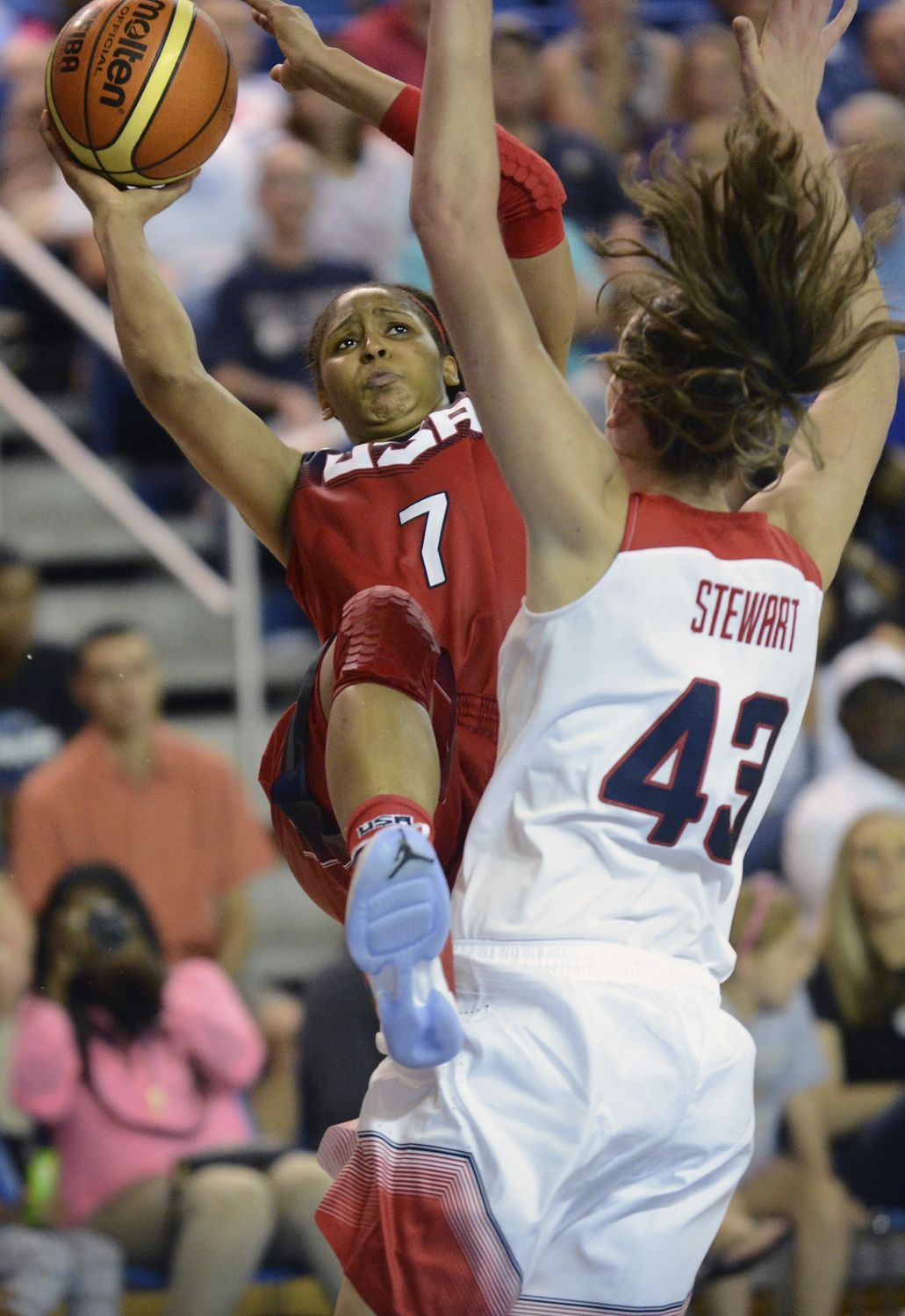
A recent example of double standards in women’s sports comes from the 2023 NCAA Women’s Basketball Championship. Louisiana State University (LSU) NCAA Women’s Basketball 2023 Most Outstanding Player Angel Reese received both praise and criticism for her response to First Lady Jill Biden’s invitation to have both LSU and the University of Iowa come to the White House for a visit. Angel called the First Lady’s invitation a joke because traditionally runner-ups never get invited to the White House, so the invitation to both teams diminished LSU’s historic win. When the First Lady’s press secretary walked back the statement, Angel stated in an interview that she did not accept her apology. Some viewers claimed that she should have accepted the First Lady’s apology and was being rude and disrespectful by not doing so. However, other viewers found it refreshing to see her stand up for what was right and not be afraid of what the naysayers may think of her. Throughout her season, Angel Reese was characterized as “ghetto”, “classless” and “disrespectful”. Many viewers that watched her play claimed she did not have respect for the game or good sportsmanship because of certain actions she would do on the court. Angel’s response was that she was always going to be her authentic self on and off the basketball court and they would not be calling her those names if she was a male basketball player. Many people took to social media post-championship game to show their support for Angel and call out her critics on their misogynistic and racist double standards.

Following the 2023 NCAA Women’s Basketball Championship game, United States Representatives Mikie Sherrill (NJ-11) and Maria Salazar (FL-27) introduced the Women in NCAA Sports (WINS) Act, a bipartisan bill that promotes and addresses fairness for NCAA women’s sports programming. The NCAA has made some corrections to the inequities between the men’s and women’s Division I Basketball Championships, but there are still inequalities that need to be fixed to ensure that women collegiate athletes have the full representation they deserve. The goal of the WINS Act is to achieve equity in women’s college sports. The Act will establish a sixteen-member congressional commission to comprehensively study inequality in the NCAA’s operation of tournaments and other programs where there are men’s and women’s divisions. The commission will include members appointed by House and Senate leadership with special consideration for individuals with expertise and experience in college sports. The commission will give its final report to Congress. The report must include three provisions. First, a comparison of how the NCAA operates men’s and women’s championship tournaments across all sports and other student-athlete programs with the respect to the treatment of the participating men’s and women’s teams. This includes evaluation of the equipment and venues provided for games and practices, lodging and transportation, media exposure and contracts, sponsors, and overall budgets. Second, would include studying the NCAA constitution, policies, and practices that affect gender equity between men’s and women’s college sports teams. Third, is an overview of federal government support for the NCAA and recommendations for improved federal oversight of the NCAA’s promotion of equality.

If the WINS Act is passed, it has the power to be very beneficial in changing the way people perceive women athletes’ behaviors. For example, collegiate women’s sports such as basketball, volleyball, and swimming would get the same amount of funding and media airtime as men’s collegiate sports. Also, there would be less pressure put on women college athletes like Angel Reese for playing the game how they want and being scrutinized for every little thing they do. It is important to note that the WINS Act would only apply to college-level sports and not professional athletes. Therefore, there is still more effort required and additional rules that need to be changed to be able to allow women professional athletes, like Serena Williams, to be able to play the games they love without being criticized or penalized for how they choose to play the game.

With this year’s NCAA Women’s Basketball Championship game being the most watched game in NCAA women’s basketball history, now is the perfect time to take advantage of the momentum and fight for a change in women’s sports.

Massive Tech Layoffs Negatively Impact H1-B Visa Workers and Immigration

By: Talia Cabrera

At the beginning of 2023, no one would have expected that the U.S. tech sector would be in the headlines for laying off thousands of tech workers. Tech giants like Google, Meta, Disney, and Microsoft were faced to deal with the consequences of inflation and potential recession after the pandemic. Even Amazon was not free from the wave of layoffs after their profits increased 220 percent during the first year of the pandemic. Collectively, the U.S. tech sector has laid off more than 150,000 workers. So why are we seeing tech companies layoff their workers? Rapid hiring because of fast growth without a care in the world about the implications of a workers life, especially H-1B visa holders.

Though layoffs are meant to alleviate the financial burden companies are left to deal with, they unfortunately disrupt a worker’s life with just a simple email. Workers who no longer have a career are now left to start over and find a new job during a time when companies are freezing hiring. Though these layoffs have had a negative impact on thousands of people, one group of workers is left in a unique position: US immigrants holding an H-1B visa.

The H-1B visa is a work visa that allows U.S. employers to sponsor a foreign worker to work in the U.S. for a specific period of time. These “specialized skill” visas are heavily used by large tech companies and have contributed to their success. For example, in 2021, Amazon was approved for over 4,800 H-1B visas, Miscroft was approved for 1,200 H-1B visas, and Apple had over 1,000. Yet, the recent wave of tech layoffs has shown us the lack of support H-1B visa holders have when the unexpected happens. Once an H-1B visa holder is told that they no longer have a job, they have to face the harsh reality of a limited time period to find a new job. If an H-1B visa is unable to find a new employer within a 60-day window, they may be forced to leave the United States and return to their home country.

But the reality is that many of these visa holders have built a life in the United States for years and are now facing the uncertainty of being deported. These visa holders have invested time and resources in their careers in the U.S. and many of them have built a family and community. Now, the post-pandemic economy is highlighting how this system needs to be updated. In the recent economic climate, the hiring freeze is leaving visa holders concerned about their future in the United States, especially now having to compete in an already competitive work sector.

So what needs to change? There need to be more resources in place to help H-1B visa workers during layoffs. Tech companies have invested millions of dollars into lobbying for visa workers to invest in innovation so they need to make sure they support them in their transition period. Now, tech companies should facilitate a smooth transition or risk losing future generations of skilled workers. Maybe tech companies need to lobby for workers to extend the 60-day window or keep them as sponsors until a new company can sponsor that so they can continue working for citizenship. If tech companies want to use H-1B visa holders then they need to not take advantage of them and leave them left with nothing.

The recent wave of tech layoffs in 2023 has had a significant impact on many workers and has highlighted the lack of support for tech workers. Employers and policymakers need to stop using greed as a motivating factor for innovation and instead make sure their workers are taken care of. But until then, we will see big tech companies concerned about making money without a care in the world.