Despite overruling the Federal Circuit’s prior practice of reviewing all aspects of patent claim construction de novo, the Supreme Court’s ruling in Teva Pharmaceuticals USA, Inc. v. Sandoz, Inc. has not dramatically changed the standard of review for patent claims. Instead, it imparts a sub-category of analysis in cases where the district court relies upon extrinsic evidence to clarify ambiguous or complicated facts needed for proper claim construction. The court first considers whether the district court relied upon extrinsic evidence and if so, whether it needed to in order to properly construe the claim. As predicted by the Supreme Court, only a small number of cases have required clear error review of fact finding in the months following the Teva decision. Ultimately, clear error review of fact-finding from extrinsic evidence simply adds one step prior to the traditional de novo review applied to patent claim construction. Continue reading
Online Retailers Beware: Amazon Search Results Might Violate Watchmaker’s Trademark
Last week, the Ninth Circuit Court of Appeals handed down its decision in Multi Time Machine, Inc. v. Amazon.com, Inc.. Although the case doesn’t deal with time travel like the name might suggest (so disappointing!), the Court’s decision on whether the behemoth online retailer’s search results could have violated the watch manufacturer’s trademark certainly is interesting. In a two to one decision, the panel of three judges decided that Amazon might have violated Multi Time Machine’s (“MTM”) trademark by displaying competitors’ watches when online customers searched for a particular MTM model.
So how is this interesting? Let’s paint this case in the terms used by Judge Silverman in his dissent against the other two judges—If a patron walks into a restaurant and orders a “coke” and the waiter responds, “We carry Pepsi,” has the restaurant infringed on Coca Cola’s trademark? The majority’s decision suggests that the restaurant might have infringed, but that it is a question for a jury. Similar to the restaurant’s actions, Amazon, who is unable to carry MTM watches, displays the similar products of MTM’s competitors when the customer searched for MTM watches.
It seems absurd that Amazon could be liable for simply responding to requests for an unavailable product by suggesting other similar products. However, things get a bit more murky when you consider the root question that results in liability for this type of trademark infringement: could a reasonable person be initially confused by the search results and believe that the watches displayed on Amazon’s page were somehow affiliated with MTM? If so, then customers might consider buying the competitors’ watches based on the reputation of MTM’s trademark, and both Amazon and the competitor would unfairly profit from MTM’s hard work in building a well-respected business.
So, how might Amazon’s search results confuse a customer? Well, in this author’s opinion, only by being a pretty thick dunce. The law requires that the results be confusing to a “reasonably prudent consumer,” and in my book, the poor dunce who gets confused by these search results doesn’t quite make the cut. Like the district court that first considered the case and Judge Silverman (who dissented from the majority’s opinion), I believe that the results are so clearly labelled that no reasonable mind would think that they were somehow affiliated with or originated from MTM. But you don’t have to take my word for it. You can check out the image in the thumbnail above or click here to see for yourself.
The majority opinion reaches a different opinion by determining that the text “MTM special ops” which remains displayed in the search box at the top is sufficient to confuse customers about who manufactured the products. The majority explained in its opinion that, although the displayed results were each clearly labeled as the product of a different company, the clarity of the page’s layout as a whole created a legitimate question of whether or not it might confuse a customer about the origins/maker of the displayed products.
As an additional note that online retailers should consider taking to heart, the majority said when reaching its conclusion, “A jury could infer that the labeling of the search results, and Amazon’s failure to notify customers that it does not have results that match MTM’s mark, give rise to initial interest confusion.” If an online retailer wants to avoid this whole debacle, the cleanest method would be to spell it out when none of the products it provides meet the exact product description typed into the search bar.
Stock Split and the Failure of a Shareholder Democracy
Background: Since its founding, Under Armour has maintained a dual-class stock structure consisting of Class A Stock, which has been entitled to one vote per share, and Class B Stock, which has been entitled to ten votes per share. Founder and CEO, Kevin Plank, beneficially owns all of the company’s Class B Stock and also owned a small portion of the Class A Stock. As of June, this provided Mr. Plank with 65.5% of the company’s total voting power, but only 16.6% of the total number of outstanding shares. Under the terms of Under Armour’s charter, if the aggregate number of shares of Class A Stock and Class B Stock owned by Mr. Plank is less than 15% of the total number of shares, the dual-class structure will unwind and all Class B Stock would be automatically converted in to Class A stock. This would result in Mr. Plank effectively losing control of Under Armour.
In November 2014, Mr. Plank reviewed his current ownership of Class B Stock with Under Armour’s Board of Directors and requested that the Board evaluate the creation and issuance of a class of non-voting common stock. The Board authorized a Special Committee to consider such a class of non-voting common stock, and to evaluate and make a recommendation to the Board as to whether and on what terms to proceed. The Special Committee recognized that the Company has been well-served by allowing Mr. Plank and management to focus on long-term value creation without distraction. Accordingly, the Special Committee informed Mr. Plank that it would recommend the creation of a Class C Stock and a Class C Dividend. The Dividend would distribute one new share of the non-voting stock for every existing share of Class A and Class B stock. This would allow shareholders to sell the Class C stock without losing any of their voting power. Continue reading
Will Google’s Patent Purchase Promotion Foster Innovation?
Some believe the US patent system is being used to curb innovation, handicap inventors and drain corporate resources in lengthy litigation that cripples competition rather than being used to drive innovation. Many US legislators believe that patent ‘trolls,’ the non-practicing entities that purchase patents and pursue infringement litigation, threaten America’s economy and ability to innovate. In response to the patent trolls, Representative Bob Goodlatte (R-VA), along with 27 cosponsors, introduced the anti-troll legislation, H.R. 9 – Innovation Act in February, 2015.
However, the US Congress is not the only entity that wishes to solve the problems within the patent system. On April 27, 2015, Google announced the ‘Patent Purchase Promotion,’ an experimental marketplace inviting owners to directly sell their patents. Google stated that bad things such as lawsuits and wasted efforts happen when smaller participants sometimes end up working with patent trolls. Therefore, the Patent Purchase Promotion is Google’s attempt to “remove friction from the patent market” and “help improve the patent landscape and make the patent system work better for everyone.” The Patent Opportunity Submission Portal opened from May 8 – 22, 2015 for patent holders to submit information to Google about the patents they wanted to sell and at what price. Continue reading
Go Fund Yourself: The SEC finalizes Regulation A+
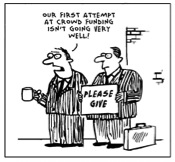
In March, the Securities and Exchange Commission (SEC) approved final rules of Title IV of the JOBS Act, changing Regulation A into “Regulation A+.” Entrepreneurs selling securities to private investors are no longer limited to using Regulation D or the old Regulation A. Entrepreneurs can now crowdfund their startup online through a “mini IPO.” Many believe these new rules show that the government has embraced technological changes. Some are optimistic about what they see as an opening of the crowdfunding floodgates, but the rules’ restrictions and requirements suggest such sweeping optimism may be misplaced. Continue reading