
FTC Seeks Public Comment: Harsher Regulations for Influencer Endorsements?

selective focus photography of person using iphone x

Photo by Kerde Severin on Pexels.com

By: Timothy Chien

As it turns out, millennials aren’t the only ones scrolling through the various news feeds on social media. In recent years, the Federal Trade Commission (FTC) has taken a keen interest in perusing the numerous social media platformsWith the rise of social media usage, many companies have started harnessing the power of influencer marketing as a way to reach millions of potential new customers. As one of our previous blog posts mentioned, influencer sponsorships are big business, with some celebrity figures commanding hundreds of thousands of dollars for product endorsements.

Continue reading

Alasaad v. McAleenan: Suspicionless Smartphone Searches at the Border are Unconstitutional, For Now.

auto automobile blur buildings

Photo by Pixabay on Pexels.com

By: Katie Haas

In November 2019, the United States District Court for the District of Massachusetts ruled in Alasaad v. McAleenan, that warrantless searches of smartphones and laptops without individualized suspicion (reason to believe the device contained contraband giving rise to a search) at United States airports and ports of entry are violations of the Fourth Amendment’s prohibition of unreasonable searches and seizure.  Filed by the ACLU and the Electronic Frontier Foundation, 11 plaintiffs alleged the Department of Homeland Security, The U.S. Customs and Border Protection (CBP), and the U.S. Immigration and Customs Enforcement (ICE) violated their constitutional rights by requiring that they turn over their phones and computers for extensive searches of their data before reentry into the United States.

Continue reading

Petty In Pink: Terms of Service Aren’t Always Terms of Certainty

Picture1

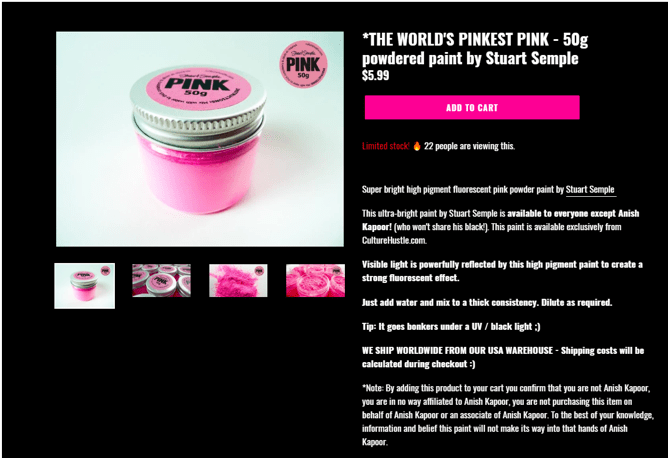
“The World’s Pinkest Pink” from CultureHustle.

By: Kaitlin Miller

In 2014, a UK-based company, Surrey NanoSystems, developed and announced the invention of Vantablack, otherwise known as the blackest black ever made (until September 2019, when MIT scientists accidentally stumbled upon the new blackest black). Surrey NanoSystems has continued to develop their unique technology. Vantablack is now so dark that it “absorbs 99.96 percent of the incident light that it comes into contact with,” and any 3D object coated in Vantablack looks to the naked eye like a 2D object— “a flat, bottomless void in space.”

A very fascinating issue has arisen from the licensing of Vantablack. Surrey Nanosystems granted British artist Anish Kapoor (known for his work “Cloud Gate,” a popular Chicago sight colloquially referred to as “the Bean”) an exclusive license to the artistic use of Vantablack. This has, expectedly, created an uproar in the art community.

Continue reading

Let’s Go Virtual With Shareholder Meetings

top view photo of people having a meeting

Photo by fauxels on Pexels.com

By: Samantha Pelto

Virtual shareholder meetings have not yet become the standard in the United States, but they should be. Virtual shareholder meetings are held online with shareholders attending remotely, and a growing number of companies are holding their annual meetings in this format. In 2009, only four companies held virtual shareholder meetings, but that number increased to 285 by 2018.

State laws require companies to hold annual shareholder meetings to vote for directors or on other matters requiring shareholder approval. The annual meetings are an opportunity for shareholders to raise questions and concerns with the company’s directors and management. Thirty states, including Washington, now permit virtual-only shareholder meetings. Virtual-only meetings are meetings held exclusively online with no physical location.

Continue reading

What if Corporations Process Our Data Without Ever Accessing it?

internet technology computer pc

Photo by Markus Spiske temporausch.com on Pexels.com

By: Samy Danesh

“Is it possible to delegate processing of your data without giving away access to it?” This was the question posed by Craig Gentry in his paper Computing Arbitrary Functions of Encrypted Data, in which he introduced the concept of homomorphic encryption.

Tech companies find the privacy discussion threatening – afraid that broad privacy legislation and high standards of privacy protection will dry up the well of innovation and economic growth.  For example, the Center for Data Innovation and IAPP view the EU’s General Data Protection Regulation as potentially inhibiting European companies’ ability to compete in AI development and the data driven economy. This fear is not completely unfounded since much of today’s technology depends on access to large troves of data. However, innovative solutions like homomorphic encryption create an opportunity for greater data privacy without compromising the industry’s ability to access data and process that information to provide products and services.

Continue reading