Wrongful Classification of Employees as Independent Contractors – Will Tech Companies Fare Better Than Transport Companies?

Screen Shot 2015-11-30 at 7.18.26 AMBy Cheryl Lee

What do Uber, Amazon and FedEx have in common? They are all multibillion dollar companies using independent contractors for transport and have faced or are facing lawsuits alleging they wrongfully classified employees as independent contractors.

Generally, independent contractors are cheaper for companies to hire. Employers do not have to offer benefits like health insurance and 401(k)s, pay overtime or give paid days off, cover the employer share of their payroll taxes, or withhold income taxes. Independent contractors essentially run their own business with autonomy to decide when, where and how to do the work assigned. They have the freedom to take on projects with other companies. Continue reading

A Glimpse into the Future: Driverless Cars Have Arrived

teslaBy Naazaneen Hodjat

To much fanfare, Tesla Motors announced the release of its Autopilot version 7.0 which effectively allows its Model S to use a “combination of cameras, radar, ultrasonic sensors and data to automatically steer down the highway, change lanes, and adjust speed in response to traffic.” Tesla’s Chief Executive Officer, Elon Musk, describes the Autopilot program as a “profound experience for its drivers” —one that “when owners try it out and see the car drive [by itself] they’re blown away.”

The Tesla Autopilot program aims to increase the driver’s confidence behind the wheel by reducing the driver’s workload and helping the car avoid hazards—significantly improving driver safety. Its Autosteer technology allows for hands-free and pedal-free driving on the highway. The new program, however, does not read traffic lights or poorly marked roads and is programmed to relinquish control back to the driver if it loses confidence in its ability to drive safely. The Autopilot also contains an Auto Lane Change feature—the driver must simply engage the turn signal and the Autopilot will move itself over to the adjacent lane when it is safe to do so. Finally, the program has an Autopark function that enables the car to scan the surroundings of a parking spot and parallel park itself. Although the Autopilot program allows Tesla sedans to steer and park themselves, Musk warns that Tesla drivers are expected to stay engaged while driving. In fact, owners are instructed to keep their hands on the steering wheel at all times. Tesla cautions drivers against trusting its Autopilot program too much and reminds drivers that they are still responsible. Continue reading

Hash Register: Startup Sees Opportunity in Point of Sale Terminals for Legal Cannabis Retailers

Untitled1By Jeff Bess

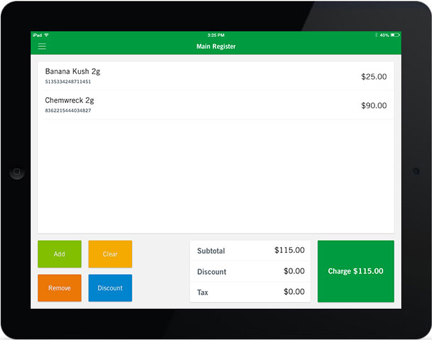
Legalization of recreational cannabis in four states and Washington, D.C.—and potentially another twelve states by the end of 2016—has brought a host of challenges and opportunities for those looking to capitalize on this newly legitimized industry. From a business perspective, the opportunities are clear: legal sales in Washington state alone netted the state $70 million in tax revenue and several times that amount in gross sales during the first year. What is often less easily appreciated, however, is the challenge cannabis retailers face in complying with complicated, sometimes onerous, state regulations. For example, Washington has instituted “seed to sale” tracking of all cannabis plants, which requires retailers to manage inventory and record sales of otherwise-identical products by plant number. Retailers must then submit all of this information to the state Liquor and Cannabis Board. Added to the obvious logistical challenge of tracking hundreds of thousands of individual plants are the severe consequences of non-compliance, which can result in revocation of a retailer’s license and forced closure.

So, what can the conscientious, law-abiding cannabis retailer do to ensure compliance–without resorting to tedious and error-prone manual recordation? Continue reading

“Oxygen OS” and the Future of the OnePlus Two

Screen shot 2015-08-03 at 8.07.20 PMBy Yayi Ding

On July 27th, 2015, Chinese smartphone manufacturer OnePlus unveiled its second-generation smartphone, the “OnePlus Two.” This was a highly anticipated launch, because OnePlus’ first device, the OnePlus One, took the smartphone industry by storm just over a year ago. The OnePlus One offered the kind of high-end specs found in today’s elite smartphones, but for just a fraction of the price. Consequently, OnePlus has sold over 1 million OnePlus One smartphones thus far – no small feat for a new start-up based out of southern China. But, due to a series of behind-the-scenes legal issues, the OnePlus Two will not offer the popular operating system found in its predecessor, Cyanogen OS, but instead will feature OnePlus’ own operating system: Oxygen OS. This difference may be critical to the OnePlus Two’s future success. Continue reading

Stock Split and the Failure of a Shareholder Democracy

underarmourBy Joe Davison

Background: Since its founding, Under Armour has maintained a dual-class stock structure consisting of Class A Stock, which has been entitled to one vote per share, and Class B Stock, which has been entitled to ten votes per share. Founder and CEO, Kevin Plank, beneficially owns all of the company’s Class B Stock and also owned a small portion of the Class A Stock. As of June, this provided Mr. Plank with 65.5% of the company’s total voting power, but only 16.6% of the total number of outstanding shares. Under the terms of Under Armour’s charter, if the aggregate number of shares of Class A Stock and Class B Stock owned by Mr. Plank is less than 15% of the total number of shares, the dual-class structure will unwind and all Class B Stock would be automatically converted in to Class A stock. This would result in Mr. Plank effectively losing control of Under Armour.

In November 2014, Mr. Plank reviewed his current ownership of Class B Stock with Under Armour’s Board of Directors and requested that the Board evaluate the creation and issuance of a class of non-voting common stock. The Board authorized a Special Committee to consider such a class of non-voting common stock, and to evaluate and make a recommendation to the Board as to whether and on what terms to proceed. The Special Committee recognized that the Company has been well-served by allowing Mr. Plank and management to focus on long-term value creation without distraction. Accordingly, the Special Committee informed Mr. Plank that it would recommend the creation of a Class C Stock and a Class C Dividend. The Dividend would distribute one new share of the non-voting stock for every existing share of Class A and Class B stock. This would allow shareholders to sell the Class C stock without losing any of their voting power. Continue reading