Your Face, Your Voice, but Whose Rights? Washington’s New Law on AI-Generated Likenesses

By: Juliana Bologna

Imagine scrolling through social media and seeing yourself in an advertisement for a product you’ve never used. Your face is on the screen, your voice is promoting the product, and you appear to be enthusiastically endorsing a company you’ve never heard of. There’s just one problem: you never agreed to any of it. With generative artificial intelligence (AI), creating a convincing imitation of someone’s appearance or voice no longer requires their participation.

The issue surrounding AI-generated identities made headlines in May 2024 when actress Scarlett Johansson raised concerns about OpenAI’s “Sky” chatbot voice, which she believed sounded remarkably similar to hers after she declined an offer to voice the product. OpenAI maintained that “Sky” was voiced by another actress and was never intended to imitate Johansson but ultimately paused its use. Although the dispute did not establish that Johansson’s voice had been cloned, it highlighted a concern that extends far beyond Hollywood: what happens when technology can convincingly recreate someone’s identity without their consent?

Washington’s Right of Publicity and SSB 5886

Washington’s Personality Rights Act has long recognized an individual’s property right in the use of their name, voice, signature, photograph, and likeness. Wash. Rev. Code § 63.60.010 (2026). Commonly known as the right of publicity, these protections are not limited to celebrities or public figures, generally prohibiting unauthorized commercial uses of a person’s identity in merchandise, advertisements, and fundraising, regardless of whether the use generates a profit. Wash. Rev. Code § 63.60.050 (2026).

However, the emergence of increasingly sophisticated AI-generated impersonations has raised new questions about whether Washington’s traditional protections for an individual’s voice and likeness adequately address synthetic representations. In response, Washington lawmakers passed Substitute Senate Bill 5886 (SSB 5886), which took effect on June 11, 2026, and expressly added “forged digital likeness” to the state’s existing personality rights protections. Rather than broadly prohibiting deepfakes, the amendment extends existing protections to certain digitally created or altered representations. Under the amended statute, a forged digital likeness must be indistinguishable from a genuine representation, misrepresent an identifiable individual’s appearance, speech, or conduct, and be likely to deceive a reasonable person into believing it is authentic. Wash. Rev. Code § 63.60.020(3) (2026).

The amendment also strengthens remedies for infringement. Under the Act, an individual whose rights are infringed may seek actual damages, profits attributable to the infringement that are not already included in those damages, and a $3,000 civil penalty. When the infringement involves a forged digital likeness, individuals may additionally recover noneconomic damages, even if the infringement generated no profit. Wash. Rev. Code § 63.60.060(2) (2026).

Does an AI Imitation Have to Deceive Someone to Be Unlawful?

Although these changes strengthen Washington’s protections against digital impersonation, the reasonable-person deception requirement raises an important question: Must an AI-generated imitation deceive someone before the person it imitates is protected?

Consider a Washington resident whose face and voice are recreated in an AI-generated advertisement for a local business. The business never obtains permission, but the advertisement includes a prominent disclaimer identifying the content as AI-generated. Viewers understand that the person never actually appeared in the advertisement, yet the business is still benefiting from their recognizable identity.

Under Washington’s new definition, an advertiser who includes a prominent AI disclaimer could argue that the content is not likely to deceive a reasonable person and therefore does not qualify as a forged digital likeness. But disclosure alone does not automatically make the advertisement lawful. Washington’s Personality Rights Act separately protects an individual’s voice and likeness, meaning an unauthorized AI-generated replica could still give rise to a claim even if it does not meet the new definition of a forged digital likeness. The Act defines “likeness” broadly to include representations of an individual’s face, distinctive appearance, gestures, or mannerisms. Wash. Rev. Code § 63.60.020(6) (2026). Whether these existing protections would apply to a particular AI-generated replica remains uncertain. Wash. Rev. Code § 63.60.050 (2026).

Revisiting Johansson Under Washington Law

This distinction matters because an advertisement does not have to fool its audience to benefit from someone’s recognizable identity. Consider Johansson’s dispute with OpenAI. If a similar situation arose in Washington today, the new law might offer protection if the voice were shown to be a digitally created imitation likely to deceive a reasonable person. But if the voice merely resembled hers, as OpenAI maintained, establishing that it qualified as a forged digital likeness could be much more difficult. The dispute illustrates the challenge Washington courts may face in distinguishing between a convincing imitation and the unauthorized use of someone’s recognizable identity when deception is no longer part of the equation.

Conclusion

Washington’s expansion of its Personality Rights Act marks a significant step toward addressing AI-generated impersonation, but questions remain about how the law distinguishes deception from unauthorized commercial use. As synthetic media becomes more sophisticated and realistic, courts may need to clarify how these existing protections apply when an individual’s identity is recreated without consent. The real question may not be whether an AI-generated imitation can deceive a reasonable person, but whether that potential for deception should determine the limits of an individual’s right to their own identity, especially when the next face or voice at the center of that question could be yours.

#RightOfPublicity #Deepfakes #WashingtonLaw #WJLTA
When Proof Becomes Partisan: How AI Is Fracturing Our Shared Reality

By: Claire Kenneally

What’s Happening? 

Note: This post contains photos of weapons and discusses violence that may be triggering. 

The shootings of Renee Good and Alex Pretti incited the nation, as viewers across the country tuned in to the violence in Minneapolis, Minnesota. Both Good and Pretti were protestors killed by U.S. Immigration and Customs Enforcement (ICE) agents employed in Operation Metro Surge– a large scale immigration raid that resulted in the detention over 4,000 documented and undocumented Minnesotans. 

But instead of prompting collective grief, the country’s varied reactions only deepened the sense that Americans now inhabit entirely different moral and political universes. In part, this stems from media coverage surrounding the shootings. AI-generated media is accelerating political polarization by reshaping public perception of violent events before facts can stabilize.

Where Does Our News Get Our News? 

News networks have always had biases. But the internet and social media have shifted networks’ priorities from well-researched and fact-based journalism to punchy pieces aimed at generating clicks. A study by UCLA Professor Arash Amini described the media’s perpetuation of misinformation as an “arms race in which mainstream media outlets struggle to stand out amid a flood of content.” 

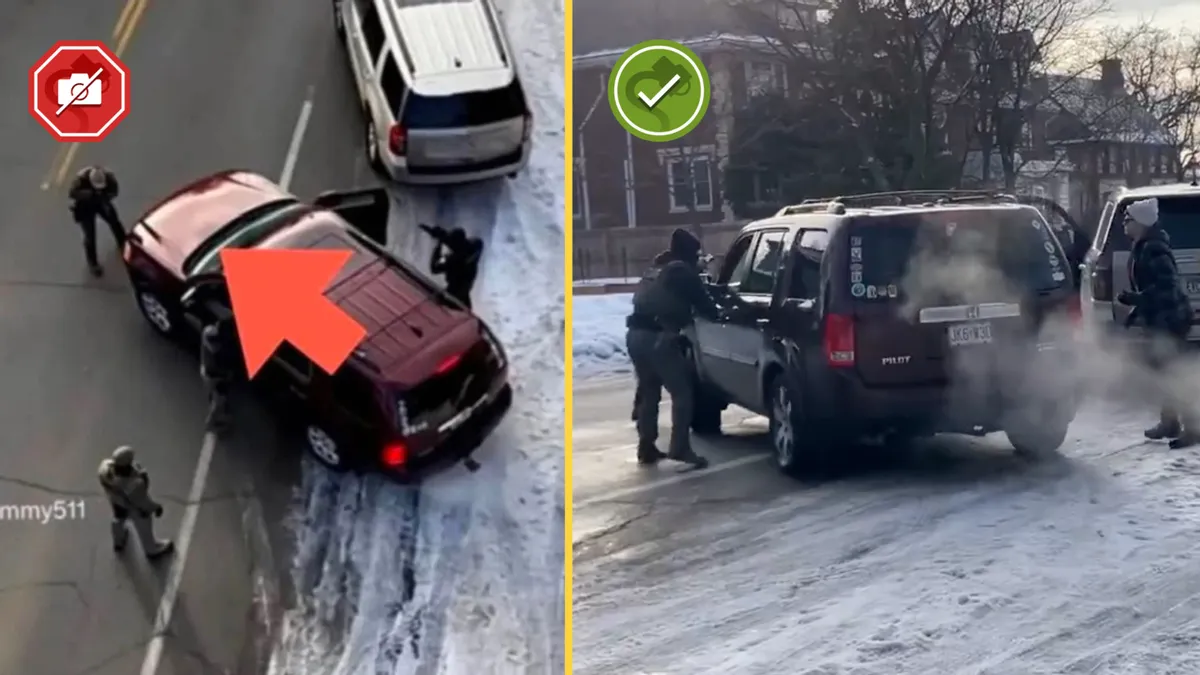
When Renee Good was shot by ICE on January 7th, 2026, online sleuths were quick to create and point to video footage of the moments leading up to the shooting. One X user, a self-proclaimed “Trump Loyalist Parody Account” shared an aerial-view photo of Good’s car that quickly gained traction online. The original post did not disclose that the photo was AI, nor that it was generated only to show why the X user personally believed agents should be allowed to use lethal force. A later post admitted the photo was AI-generated, after Snopes and Lead Stories debunked it (in part because the falsified photo included imagery like car doors open that were actually closed, and bystanders in different outfits than they had on in verified video footage). But the original photo, without the subsequent post’s clarification, had already spread across the internet. 

Image taken from Twitter user @ScummyMummy511/Max Nesterak/Snopes Illustration

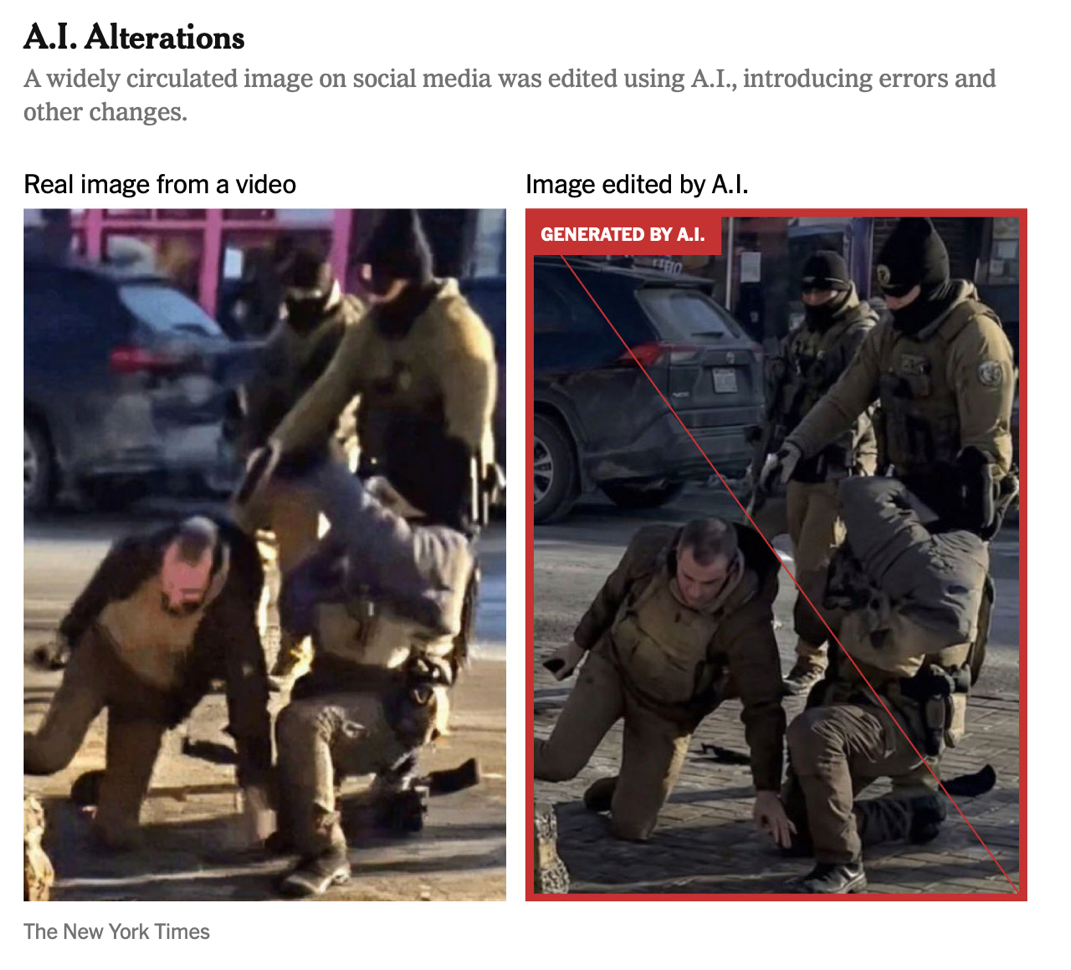
In the wake of Alex Pretti’s death a few weeks later, social media users flooded the internet with AI-generated images of him holding a gun, while video footage of the shooting later revealed him to be holding his cell phone.  Other doctored footage circulated inaccurately showed an agent holding a gun to the back of Pretti’s head while he lay prone on the ground. 

Photo taken from the January 25th, 2026 New York Times article “False Posts and Altered Images Distort Views of Minnesota Shooting”

Ironically, the AI-enhancement of media to justify a singular political narrative is not a partisan issue. Viewers across the political spectrum suffer when the news they consume is riddled with inaccuracies, even if those inaccuracies confirm their biases. This, in turn, only serves to widen the gap between Americans- how can you converse about an important social issue when you’re each convinced you have the concrete evidence, and that it supports your opinion? 

Long-Reaching Implications

In the cases of Good, Pretti, and countless other victims of violence, another troubling aspect in the coverage of their deaths is how their images are reshaped posthumously to fit familiar narratives and biases. 

Altered photos of Good were circulated in the wake of her death, claiming she’d posted in celebration of Charlie Kirk’s shooting earlier this year. This led to some Conservative-leaning viewers calling her death “karma”- stoking animosity against her even after the photo’s authenticity was fact-checked and disproven. 

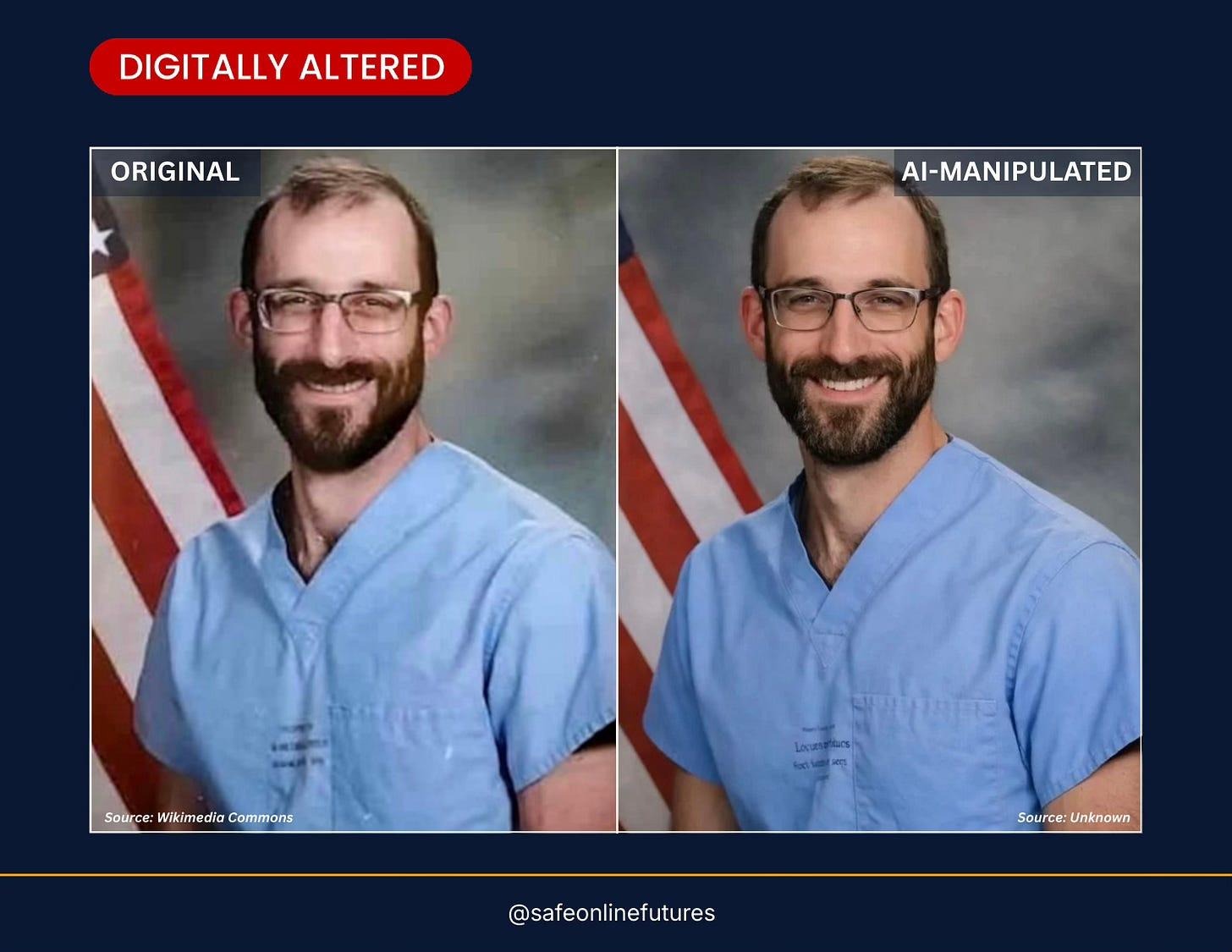
In Pretti’s case, multiple stations accidentally used an AI-doctored photo of him in their initial coverage. Some speculate the edited photo was created to make him appear “less Jewish”. Others suggested it was to make him “. . . a more appealing ‘poster boy’ for the anti-ICE movement.” MSNBC, who used the altered photo, claimed that they merely pulled it from the internet after searching Pretti’s name. Knowing AI’s predilection for generating images that favor whiteness, conventional beaty standards, and imbedded racial biases, it’s unsurprising, but disturbing, how mundane Google Image searches further subtle whitewashing and stereotyping under the guise of algorithmic neutrality.

Photo taken from the January 28th, 2026 New York Post article “AI-altered pic of Alex Pretti is being widely circulated after his killing by Border Patrol” 

The Legal Implications

Currently there are few legal protections in place to counteract AI “enhanced” media. The current administration has taken a strong stance against AI regulation, passing Executive Order 14179 in  January 23, 2025 (“Removing Barriers to American Leadership in Artificial Intelligence”) and Executive Order 14365 of December 11, 2025 (“Ensuring a National Policy Framework for Artificial Intelligence”). Both orders removed barriers like state-wide AI regulations to “encourage adoption of AI applications across sectors.”  

The legislative branch has taken a different approach than the executive. The TAKE IT DOWN Act was signed into law in May 2025 and prohibits the nonconsensual online publication of intimate visual depictions of individuals, both authentic and computer-generated. However, the act focuses on sexual imagery and would not apply to Good or Pretti.  

The 2025 proposed NO FAKES Act holds more promise, as it would make individuals and entities legally responsible for creating unauthorized digital copies of a person. The Act is focused on establishing intellectual property rights against AI-generated deepfakes and creating a legal recourse for individuals whose likeness is used without consent. If this bill passes, it could create a way for members of Good and Pretti’s families to sue in civil court for damages. 

So What Am I Supposed to Do?  

The 24-hour news cycle is not slowing down. But with minimal legal recourse and an executive office that happily generates AI misinformation as freely as fringe conspiracy theorists, sometimes it feels that there’s not much to do but hope Congress acts quickly. However, one intermediate solution is turning to local, community journalism instead of national pundits. In the realm of immigration crackdowns, protest coverage, and updates on Minneapolis, consider:  

In the emerging age of AI narratives and de-regulation, staying truly informed now means choosing intention over speed, resisting easy narratives, and doing the critical thinking ourselves. 

This article acknowledges and honors all individuals who have been murdered by ICE and the Department of Homeland Security in 2026: Keith Porter, Parady La, Heber Sanchaz Domínguez, Victor Manuel Diaz, Luis Beltran Yanez-Cruz, Luis Gustavo Nunez Caceres, and Geraldo Lunas Campos, Renee Good, and Alex Pretti. Learn more about their stories here. 

#Deepfakes #A.I.Misinformation #WJLTA