
By: Francis Yoon
For decades, the intellectual property of the hardware world has been defined by physical chips and their structural protection rather than by the experience they produce. However, in 2026, the value of a device is shifting from how it is built to how its performance feels. As Gallium Nitride (GaN) pushes the physics of the possible into the mainstream, the hardware industry is discovering that while a patent protects the circuit, it can no longer protect the soul of the machine.
The GaN Inflection and the Pursuit of Analog Warmth
GaN is a material that allows electrons to move with significantly more energy and speed than traditional silicon. In the high-stakes world of the 2026 power electronics market, this distinguishes a sterile digital signal and a rich linear resonance.
In the audio sector, this is a tonal revolution. Because GaN switches up to four times faster than silicon, reaching slew rates of 150 V/ns, it virtually eliminates the inevitable distortion from switching devices that has plagued digital amplifiers for years. The result is what audiophiles describe as “shockingly good sound” and “crisper treble” from GaN systems, noting that the tech finally provides the “analog warmth” the digital age lacked.
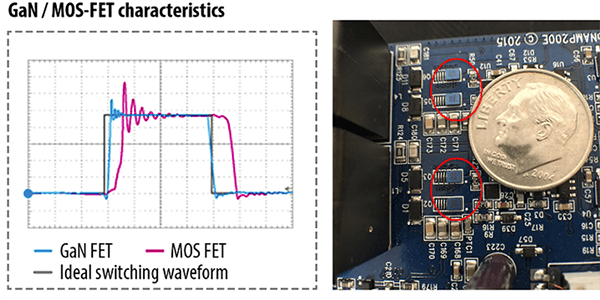
Image taken from: GaN Talk Blog
As seen in the waveform comparison above, the GaN Field-Effect Transistor (GaN FET) eliminates the high-frequency “ringing” (the purple oscillations) found in traditional Metal-Oxide-Semiconductor Field-Effect Transistors (MOSFETs), resulting in a significantly smoother and more linear output.
The Double Wall of Modern Patentability
As GaN matures into a $3.32 billion market this year, the path to protecting these innovations through patents is becoming increasingly fraught. Inventors are hitting two distinct legal hurdles when dealing with the United States Patent and Trademark Office (USPTO). First, as GaN becomes an industry standard, inventors frequently face “obviousness” rejections, where the transition from silicon to GaN is characterized as a predictable substitution of materials rather than a patentable breakthrough.
Second, innovators often face a hurdle in which the Patent Office labels their specific hardware designs as simply a “natural phenomenon” of the material itself rather than a unique, human-made invention. This creates a significant identity problem: there is no legal safe zone for protecting the aesthetic output of hardware through patent law alone.
The Category 30 Strategic Exit
If the internal circuit is becoming harder to patent, the solution lies in protecting the external output. On February 10, 2026, the USPTO provided the industry with a quiet but massive strategic exit through the modernization of the Trademark Design Search Code Manual. The introduction of Category 30, specifically 30.02.06, which provides specific search codes for non-traditional marks like machine-generated tones and musical sounds, allows hardware firms to plant a different kind of flag.
While a patent on a GaN heterostructure will eventually expire in 20 years, a trademark on the unique startup chime or the specific tonal texture enabled by that hardware can last indefinitely. By shifting the IP focus from the atom to the audio, companies can secure long-term brand equity that survives the commodity cycle of the semiconductor market. This pivot allows engineers to turn a functional byproduct into a registrable asset.
Suggestions for the Next Era of Intellectual Property
As hardware identity becomes as valuable as hardware functionality, we risk a future where trademark law prevents innovation. A viable resolution to this gridlock requires a clear path forward for regulators and practitioners. The adoption of a Technical De Minimis safe harbor for hardware output would allow the USPTO and the courts to protect brand identity without granting a monopoly over the natural music of innovation. Just as copyright law protects transformative use, trademark law should distinguish between a branding-heavy sonic logo and the functional, incidental sounds inherent to a material’s physics. A GaN-based hum or a mechanical click should remain a shared resource.
If you are a hardware developer, the 2026 playbook seems to require a hybrid approach: use patents for the truly non-obvious structural leaps, but use Category 30 to tether the sensory experience of your engineering to your brand. In 2026, the goal of IP should be ensuring that the resulting sound remains free for the next generation of creators to build upon.
#Hardware-IP #GaN #Trademarks #USPTO #WJLTA

