By: Evan Stewart
Introduction of Torpedo Bats
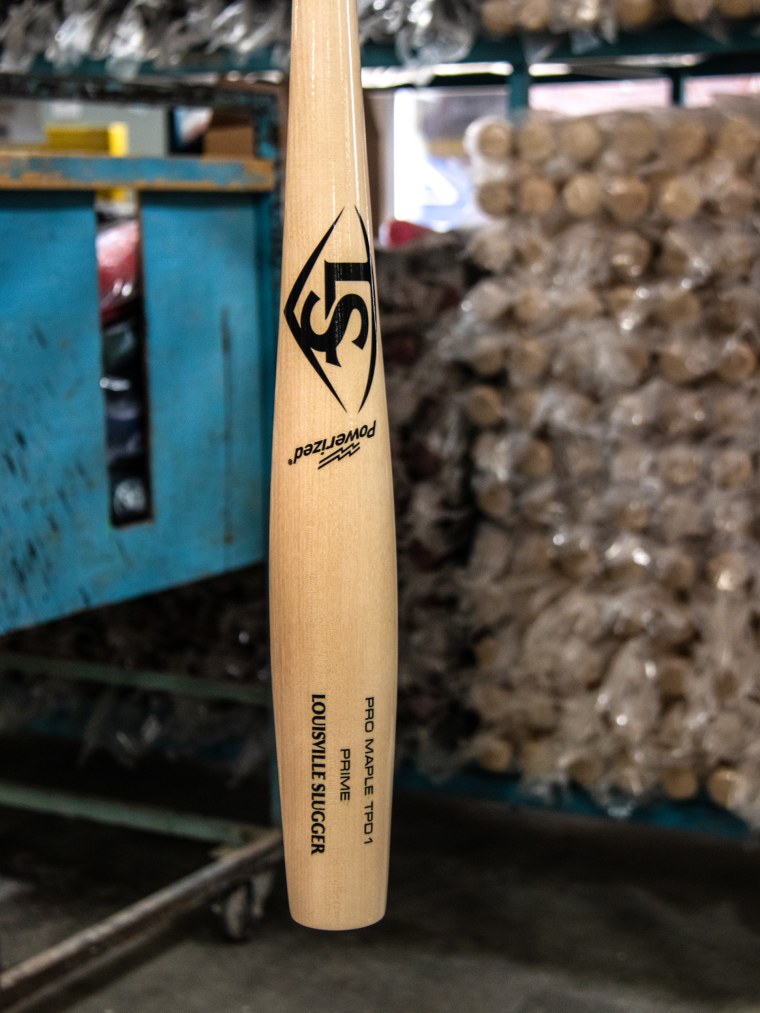
On March 29th, the New Yankees beat the Milwaukee Brewers 20-9, hitting a franchise record nine home runs, including three home runs on the first three pitches of the game. However, the story that took the baseball world by storm was not the franchise’s single-game home-run record, or the three-game sweep in which the Yankees hit 15 home runs and scored 36 runs. Instead, the national spotlight was on the new bowling-pin shaped bats that several of the Yankees players were using. These bats, dubbed “torpedo bats” have dominated baseball news for the first two weeks of the season, and are likely to impact the intellectual property world as well.
What Are Torpedo Bats
Torpedo bats differ from regular bats because the part of the bat with the widest diameter is lower on the bat. The lower sweet spot is meant to distribute the most mass of the bat to the “sweet spot”. The rationale for this change was very simple: put more wood in the area where the ball usually hits the bat. In the words of MIT physicist Dr. David Pritchard, “When you look at the design of a classic baseball bat, the physics just don’t add up. When the ball comes in and hits the sweet spot, it bends the bat so some of the energy goes into bending the bat.” With more wood in the sweet spot, there will be less energy lost by the bat bending back.
Who Created the Torpedo Bat
Credit for the creation of the torpedo bat goes to another MIT physicist turned baseball coach, Aaron Leanhardt. Leanhardt is currently a field coordinator for the Miami Marlins but previously worked as a Minor League hitting coordinator for the Yankees. Before beginning his career as a coach, Leanhardt earned a PhD in physics from MIT and was a physics professor at the University of Michigan.
Leanhardt first began designing and testing the torpedo bat while working for the Yankees. In 2024, he first introduced the torpedo bat design to some Yankees players, including star hitter Giancarlo Stanton. There are even pictures of Stanton using a torpedo bat in the 2024 World Series. However, it was not until the opening weekend of the 2025 season, following the Yankees 3-game drubbing of the Milwaukee Brewers, when social media caught wind of the torpedo bats, and their popularity began to soar.
In the two weeks following the introduction of torpedo bats to the mainstream, baseball bat companies received thousands of preorders for torpedo bats. Two notable bat companies, Marucci and Victus, had models of the bats on their websites within a few days, trying to capitalize on the newest trend and had record sales.
The requests for torpedo bats are also coming from MLB teams themselves. Hillerich & Bradsby, the company that is credited for creating the Yankees’ torpedo bats, received an influx of orders from MLB teams directly asking for torpedo bat models. Within a few days, there were MLB players across the league using torpedo bats, and it will be interesting to see if their popularity continues to grow among players.
Can Torpedo Bats Be Patented
Whenever there is a popular new invention, one of the first questions is whether it is eligible to receive patent protection. Patents offer inventors “the right to exclude others from making, using, offering for sale, or selling” their invention in the United States. The two main types of patents available to inventors are utility patents and design patents. Utility patents are granted to inventors of new and useful processes or machines. Design patents are granted to inventors of new, original, and ornamental designs for an article of manufacturing.
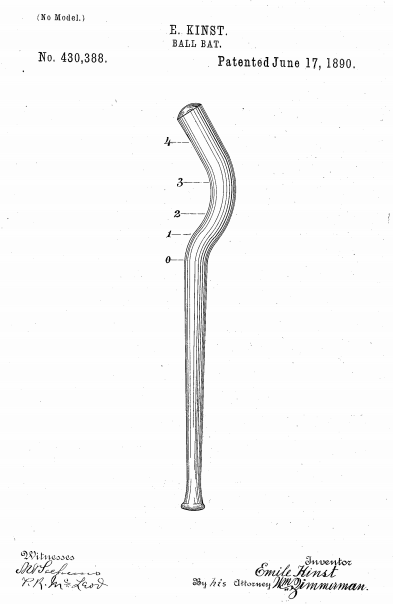
Although the general shape of baseball bats has stayed nearly the same for over 100 years, there have been some modifications that have received patents. The first, and goofiest, example of these was the banana bat. Banana bats, which had a curved barrel, received a patent in 1890, despite not catching on in professional baseball (for obvious reasons).
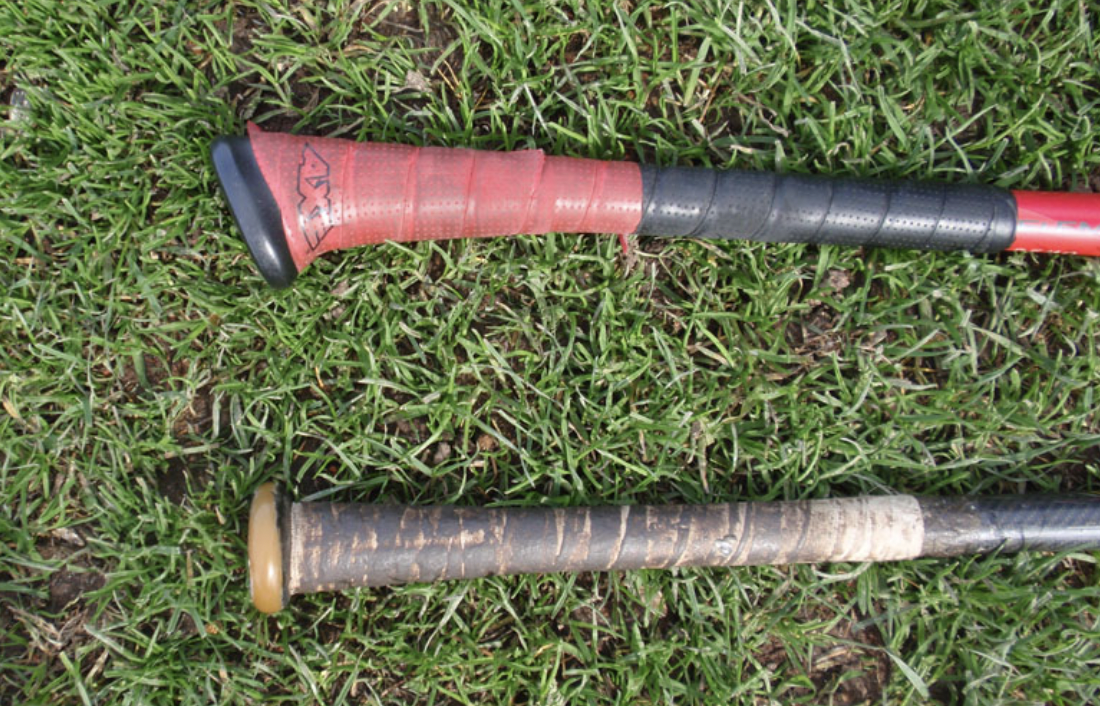
A modern example of a bat modification that received a patent is the “axe handle” bat. Axe bats, which grew in popularity around 2015, featured a bat handle that resembled an axe handle instead of the rounded handle that is usually used on a baseball bat. Axe bats received a design patent in 2013, as an ornamental change to the traditional baseball bat. Today, “axe bats” are sold exclusively by Baden Sports, but the company does license the axe handle design to other bat companies.
Based on the axe bat precedent, it seems like torpedo bats could eventually receive a design patent. Interestingly, Bob Hillercih, the vice president of the aforementioned bat manufacturer Hillerich & Bradley, does not believe that torpedo bats are eligible for a patent because the changed design for the bat is just a change in the shape.
However, based on the description of design patents, this does not seem to be true.
There are two factors in determining whether a design qualifies for a design patent. First, the design must be an integral aspect of the product that cannot be separated. The difference in barrel placement is the integral aspect of the design of torpedo bat, so it appears that this element would be met. Next, the design must have no bearing on the item’s functionality. The torpedo bat design would likely meet this element, because the new design does not alter the baseball bat’s functionality. Rather, the torpedo bat just changes the amount of wood at the point of contact. Although some Yankee players had early success with the torpedo bats, it does not, on its own, make it easier to hit home runs. Torpedo bats are used just like regular baseball bats, the only difference is that it has a unique ornamentation with the location of the largest part of the ball being moved.
Design patents also require that the new patent not be obviously derived or resembling other designs. While there may be an argument that the torpedo bat resembles other bats, the same argument could have been used for the axe bat handle resembling a baseball bat handle or an axe handle. When viewing all of these elements, and comparing torpedo bats to the patent that the axe handle received, there is a possibility that torpedo bats could receive a design patent, if Leanhardt chooses to do so.
Conclusion
Time will tell if torpedo bats are the next big thing in baseball, or if they are just another banana bat. While more players have begun using them, other players tried them but returned to their old bats or refused to use them altogether. Regardless of their long-term impact on baseball, it will be very interesting to track whether the United States Patent and Trademark Office determines that torpedo bats can be patented. While historical precedent makes it seem like torpedo design can be patented, there seem to be concerns from people in the bat manufacturing business, who also may not want the bat design to be patented so they do not have to license the design to use it.

 Washington Journal of Law, Technology & Arts