Your Squishmallow Isn’t Who You Think It Is: Setting The Bounds Of The Soft Toy Market 

By: Caroline Dolan

Squishmallows were introduced in 2017 and went viral on TikTok and Instagram during the Covid-19 pandemic in 2021. People fell in love with these affordable and huggable plushies that are available in more than 3,000 different characters. Their unique sizes and colors provide comfort and joy for all ages and even serve a niche of Squishmallow collectors

Trade Dress: The Look and Feel

Trademarks are “words, names, symbols, or devices” that are distinct, functional, and used in commerce to identify the source of a good. The Lanham Act provides federal protection over the good-will of such artistic creations from infringement, dilution, cybersquatting, and false advertising. It also protects consumers from being deceived by knock-off products. The Lanham Act also protects a product’s trade dress, which is “the commercial look and feel of a product or service that identifies and distinguishes the source of the product or service.” Similar to trademarks, trade dress can receive protection even without formal registration with the U.S. Patent and Trademark Office.  

To assert a trade dress infringement claim, a plaintiff must demonstrate that their product’s trade dress  (1) is distinctive; (2) is owned by the plaintiff; (3) is nonfunctional; and (4) that the defendant used the trade dress without consent in a way that is likely to confuse the ordinary consumer as to the source, sponsorship, or affiliation of the product. The Ninth Circuit has held that a trade dress that fails to be inherently distinctive may still be protected if it possesses a secondary meaning. To show a secondary meaning, a plaintiff must prove “a mental recognition in buyers’ and potential buyers’ minds that products connected with the [trade dress] are associated with the same source.” 

Build-A-Bear vs. Squishmallow

Warren Buffet’s investment company, Berkshire Hathaway, owns Alleghany Corporation which is the parent company of Jazwares LLC. Jazwares oversees Kelly Toys which is a leading toy manufacturer and the creator of Squishmallows. Squishmallows have seen its sales boom since 2021 and can be purchased in a variety of spaces, including in bulk at your local Costco. However, in January 2024, to offer “optimal hugging benefits” in light of Valentine’s Day, Build-A-Bear launched its Skoosherz line—a variety of collectible plush pillow-like toys. 

Once the Sckoosherz line was released, Kelly Toys promptly filed a lawsuit in the Central District of California claiming that Build-A-Bear’s Skoosherz line infringes on Squishmallow’s trade dress because Skoosherz imitate Squishmallows’ “shape, face style, coloring and fabric.” Kelly Toys’ complaint alleges that Skoosherz “have the same distinctive trade dress as the popular Squishmallows, including: shaped fanciful renditions of animals/characters; simplified Asian style Kawaii faces; embroidered facial features; distinctive and nonmonochrome coloring; and velvety velour-like textured exterior.” It asserts that these similarities seek to “trick consumers” and has harmed the Squishmallows brand by “divert[ing] sales and profits from Kelly Toys to Build-A-Bear.” Kelly Toys is seeking unspecified damages and an injunction to stop the sale of Skoosherz. In Kelly Toys’ view, Build-A-Bear is intentionally copying the distinct physical characteristics and exterior appearance of Squishmallows to capitalize on Squishmallows’ international success.

Build-A-Bear has responded by filing its own complaint in the Eastern District of Missouri asserting that its Skoosherz line is merely an extension of its already existing line of animal toys. In Build-A-Bear’s view, Skoosherz merely imitates the popular plushies that Build-a-Bear has previously sold. For instance, Build-A-Bear claims that the Skoosherz Pink Axåolotl is merely an imitation of its original Pink Axolotl toy. The company is seeking a declaratory judgment stating that Skoosherz do not infringe on the Squishmallow trade dress and furthermore, that the Squishmallow trade dress is not even protectable under the Lanham Act. Build-A-Bear asserts that the Squishmallow trade dress lacks a consistent look and feel and shares characteristics with toys already present in the market. According to its complaint, “[i]f each aspect of the claimed trade dress were in fact protected trade dress, it would be virtually impossible for competitors to create alternative designs.”

Bearing a Squishy Future

Trade dress is a critical element of trademark law and serves to safeguard the goodwill of creators, the protection of consumers, and a competitive market. Although this dispute resides in the market of soft toys, it highlights a new perspective of trade dress law and application. If a jury trial is granted, Kelly Toys will likely rely on side-by-side comparisons to highlight the visual similarities between Squishmallows and Skoosherz as well as present consumer comments that have been made on Build-a-Bear’s social media account dubbing Skoosherz as “knockoff Squishmallows.” Although such evidence can support Kelly Toys’ infringement claims, it will still have the initial burden of proving that its trade dress is protectable.
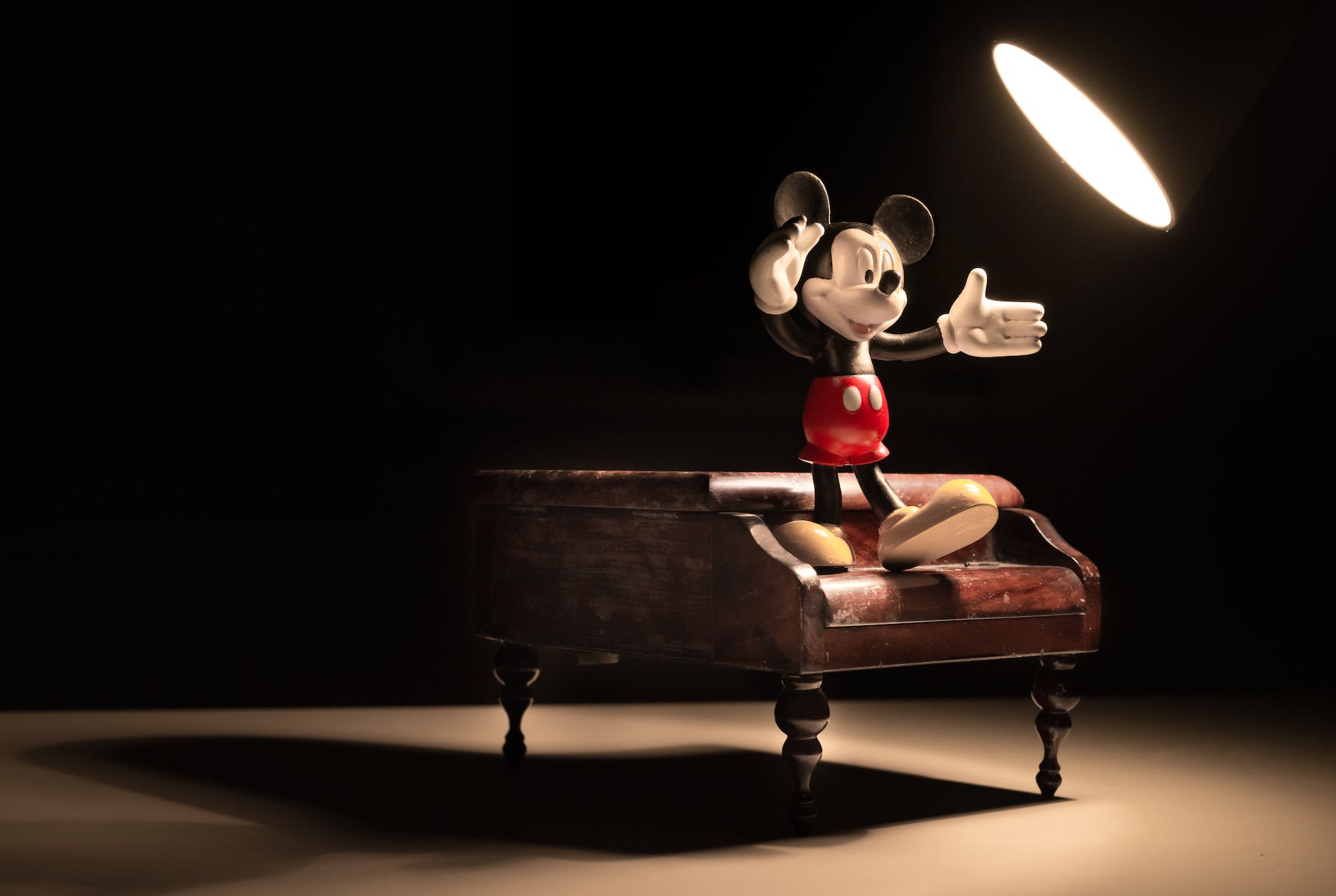
Can we go see Mickey? We have Mickey at home! Mickey… at home?

By: Kevin Vu

Nearly 100 years ago, Walt Disney released “Steamboat Willie,” showcasing Mickey Mouse’s first adventure. That mouse would kickstart what is now one of the world’s biggest companies, Disney. Today, Disney does a variety of things: it operates its own streaming services, runs a majority of the world’s most popular theme parks, and releases some of the world’s highest grossing movies. At the center of all that success is Mickey Mouse, who’s been dubbed “the world’s most famous cartoon character.” But Mickey is no longer just Disney’s to parade around, recently Mickey has become part of the public domain. What does being part of the public domain really mean though? This blog will explore and explain Mickey’s complicated history with copyright, what the public domain is, and what being in the public domain means for both Mickey’s future and others similarly situated to him. 

Copyright’s Origins

Copyright law originates from Article I, Section 8, Clause 8 of the United States Constitution which provides that Congress shall have the power “To promote the Progress of Science and useful Arts, by securing for limited Times to Authors and Inventors the exclusive Right to their respective Writings and Discoveries.” Copyright is a set of protections from the federal government for originally created works. Copyright disallows others from using the work without the author’s permission, and as was alluded to earlier, protection generally lasts for the author’s lifetime plus 70 years after the author’s death. In 1790, Congress used that power to pass the first Copyright Act which extended protection of works to 14 years, with a renewal period of another 14 years. 

Then, in 1909, a new Copyright Act doubled the length of protection for works from 28 years to 56 years, along with adding protections for motion pictures. “Steamboat Willie” was then released in 1928, and fast-forwarding some years and some minor changes to the Copyright Act, Disney entered the copyright arena in 1998. By that time, Mickey’s copyright was set to expire in 2003. Disney, worried about its copyright for Mickey, successfully lobbied Congress to protect him for 20 more years—extending his copyright expiration date to 2024. But that was the final extension for the mouse, as he is now part of the “public domain,” no longer just the sole property of Disney. 

What’s the Public Domain?

In contrast to copyrighted works, the public domain consists of “creative materials that are not protected by intellectual property laws such as copyright, trademark, or patent laws.” That means that items which were not originally subject to intellectual property protections, like laws for example, are part of the public domain and freely usable by individuals. Creative materials, like Mickey, which were previously protected under laws like copyright may also become part of the public domain once their copyright has expired.

Once something is in the public domain, it is fair game for any one to use. As the United States Supreme Court articulated in Dastar Corp. v. Twentieth Century Fox Film Corp., uncopyrighted materials are not protected under federal law. Further, because Article I, Section 8, Clause 8 vests the power to protect creative endeavors in Congress, states are precluded from passing copyright laws under the Supremacy Clause of the U.S. Constitution. This means that anyone can use works in the public domain without obtaining permission or giving credit to the original author, and no one can ever own that work.

Mickey… at home?

One can immediately see why Mickey’s move to the public domain is problematic for Disney. 20 years ago, it was estimated that Mickey Mouse had made over $5.8 billion for Disney. This explains why Disney was adamant about lobbying Congress for copyright protection extensions, as Mickey going to the public domain could affect his worth. 

Fast-forwarding to today, Mickey has entered the public domain, with one company has already announced that they plan on making a Mickey Mouse horror movie, following in the footsteps of “Winnie-the-Pooh: Blood and Honey,” a Winnie the Pooh slasher movie created when Pooh Bear entered the public domain in 2023. Ultimately, it remains to be seen what else individuals will do with Mickey.

But luckily for Disney, Mickey’s presence in the public domain does not spell the end of their rights to the iconic character. Copyright law makes distinctions between versions of characters meaning only the “Steamboat Willie” version of Mickey is in the public domain and usable by anyone. The red shorts, big-boots, and high-pitched voice of the current Mickey Mouse remains Disney’s property, and is therefore subject to copyright protection. Another thing to note is that Disney’s use of Mickey as a brand or symbol is protected under trademark law. So, while “Steamboat Willie” Mickey is freely usable, individuals should be careful not to confuse that character with his newer versions, and avoid making it seem like Disney endorses their new creative work. As some commentators have noted, Disney is actively seeking to protect its brand and anyone seeking to use Mickey should seek out legal counsel.  

Ultimately, it remains to be seen whether Mickey’s introduction into the public domain will create new, expansive creative works, or if Disney will continue to aggressively fight for the mouse. Whatever the case, Mickey’s move into the public domain is a historic event, and its effects remain untested.

Fan Creativity in Gaming and IP Infringement

By: Yixin Bao

Gaming is known to be a big and rapidly growing industry. In recent years, the COVID-19 pandemic has contributed to a surge in gaming activity and revenue. Many people turn to gaming as a form of entertainment during their time at home. According to The NPD Group, the average time people spent on gaming rose from 12.7 hours per week in 2019 to 14.8 hours per week in 2020 and to 16.5 hours per week in 2021. Statista data further shows that the estimated global gaming market will increase to $268.8 billion annually in 2025 from $155.89 billion in 2020. 

There are many different types of gaming. The most commonly recognized ones include mobile gaming, console gaming, and PC gaming. In addition, new categories have emerged, such as esports and virtual reality gaming. With the increasing popularity of gaming and the increasing number of players, the gaming industry is expected to continue to grow in the future. 

As popularity of the gaming industry is on the rise, so are related intellectual property infringement issues. Intellectual property can include inventions, artistic works, designs, and names that are used in commerce. Normally, IP infringement includes patent infringement, copyright infringement, or trademark infringement. IP infringement can result in legal action taken by the owner against the infringing party, including but not limited to injunctions and monitary damages. 

A “fan” or “fanatic” is defined as someone who exhibits intense admiration and enthusiasm for something or somebody. Without a doubt, the gaming industry has its own fans. In fact, this number can be huge. For example, League of Legends (“LoL”) is known to be one of the most popular online games in the whole world. It is said that there are currently 180 million League of Legends players right now in 2023. Esports also heavily influenced the growth of the game’s popularity. Each year, the World Championship is organized so that teams from all different countries gather together and compete for the best team. In 2018, 99.6 million unique viewers watched the World Championship. Although it can be difficult to accuralty measure how many fans a game has, as some will not identify themselves as fans, it is reasonable to assume LoL’s fanbase is enormous. 

Many fans of the gaming industry make their own content. This includes, for example, creating new characters or inventing new storylines based on the original characters and artworks. On one hand, this benefits the gaming industry because fans give free promotion for the games. On the other hand, however, this is when the fan creativity ends, and IP infringement occurs. Kostya Lobov, a partner at a United Kingdom (“UK”) law firm, discussed the balance between fan creativity and IP infringement. Lobov admitted that companies didn’t want to alienate genuine fans, but some bad actors tried to profit from making use of the others’ IP rights. This might lead to trademark and copyright infringement. This also happens in the United States. 

Gaming companies often issue take-down requests in response to content created using their intellectual property. While some companies have a zero-tolerance policy and remove most potentially infringing content, others are more lenient and only take action when the content is being used for commercial purposes. Although fair use may allow for some creative use of copyrighted material without permission, it is important for fans to be cautious. Non-commercial use may support a fair use argument, but it is not definitive. Other factors, such as the nature of the copyrighted material, may also play a significant role. Overall, as long as one creates something that uses the gaming company’s IP rights, he or she bears a degree of risk of infringement. 

In conclusion, the companies in the gaming industry should consider carefully how to set up their line between fan creativity and IP infringement. There can be thousands of potential content that can technically infringe on the gaming companies’ IP rights. Enforcement can be infinite and difficult if the line is too blurry. The legal actions might also “promote” their games in a negative way. In the end, the gaming industry should learn how to coexist with fan creativity and learn to profit from the efforts of fans while at the same time protecting its own rights.