By: Sam W. Kuper
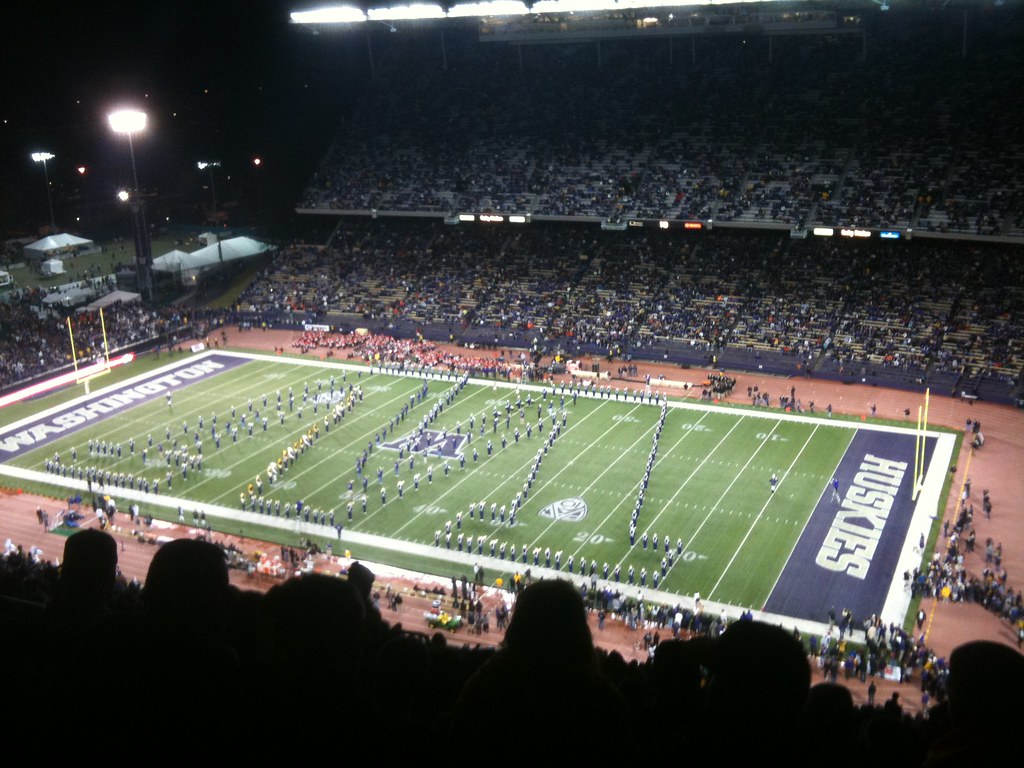
While “misery” may be a bit facetious to describe a program and fanbase which just experienced its most successful season in recent memory, there is little doubt that nothing has gone UW football’s way since kicking off the national championship game on January 8th. In the span of a week, UW lost the national championship game, its coaching staff, and countless starters on offense and defense—with many lost to the depths of the “transfer portal.” Even a few years ago, this turnover would be completely unheard of—but that is the current reality of collegiate athletics. However, recently proposed Washington State legislation may make it easier for UW to recruit and retain prospective student athletes (PSAs) in the Name, Image, and Likeness (NIL) and transfer portal era.
Payment to the Players
“Nowhere else in America can business get away with agreeing not to pay their workers a fair market rate on the theory that their product is defined by not paying their workers a fair market rate . . . . The NCAA is not above the law.” Justice Kavanaugh’s concurring opinion in NCAA v. Alston (2021) signaled to the NCAA that they would likely lose any future antitrust challenges to their longtime ban on student athlete compensation. While the Alston decision was limited to education-related non-cash compensation, the NCAA quickly recognized the changing landscape and announced an interim NIL policy just nine days after the decision’s release.
To the distress of ex-collegiate athletes like Reggie Bush, the interim policy now allows student athletes to receive cash or non-cash compensation for the use of their NIL through activities like endorsements, signings, and appearances. But NIL agreements must still be based on the market value that each player brings to the deal—ostensibly prohibiting NIL agreements that are “pay-for-play” (compensation solely for playing sports at the university) or compensation that is contingent on enrollment at a particular school (known as a “recruiting inducement”).
The “Wild West”
Due to NIL and the introduction of the transfer portal in 2018 —which eliminated the requirement for players to serve a “year of residence” before becoming eligible after transferring schools—student athletes now have agency to move to schools where they will both play and earn more. Facilitated mostly through what are known as “NIL Collectives”—independent entities that pool the money of two or more influential supporters or alumni of certain institutions—student athletes now have legal access to the type of money that traditionally was reserved only for professionals (schools themselves are still prohibited from directly paying athletes for their NIL).
As House subcommittee chair Gus Bilirakis (R-Fla.) stated during an NIL hearing on January 18th, “the sudden transition to NIL has enabled a wild west environment where pay-for-play is rampant.” By NCAA rule, collectives are not only disallowed to contact or issue recruiting inducements to PSAs, but they also cannot communicate with coaching staffs or institutions regarding recruiting lists or watch lists. Florida State University’s football program, for example, was penalized by the NCAA earlier this year for coordinating an improper recruiting inducement worth $15,000 per month to a PSA. But despite reports of pervasive rule breaking by coaches, athletes, and collectives alike, this has been the only significant punishment dished out by the NCAA regarding NIL rules. As one anonymous Pac-12 football coach stated regarding conversations about pay-for-play deals with PSAs and their parents, “We’ll tell them those are against NCAA rules, but you know how it works… it’s basically NFL free agency money.” Colorado football coach Deion Sanders even publicly asserted in an interview “Fifty [thousand]!?…Fifty will get you a walk-on these days. … [A]in’t never seen nothing like it.” NCAA leaders have cited lack of evidence for not pursuing more cases concerning NIL violations. In reality, it is likely the murkiness of the interim policy, combined with the lack of a federal law and inconsistent state law, that makes it almost impossible for the NCAA to enforce its own laws on pay to play and improper inducement.
Ongoing Development of Federal and State NIL Laws
During the aforementioned January 18th hearing, Congressman Bilrakis proposed the FAIR College Sports Act, aiming to federally address the compliance and standardization issues in NIL by creating a nongovernmental oversight board that would dictate NIL rules. But despite some support by current student athletes, it also received significant pushback via the testimony of current UCLA quarterback and NIL star, Chase Griffin. For now, standardized federal legislation may still be a long way off.
While the NCAA announced proposed changes to the NIL interim policy to also address these issues, to date, collegiate institutions have mostly been guided by their own state’s laws for NIL compliance. Thirty-two states (not including Washington) have passed legislation largely modeled after California’s “Fair Pay to Play Act” passed two years prior to the Alston decision. The advantage of these laws in concurrence with NCAA interim policy comes down to one crucial aspect—many of them allow school personnel to work directly with students to facilitate deals without running afoul with state ethics laws. This provides a significant advantage in both recruiting and player development, as it allows coaches and athletics departments to “basically barter on behalf of athletes.”
Proposed Washington State Bill
In a tongue and cheek opening to a hearing for his proposed bill on January 16th, UW grad and State Senator Javier Valdez communicated the concern voiced to him by UW and WSU athletics administrators by saying, “[a]s much as I would love to have a bill about the transfer portal . . . this is actually about NIL.” The bill would amend the current ethics guidelines to allow state employees to directly communicate with student athletes about NIL opportunities and help organize NIL deals with collectives like Montlake Futures. Testifying in support of the bill, UW Chief Compliance Officer Kiley Strong noted, “[W]e want to avoid putting our student athletes at a disadvantage and to ensure that recruits want to continue competing at schools in Washington State.” During the hearing, UW reported that in 2023, 150 students disclosed NIL deals to the school.
Future of NIL?
NIL rulemaking and regulation is clearly still in flux. Countless issues all deserve their own debate: the legality of 501(c)3 NIL collectives; whether these unprecedented payments mainly to male athletes comply with Title IX; predatory NIL deals; the effect of transferring on preexisting NIL contracts; and whether student athletes should be considered employees. (e.g. a recent University of Alabama sophomore had to forfeit $1.5 million in PGA tour winnings due to his “amateur” status). The NCAA, the States, and the federal government all must wrestle with these problems going forward.One thing is certain: all student athletes deserve the opportunities that NIL presents. They pour their time, effort, and heart into representing their respective institutions. To quote Chris Mulick, the Washington State University representative who testified in support of the bill: “The star quarterback will always be found, but the tennis player may not be, and we think . . . this bill could really help us grow into that.” As of now the proposed legislation has passed to the Rules Committee for a second reading.
 Washington Journal of Law, Technology & Arts