Apple Gets New Encryption Patent as Apple v. FBI Feud Seemingly Comes to an End

appleBy Denise Kim

After the Federal Bureau of Investigation (FBI) announced on March 28 that it had successfully accessed the iPhone used by one of the gunmen in the San Bernardino terrorist shooting without Apple’s help, the Department of Justice (DOJ) is now officially dropping its case against Apple. Earlier, the DOJ’s motion for continuance halted the ongoing feud between Apple v. FBI. The DOJ filed the motion on March 21, 2016, one day before the court decided whether Apple would be forced to hack into its own system. In its memorandum of points and authorities, the DOJ claimed that on March 20, 2016, an “outside party demonstrated to the FBI a possible method for unlocking Farook’s iPhone.” After successfully unlocking the iPhone, the government asked the federal judge to vacate the disputed order. Continue reading

Can Kazakhstan Use the United States Legal System to Attack Free Speech?

laikrastis-respublika-63491024By Juliya Ziskina

The government of Kazakhstan has pursued one of its fiercest critics, the newspaper Respublika, with lawsuits and threats for fifteen years. But despite blocks, bans, and overwhelming distributed denial-of-service (DDoS) attacks, Respublika continues to publish on its websites, which critically report on the country’s affairs and provide a forum for discussion from the relative safety of servers hosted in the United States. Because Respublika’s site is blocked in Kazakhstan, the news service also posts its articles to third party sites, including its Facebook group.

Earlier this month, the Kazakhstan government had a major setback in its attempt to use the U.S. legal system to attack Respublika. A federal judge in California rejected Kazakhstan’s demand that Facebook turn over information about users associated with Respublika’s account on the social media site. The judge found that Kazakhstan lacked the appropriate judicial authorization to pursue such discovery, rejecting Kazakhstan’s claims that its Computer Fraud and Abuse Act (CFAA) lawsuit gave it free rein to obtain information about its critics. The CFAA is a federal anti-hacking statute that prohibits unauthorized access to computers and networks and was enacted to expand existing criminal laws to address a growing concern about computer crimes. It also allows civil actions to be brought under the statute as well. Continue reading

Apple Encryption Under Fire: Judge Says FBI Can Force Apple to Hack its Own Encryption Systems

passcodeBy Brennen Johnson

The fight is back on between Apple and the FBI over encryption technology. In June 2014, we first covered Apple’s move to encrypt iOS 8 phones that could stump even the FBI. But the FBI wasn’t happy about it. Last November, we covered how the FBI sought a court order to force Apple to develop a method for breaking the encryption on these phones with “brute force.” However, the phone in that case ran older software that Apple could simply unlock, iOS 5, so the FBI wasn’t able to use the case as a stepping-stone to win the fight over encryption.

But as of last Tuesday, February 16, the heat turned up when a Federal Magistrate Judge ordered Apple to provide the FBI with software and technical support to help crack an iPhone of one of the San Bernardino shooters. Authorities recovered the iOS 9 phone after a married couple, Rizwan Farook and Tashfeen Malik, shot and killed 14 people and wounded 22 others last December. After the judge issued the order, Apple CEO Tim Cook called the order a “dangerous precedent that threatens everyone’s civil liberties,” while other tech giants, like Google, stated their own support for Apple: Continue reading

Could the E.U.-U.S. Privacy Shield Provide Greater Protection to U.S. Citizens’ Personal Data?

kenzieo_picBy Mackenzie Olson

The E.U.-U.S. Privacy Shield promises greater privacy protection for E.U. citizens’ personal data, but it provides no such assurances to U.S. citizens—even though consumers have become increasingly concerned about how companies use their personal information. However, as companies reconfigure their current privacy protocols to satisfy these new standards, U.S. citizens could realize a windfall.

In Europe, privacy is considered a fundamental right, though it is not in the U.S. Data protection safeguards are included in the E.U.’s charter, but there is no U.S. federal law that establishes a right to privacy. The Safe Harbor data transfer agreement of 2000 between the U.S. and E.U. previously dictated how companies could satisfy the heightened privacy requirements due their E.U. customers’ personal data. However, Safe Harbor is now defunct. In October 2015, the European Court of Justice struck down the agreement because it failed to protect E.U. citizens from U.S. government surveillance. Ever since Edward Snowden’s 2013 document leaks revealed details about the National Security Agency (N.S.A.)’s intelligence operations, Europeans have been concerned about how U.S. intelligence uses their personal data. Though the European Commission and U.S. Department of Commerce are still developing the details of the Privacy Shield and its text, officials state that an agreement should be reached by the second part of February of this year. Continue reading

London Calling: Will 10 Downing Street Be Listening?

ukBy Jeff Bess

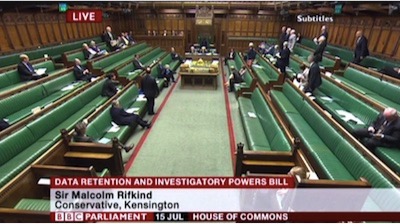
As the debate over the appropriate extent of – and necessary limits to – government surveillance rages on in the United States, other nations are looking to expand their own powers to monitor the electronic communications of their citizenry. Chief among these is the United Kingdom, whose parliament is currently considering passage of the so-called “Investigatory Powers Bill,” which would authorize a whole host of new tactics for monitoring citizens’ Internet use and would also require compliance from the large Internet companies that possess troves of user data. Continue reading