 By Brennen Johnson
Last week, the Ninth Circuit Court of Appeals handed down its decision in Multi Time Machine, Inc. v. Amazon.com, Inc.. Although the case doesn’t deal with time travel like the name might suggest (so disappointing!), the Court’s decision on whether the behemoth online retailer’s search results could have violated the watch manufacturer’s trademark certainly is interesting. In a two to one decision, the panel of three judges decided that Amazon might have violated Multi Time Machine’s (“MTM”) trademark by displaying competitors’ watches when online customers searched for a particular MTM model.
So how is this interesting? Let’s paint this case in the terms used by Judge Silverman in his dissent against the other two judges—If a patron walks into a restaurant and orders a “coke” and the waiter responds, “We carry Pepsi,” has the restaurant infringed on Coca Cola’s trademark? The majority’s decision suggests that the restaurant might have infringed, but that it is a question for a jury. Similar to the restaurant’s actions, Amazon, who is unable to carry MTM watches, displays the similar products of MTM’s competitors when the customer searched for MTM watches.
It seems absurd that Amazon could be liable for simply responding to requests for an unavailable product by suggesting other similar products. However, things get a bit more murky when you consider the root question that results in liability for this type of trademark infringement: could a reasonable person be initially confused by the search results and believe that the watches displayed on Amazon’s page were somehow affiliated with MTM? If so, then customers might consider buying the competitors’ watches based on the reputation of MTM’s trademark, and both Amazon and the competitor would unfairly profit from MTM’s hard work in building a well-respected business.
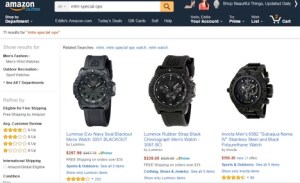
So, how might Amazon’s search results confuse a customer? Well, in this author’s opinion, only by being a pretty thick dunce. The law requires that the results be confusing to a “reasonably prudent consumer,” and in my book, the poor dunce who gets confused by these search results doesn’t quite make the cut. Like the district court that first considered the case and Judge Silverman (who dissented from the majority’s opinion), I believe that the results are so clearly labelled that no reasonable mind would think that they were somehow affiliated with or originated from MTM. But you don’t have to take my word for it. You can check out the image in the thumbnail above or click here to see for yourself.
The majority opinion reaches a different opinion by determining that the text “MTM special ops” which remains displayed in the search box at the top is sufficient to confuse customers about who manufactured the products. The majority explained in its opinion that, although the displayed results were each clearly labeled as the product of a different company, the clarity of the page’s layout as a whole created a legitimate question of whether or not it might confuse a customer about the origins/maker of the displayed products.
As an additional note that online retailers should consider taking to heart, the majority said when reaching its conclusion, “A jury could infer that the labeling of the search results, and Amazon’s failure to notify customers that it does not have results that match MTM’s mark, give rise to initial interest confusion.” If an online retailer wants to avoid this whole debacle, the cleanest method would be to spell it out when none of the products it provides meet the exact product description typed into the search bar.
 By Vijay Kumar
 By Robin Hammond


 Washington Journal of Law, Technology & Arts