
The Trademark Games: When Should Athletes Start Playing?

By: Alexander Tranquil

In the early 2000s, it felt like personal trademarks in athletics were reserved for the select few that attained superstardom. With distinguished names like LeBron James, Tiger Woods, Roger Federer, and Cristiano Ronaldo coming to mind, possessing a personal trademark meant that an athlete had reached the pinnacle of their sport. However, this yardstick of athletic success appears to be shifting with the advent of name, image, and likeness (NIL) rights in college athletics. In the now-famous NCAA v. Alston decision, the Supreme Court found that the denial of education-related benefits for student-athletes violated federal antitrust laws, paving the way for athletes to profit off their NIL rights through endorsements, merchandising, and licensing deals. With some college athletes now making millions of dollars a year through NIL, several have taken the leap into branding by registering trademarks with the United States Patent and Trademark Office (USPTO). Currently, the bulk of these trademark applications are filed by colleges’ top NIL earners, but this raises the question: should less-famous athletes follow their lead, making ownership of trademarks the new norm in college sports?

Ultimately, registering a trademark with the USPTO represents an additional or auxiliary protection for athletes looking to profit off their NIL rights. In every U.S. state, an athlete’s NIL rights are already protected under state right of publicity laws or, if unavailable, the common law tort of appropriation. While these existing protections may vary in scope, both the right of publicity and the tort of appropriation provide financial remedies to individuals when their name, image, identity, or likeness is used without permission for commercial benefit. For college athletes looking to leverage their fame into new NIL deals, legal protection over their identity is critical. Ultimately, these existing protections allow them to control where and how their likeness is used, protecting their NIL profits by preventing false endorsement, advertisement, and sponsorship. Ever wonder why EA Sports had to stop making their popular NCAA sports games? Under the right of publicity, courts found that EA Sports alluded to college athletes in the game, failing to sufficiently transform the players’ identities

In this way, trademark law and existing right of publicity laws protect against the same wrong: infringing use. Like the right of publicity protects against unauthorized uses of an individual’s NIL, a trademark protects any word, phrase, or symbol that a party uses to identify their products. When an athlete registers a trademark with the USPTO, it grants them nationwide ownership rights over the mark, providing consistent legal protection in every U.S. state against unauthorized uses of the mark by third parties. But since the focus of athletics is on the athletes themselves, many personal trademarks concentrate on the athlete’s name, signature, personal logo, or catchphrase. Inherently then, personal trademarks, like the right of publicity, protect name, image, and likeness rights in the commercial sphere. For example, former Heisman Trophy-winning quarterback Johnny Manziel was able to secure a settlement by raising both trademark infringement and right of publicity claims against an infringing party selling “Johnny Football” labeled merchandise.

While Johnny Football may have had the means and motivation to apply for a trademark, still, filing a trademark may not be practical for all college athletes. Specifically, seeking trademark protection requires a party to apply, register, and maintain their registration with the USPTO. This can be both a costly and labor-intensive process. Not only must an applicant show that their mark is distinct from other registered trademarks, but, before registration, they must establish use in commerce. This requires the applicant to adopt a proactive, business-minded strategy, showing that their mark has been actively used in connection with the sale of a good or service. Further, between application and attorney’s fees, athletes can expect to pay anywhere between $1,500 – $4,000 to register a trademark. Although not terrifically expensive, this is not a drop in the bucket for most college athletes, especially if, like Paige Bueckers or Olivia Dunne, your trademark eventually gets denied by the USPTO. 

Furthermore, assuming an athlete can obtain a trademark, they may be frustrated with the scope of its protections. Overall, trademark law is constrained by the likelihood of confusion doctrine. This doctrine requires the plaintiff to not only show that consumers are likely to associate an infringing mark with the plaintiff’s trademark, but also demonstrate that the infringing product is sufficiently related to the plaintiff’s to induce confusion. In contrast, the right of publicity offers a far broader scope of protection. For example, in White v. Samsung, Vanna White, the famous hostess of “Wheel of Fortune,” prevailed on a right of publicity claim after Samsung ran a commercial featuring a robotic replica of her turning letters on a TV set. Here, no infringing trademark was used, however, the Ninth Circuit found that the right of publicity “does not require that appropriations of identity be accomplished through [any] particular means,” thus widening the scope of identity misuse to include the commercial use of another’s likeness. In fact, some critics now argue that the rights afforded under the right of publicity have “swelled [] to the point [that] virtually any reference to an individual that brings financial benefit to someone else qualifies as a violation of the right of publicity.

So, with these shortcomings of trademark law, why then are trademarks attractive to athletes? Because they have the opportunity to build a brand. Trademarks identify the source of a product, and, therefore, an athlete’s mark can quickly draw attention from fans that want to be associated with a particular player. In this way, personal trademarks engage the public, facilitating future marketing opportunities, maximizing NIL profits, and promoting the sequential growth of an athlete’s brand. With every athlete’s dream of becoming the next Michael Jordan with his immortal Jumpman logo, ultimately, trademarks allow an athlete to cultivate an image and develop their own unique identity. Recently, we have seen Shedeur Sanders roll out apparel featuring his signature ‘dollar-sign squared’ mark that, at least in part, allowed him to gain a strong following and led him to be the first college football player endorsed by Nike
Still, Sanders’s success and his designation as the top NIL earner highlights the trademark dilemma: balancing the pros and cons of trademark protection often hinges on an athlete’s popularity and their following. Overall, athletes should consider filing a trademark application when their names start to take public recognition. At this point, the potential for significant brand growth provided by a trademark is likely to offset the potential headaches of developing a business strategy and registering a trademark. Unfortunately, for the many college athletes that are not top NIL earners, the limited benefits may not justify the time, effort, and costs associated with pursuing trademark protections.
Ready, Set, Go: Navigating the Race to Trademark on Social Media

By: Penny Pathanaporn 

With the rise of fast-paced social media platforms like TikTok, it’s no surprise that viral trends come and go just as swiftly. For example, in May 2023, a controversial viral trend called “Girl Dinner” circulated all over TikTok. Across many social media platforms, users documented meals consisting of an arbitrary combination of leftovers and snacks, dubbing them “Girl Dinner.” 

This past June, another viral trend—“Brat Summer”—emerged following the release of Charli XCX’s album “Brat.” Users across social media platforms used the term “Brat Summer” to describe an aesthetic or a lifestyle that embraces bold self-expression, a trait endorsed by Charli XCX herself

On the surface, viral trends may appear trivial. Social media users might derive joy from participating in these trends without much thought about who actually created them or whether they can even be owned. But, in reality, creators of viral trends are often faced with an uphill battle of obtaining legal protection for their creations through trademarks. Trademarks, which are words, symbols, or designs used to identify goods, help prevent other people from profiting off a creator’s work without permission and from tainting the reputation of a creator’s brand

The Latest Viral Trend: “Very Demure, Very Mindful”

This past summer, TikTok creator Jools Lebron created a viral trend known as “Very Demure, Very Mindful.” On August 2, 2024, Lebron published a TikTok video titled “How To Be Demure at Work.” In the video, which has now amassed more than 52 million views, Lebron states: “You see how I come to work? Very demure . . . I do my makeup . . . I do a little braid . . . Very demure. Very mindful.”  

Following her first video, Lebron documented herself engaging in ordinary activities that she describes as “demure” and “mindful,” such as going to the salon or deboarding a plane. Although these terms are initially equated with endearment or modesty, as the trend caught on, TikTok users began using the terms in a more ironic fashion

Despite the virality of her videos, Lebron soon faced issues with obtaining legal protection for her work. On August 20, 2024, a man named Jefferson Bates, who did not create the “Very Demure Very Mindful” trend, submitted a trademark application for the phrase at the United States Patent and Trademark Office (USPTO). 

On August 29, 2024, Lebron rushed to file a trademark application for her viral creation at the USPTO. However, by that point, at least three other people had already submitted trademark applications for the very same catchphrase. Like Bates, these individuals did not create the “Very Demure Very Mindful” trend. 

U.S. Trademark Law: A Silver Lining 

There is still a silver lining for Lebron. Although just about anyone can file a trademark application for a phrase at the USPTO, filing an application does not guarantee ownership over the trademark. 

First, for a phrase to be successfully registered as a trademark, the registrant must use the phrase for a commercial purpose. For example, if an individual uses the phrase on a product or ties the phrase to a service, this can qualify as commercial usage. Under U.S. trademark law, those who first utilized a phrase for a commercial purpose may be able to amass trademark rights and have priority over those who first filed a trademark application.  

After going viral, Lebron partnered with multiple companies such as Lyft and Verizon, using her viral catchphrase to help promote these famous brands. These partnerships may work in Lebron’s favor in her fight to trademark the catchphrase since these brand deals could be evidence of commercial use. 

Second, the USPTO can reject trademark applications based on false associations. In other words, if the phrase that has been applied for is falsely connected with a person, the application may not be approved. For example, the Trademark Trial and Appeal Board denied Bang Energy’s application to trademark the words “Purple Rain” due to its false association with the artist Prince. Prince’s album “Purple Rain” is so culturally significant that the general public would automatically associate the words “Purple Rain” with the artist’s brand rather than Bang Energy. 

Like the Bang Energy case, there is a possibility that trademark applications for “Very Demure, Very Mindful” may be rejected. Lebron’s legal team may be able to argue that, because the public strongly associates Lebron’s identity with the “Very Demure, Very Mindful” trend, permitting individuals like Bates to trademark the catchphrase would fall under the false association doctrine.  

Afterall, unlike the “Girl Dinner” trend—which saw social media users partaking in the trend without associating the creator with the catchphrase—Lebron became the face for the “Very Demure, Very Mindful” movement. Lebron even appeared as a guest on Jimmy Kimmel live to promote her catchphrase, and was invited to attend the Democratic National Convention, most likely due to her popularity amongst the younger generation. 

Lastly, under U.S. trademark law, the USPTO can also reject trademark applications for phrases that are “widely used message[s]” and are not directly related to the applicant. Lebron’s trademark application could be successful since TikTok users seem to consider the viral catchphrase “Very Demure, Very Mindful” to be a part of Lebron’s personal brand. Nevertheless, the USPTO has the final say and may ultimately render a decision that could swing either way. 

Implications of the Race to Trademark in the Online World 

Although Lebron has a strong case against the individuals who have attempted to trademark her creation, Lebron’s struggle to hold on to something that should have already been hers represents a problem that many small creators face. Small creators typically lack the legal knowledge and resources to know when to take swift action to protect their work and profit from their own creations.  

Despite the silliness of viral trends, these creators still deserve legal recognition and protection for their work. For Lebron, her catchphrase represents a life-changing miracle. Because of her newfound success resulting from the “Very Demure, Very Mindful” trend, she was able to “finance the rest of [her] transition.” Accordingly, it is important for small creators and influencers to be educated on the rights that they have to their online content, which for many is how they ultimately earn a living.  

Have Trademark Protections Gone to the Dogs?

By: Nick Clawson

Spuds Mackenzie was not without his share of controversies as the face of Bud Light from 1987 to 1989, but at least the “original party animal’s” antics never prompted Supreme Court intervention. Unfortunately, the same cannot be said for VIP Products (“VIP”) and their “Bad Spaniels” chew toy. The Supreme Court recently granted the petition for a writ of certiorari in Jack Daniel’s Properties, Inc. v VIP Products LLC, a case that will review the 9th Circuit’s application of one of trademark law’s most well-known cases. The outcome at the nation’s highest court next year could result in an expansion of the fair use defense in trademark infringement cases, as well as new challenges for trademark owners moving forward.

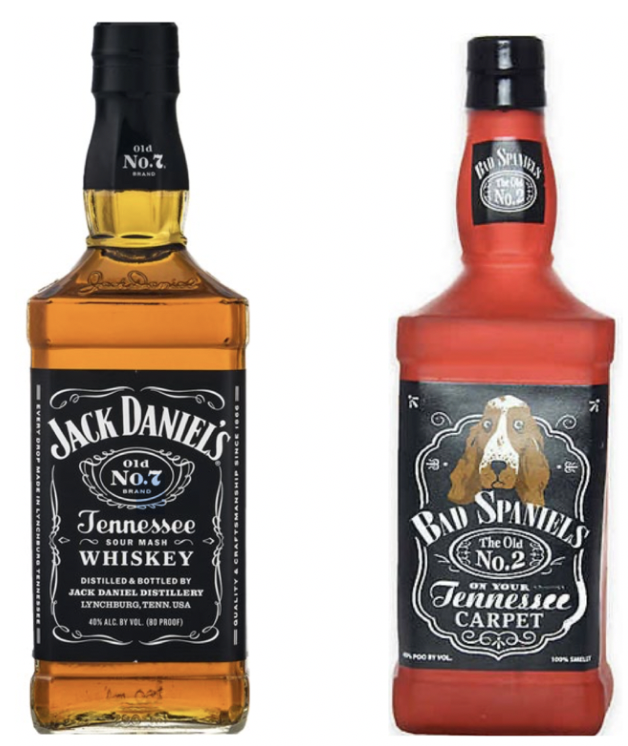
VIP Products, a manufacturer of dog toys, sells a plastic squeak toy that resembles a bottle of Jack Daniel’s Old No. 7 Black Label Tennessee Whiskey. VIP’s “Bad Spaniels” toy incorporates dog puns and “poop humor” to distinguish the two products, as depicted below. Per court filings, the dog toy also comes with a tag stating that the product is “not affiliated with the Jack Daniel Distillery” (not pictured). 

After receiving a cease-and-desist letter from Jack Daniel’s in 2014, VIP filed the present action, seeking declaratory judgment that the dog toy did not infringe upon or dilute the distiller’s trademark. VIP alleged that the dog toy constituted both nominative and First Amendment fair use. While differing slightly in application and analysis, both would provide an affirmative defense to an infringement claim.

Nominative fair use involves a party’s use of a trademark in a descriptive manner to refer to the trademark and its associated goods or services. The Ninth Circuit Court of Appeals outlined the requirements for the nominative fair use defense in the 1992 case New Kids on the Block v. News America Publishing, Inc., which would allow VIP to avoid liability for infringing use of an identical trademark if they could demonstrate each of the following: (1) the product is difficult to describe or identify without using the trademark; (2) the use of the trademark is limited to the amount necessary to identify the product; and (3) nothing about the use of the trademark could suggest endorsement or sponsorship by the holder of the trademark. Such a nominative use would, by definition, not dilute the distiller’s trademark. 

First Amendment fair use, as applied to trademarks, protects the right of an alleged infringer to use a trademark (or, often, a humorous variation thereof) for creative expression. While courts generally grant greater latitude when the use is purely creative, the Ninth Circuit notes in this case that parodying a trademark for a commercial product is not inherently dispositive. Courts generally review the case facts to determine whether (1) the use is actual parody, and (2) whether the use is likely to cause confusion for consumers. Whether the mark is diluted would depend upon the outcome of this second factor–if the likelihood of confusion is low, a trademark is less likely to be diluted by the parodic use.

The district court rejected both of VIP’s fair use defenses. First, the district court held that, because VIP did not use the identical Jack Daniel trademark or trade dress in its toy, it could not be considered nominative fair use. Second, the district court held that VIP could not receive First Amendment fair use protections because the manufacturer used Jack Daniel’s distinctive trade dress to promote a commercial product, which traditionally weighs against a finding of fair use. Furthermore, the district court found that the distiller’s brand had been tarnished by the squeaky look-alike and granted partial summary judgment to Jack Daniel’s.

The Ninth Circuit Court of Appeals, however, viewed two of VIP’s arguments much more favorably. While affirming the lower court’s holding regarding nominative fair use (reiterating that nominative fair use defense did not apply where a mark was “not identical”), the circuit court held that the dog toy constituted an expressive work deserving of First Amendment fair use protections. To reach this conclusion, the Ninth Circuit attempted to balance artistic expression with trademark rights utilizing several precedential tests. First, the Lanham Act, which governs trademarks at the Federal level, imposes liability upon those who create a likelihood of confusion with a valid, protectable trademark. The court notes, however, that this test fails to fully account for the public’s interest in free expression and thus is only applicable when the plaintiff can establish one of the two requirements set forth in Rogers v Grimaldi—a landmark trademark case from 1989 out of the Second Circuit Court of Appeals. In the Ninth Circuit, the Rogers test requires the plaintiff to show that the defendant’s use of the mark is either (1) not artistically relevant to the underlying work or (2) explicitly misleads consumers as to the source or content of the work. 

The Ninth Circuit held that the VIP’s chew toy, while “not the equivalent of the Mona Lisa,” did constitute artistic expression, commenting on corporations (like Jack Daniel’s) that take themselves and their brand “too seriously.” The court further held that, because VIP’s chew toys conveyed an artistic expression, its use of the Jack Daniel’s trade dress did more than propose a commercial transaction, making the use noncommercial overall. Therefore, the use did not dilute the distiller’s trademark. The circuit court remanded the case back to the lower court for a determination of whether Jack Daniel’s could satisfy either prong of the Rogers test. Jack Daniel’s appealed this decision.

Next term, the Supreme Court will take on two questions arising from this decision: 

(1) Whether humorous use of another’s trademark as one’s own on a commercial product is subject to the Lanham Act’s traditional likelihood-of-confusion analysis, 15 U.S.C. § 1125(a)(1), or instead receives heightened First Amendment protection from trademark-infringement claims; and 

(2) whether humorous use of another’s mark as one’s own on a commercial product is “noncommercial” and thus bars as a matter of law a claim of dilution by tarnishment under the Trademark Dilution Revision Act, 15 U.S.C. § 1125(c)(3)(C).

The answer to the first question will hinge upon the Ninth Circuit’s holding that VIP’s dog toy constituted artistic expression. While it may sound bizarre, it is supported, albeit indirectly, by a 2007 decision out of the Fourth Circuit Court of Appeals—Louis Vuitton Malletier S.A. v. Haute Diggity Dog, LLC.  The defendant in this case produced a line of dog toys based on the famous luxury brand’s name and logo (aptly named “Chewy Vuiton”). The Fourth Circuit held that the toys constituted a successful parody that was similar to, yet clearly distinct from, the registered mark. Given the First Amendment protections granted to parody, the court then applied its own likelihood of confusion test (the Pizzeria Uno test, analogous to the Rogers test), holding that the factors substantially favored the dog toy manufacturer and that any likelihood of confusion was minimal. Furthermore, the court held that the toys did not dilute the fashion house’s mark by either dilution or tarnishment. Regarding dilution, the court noted that the similarities found in the toy were not close enough to destroy the parodic message in the product or lead consumers to believe that they were a source of Louis Vuitton merchandise. Regarding tarnishment, the court held that the fashion house had not provided any evidence that would support a finding that the dog toys had harmed their illustrious brand.

Several concerned parties have already filed amici curiae briefs in support of Jack Daniel’s, including the American Intellectual Property Law Association, the International Trademark Association, and the American Craft Spirits Association. Many note that the Rogers test has been historically limited to artistic works, and that its application to commercial products is misguided. Their concerns are certainly valid–if the Ninth Circuit’s approach is adopted in this case, trademark owners will likely have a more difficult time bringing infringement actions against parodies of their marks and trade dress. However, the circuit court’s approach does not appear to be so limiting as to grant potential infringers free reign over registered marks under the guise of protected parody. This case will likely be one in which the Supreme Court steps in to clarify and elaborate upon the various circuits courts’ decisions, rather than a major upheaval of trademark law and free speech protections.