With the Paramount Decrees gone, that opened the way for a studio like Sony Pictures to purchase the Alamo Drafthouse chain, completely legally. Sony is the first major studio to make this move, but not the only one thinking about it. Amazon has been rumored to be eyeing the theater chain AMC for a future buyout. While maybe not a monopoly in the same way as in the old Hollywood system, some believe cinema is once again becoming a monopoly, with how many studios are buying up and acquiring other studios, making the entertainment we consumed controlled by fewer and fewer companies. Movie studios being able to buy up theaters and theater chains could contribute to that, once again giving them control over distribution and exhibition of the films that we watch.
The internet has made it incredibly easy for people to find, copy, and paste other’s photography. But what are the legal protections available for photographers? How likely is it that artists, well-known or novice, can find every unlawful use of their copyrighted work? In a groundbreaking case, photographer Scott Hargis made history with a record-setting damages award for the unauthorized use of his photographs.
Statutory damages are damages awarded by a judge or jury in a copyright infringement suit to a copyright owner. The amount of statutory damages awarded to a copyright owner when copyright infringement is found depends on whether the infringement is considered innocent or willful. A court may find innocent infringement when the defendant, or infringer, can demonstrate they were “not aware and had no reason to believe that the activity constituted an infringement.” However, innocent infringement cannot be found when there was a proper copyright notice on the work, as found in Hargis v. Pacific Senior Living Management.
Protection of Photographers Works in the Growing World of AI
In 2019, Copytrack, a global company that enforces image rights, investigated how many photographer’s images are stolen on the internet. They estimated that more than 2.5 billion images are stolen daily. Hargis v. Pacific Senior Living Management demonstrates how seriously U.S. courts view the infringement of photographs and the financial impact unlawful uses of copyrighted works can result in. Currently, with the ever growing world of AI, more lawsuits are popping up, with claims that AI companies are infringing on their copyrights by using the owner’s images to train AI Models.
Hargis v. Pacific Senior Living Management sets a powerful precedent for protecting photographers’ right in the growing digital era and the severe financial consequences of infringement, especially willful infringement. Photographs, and other copyrighted works, are exposed to misuse and as courts began to evaluate AI’s use of copyrighted material, the lessons from Hargis v. Pacific Senior Living Management may play an instrumental role in decision making and serve as a warning to infringers.
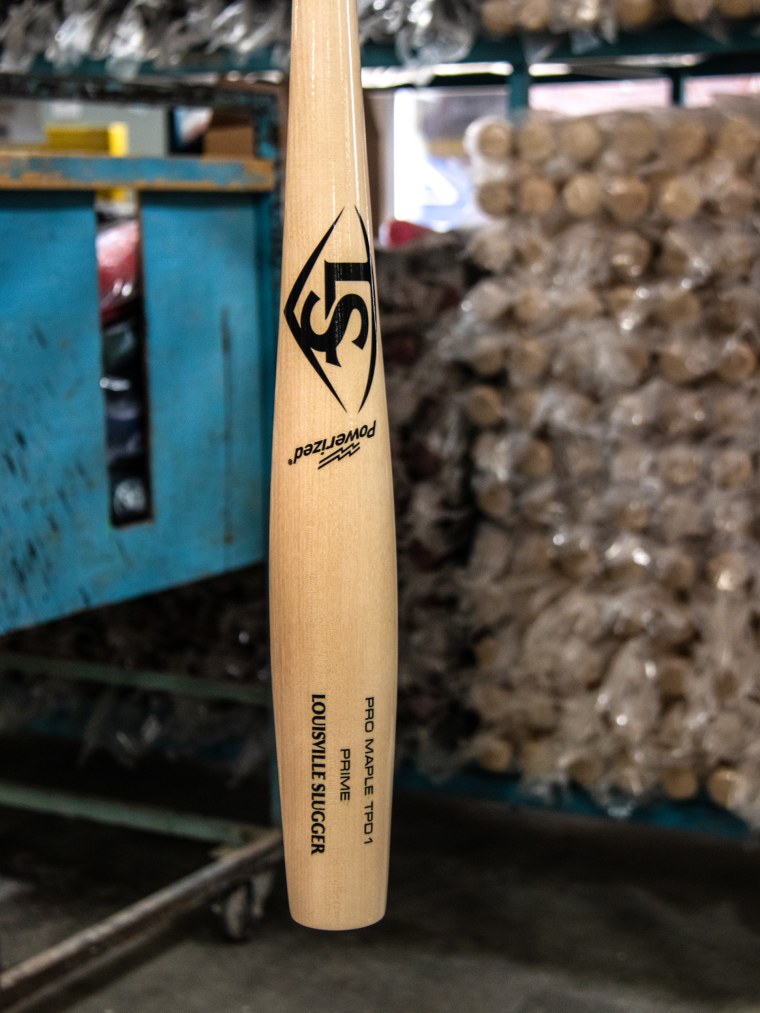
On March 29th, the New Yankees beat the Milwaukee Brewers 20-9, hitting a franchise record nine home runs, including three home runs on the first three pitches of the game. However, the story that took the baseball world by storm was not the franchise’s single-game home-run record, or the three-game sweep in which the Yankees hit 15 home runs and scored 36 runs. Instead, the national spotlight was on the new bowling-pin shaped bats that several of the Yankees players were using. These bats, dubbed “torpedo bats” have dominated baseball news for the first two weeks of the season, and are likely to impact the intellectual property world as well.
What Are Torpedo Bats
Torpedo bats differ from regular bats because the part of the bat with the widest diameter is lower on the bat. The lower sweet spot is meant to distribute the most mass of the bat to the “sweet spot”. The rationale for this change was very simple: put more wood in the area where the ball usually hits the bat. In the words of MIT physicist Dr. David Pritchard, “When you look at the design of a classic baseball bat, the physics just don’t add up. When the ball comes in and hits the sweet spot, it bends the bat so some of the energy goes into bending the bat.” With more wood in the sweet spot, there will be less energy lost by the bat bending back.
Who Created the Torpedo Bat
Credit for the creation of the torpedo bat goes to another MIT physicist turned baseball coach, Aaron Leanhardt. Leanhardt is currently a field coordinator for the Miami Marlins but previously worked as a Minor League hitting coordinator for the Yankees. Before beginning his career as a coach, Leanhardt earned a PhD in physics from MIT and was a physics professor at the University of Michigan.
Leanhardt first began designing and testing the torpedo bat while working for the Yankees. In 2024, he first introduced the torpedo bat design to some Yankees players, including star hitter Giancarlo Stanton. There are even pictures of Stanton using a torpedo bat in the 2024 World Series. However, it was not until the opening weekend of the 2025 season, following the Yankees 3-game drubbing of the Milwaukee Brewers, when social media caught wind of the torpedo bats, and their popularity began to soar.
In the two weeks following the introduction of torpedo bats to the mainstream, baseball bat companies received thousands of preorders for torpedo bats. Two notable bat companies, Marucci and Victus, had models of the bats on their websites within a few days, trying to capitalize on the newest trend and had record sales.
The requests for torpedo bats are also coming from MLB teams themselves. Hillerich & Bradsby, the company that is credited for creating the Yankees’ torpedo bats, received an influx of orders from MLB teams directly asking for torpedo bat models. Within a few days, there were MLB players across the league using torpedo bats, and it will be interesting to see if their popularity continues to grow among players.
Can Torpedo Bats Be Patented
Whenever there is a popular new invention, one of the first questions is whether it is eligible to receive patent protection. Patents offer inventors “the right to exclude others from making, using, offering for sale, or selling” their invention in the United States. The two main types of patents available to inventors are utility patents and design patents. Utility patents are granted to inventors of new and useful processes or machines. Design patents are granted to inventors of new, original, and ornamental designs for an article of manufacturing.
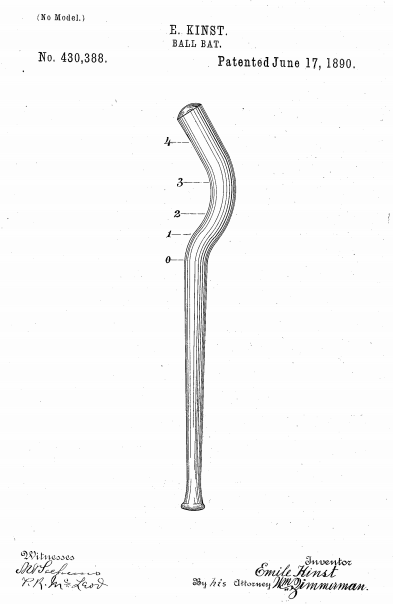
Although the general shape of baseball bats has stayed nearly the same for over 100 years, there have been some modifications that have received patents. The first, and goofiest, example of these was the banana bat. Banana bats, which had a curved barrel, received a patent in 1890, despite not catching on in professional baseball (for obvious reasons).
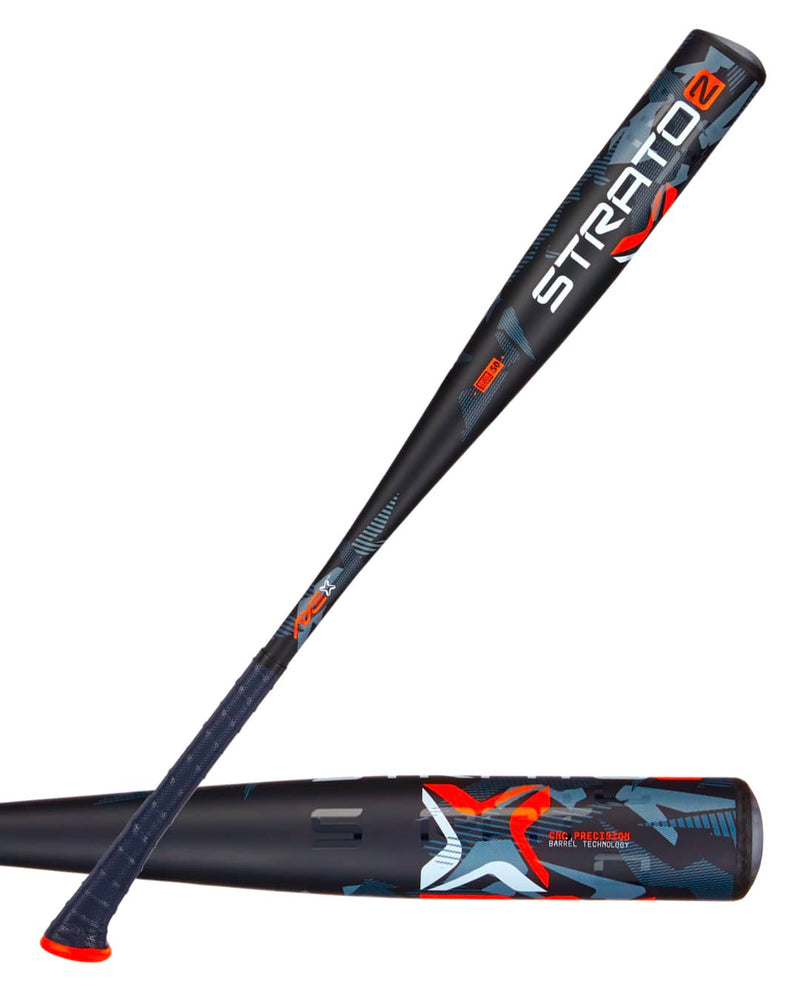
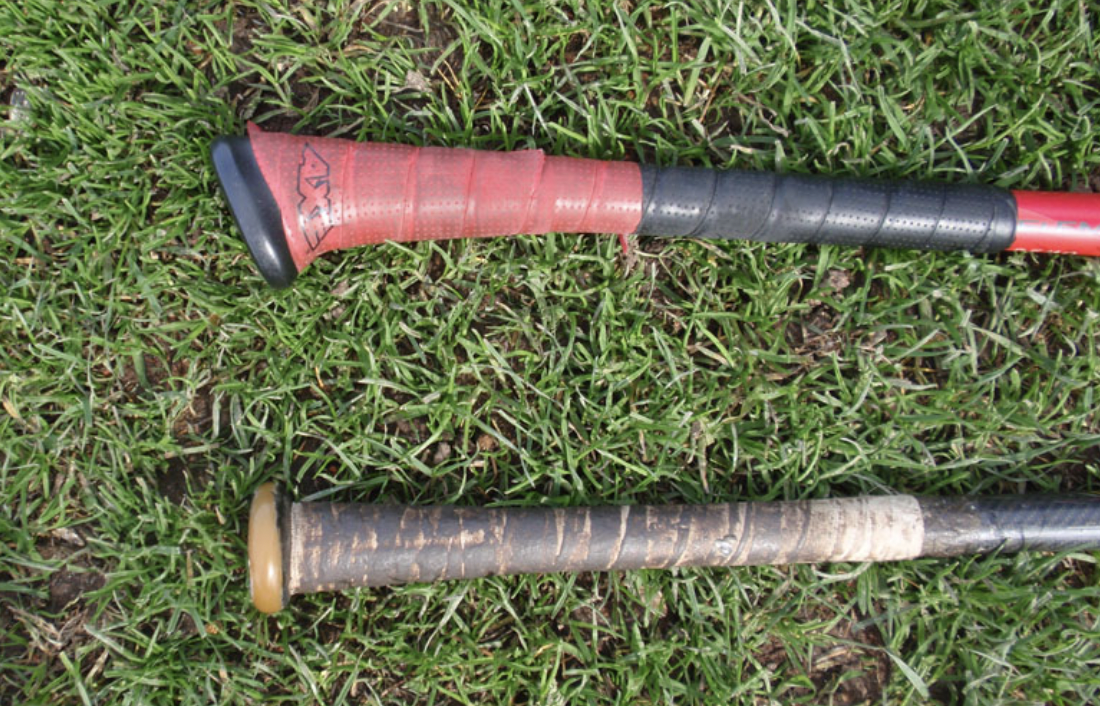
Based on the axe bat precedent, it seems like torpedo bats could eventually receive a design patent. Interestingly, Bob Hillercih, the vice president of the aforementioned bat manufacturer Hillerich & Bradley, does not believe that torpedo bats are eligible for a patent because the changed design for the bat is just a change in the shape.
However, based on the description of design patents, this does not seem to be true.
There are two factors in determining whether a design qualifies for a design patent. First, the design must be an integral aspect of the product that cannot be separated. The difference in barrel placement is the integral aspect of the design of torpedo bat, so it appears that this element would be met. Next, the design must have no bearing on the item’s functionality. The torpedo bat design would likely meet this element, because the new design does not alter the baseball bat’s functionality. Rather, the torpedo bat just changes the amount of wood at the point of contact. Although some Yankee players had early success with the torpedo bats, it does not, on its own, make it easier to hit home runs. Torpedo bats are used just like regular baseball bats, the only difference is that it has a unique ornamentation with the location of the largest part of the ball being moved.
Design patents also require that the new patent not be obviously derived or resembling other designs. While there may be an argument that the torpedo bat resembles other bats, the same argument could have been used for the axe bat handle resembling a baseball bat handle or an axe handle. When viewing all of these elements, and comparing torpedo bats to the patent that the axe handle received, there is a possibility that torpedo bats could receive a design patent, if Leanhardt chooses to do so.
Conclusion
Time will tell if torpedo bats are the next big thing in baseball, or if they are just another banana bat. While more players have begun using them, other players tried them but returned to their old bats or refused to use them altogether. Regardless of their long-term impact on baseball, it will be very interesting to track whether the United States Patent and Trademark Office determines that torpedo bats can be patented. While historical precedent makes it seem like torpedo design can be patented, there seem to be concerns from people in the bat manufacturing business, who also may not want the bat design to be patented so they do not have to license the design to use it.
Remember the start of the Covid-19 pandemic? Like myself, many Americans turned to TV to find comfort, and, in those first few surreal weeks, many found themselves watching one particularly enthralling, peculiar, and utterly outlandish story: Tiger King. Tiger King is a Netflix documentary series released in March 2020, which details the increasing tensions between rival big cat eccentrics, eventually culminating in Joe Exotic’s arrest in a murder-for-hire plot of rival Carole Baskin. While Tiger King initially generated massive media attention, it has more recently been the subject of intense copyright litigation.
If you are unfamiliar with this story, Joe Exotic was an internet personality long before Tiger King. With a substantial presence on YouTube, the Netflix documentary heavily relied on video footage originally created by Exotic and his employees. The suit now at issue, Whyte Monkee v. Netflix, centers on Netflix’s use of a video that shows Exotic giving an eulogy at his late husband’s funeral. The video was originally shot by Timothy Sepi, an employee and videographer at Exotic’s Gerald Wayne Zoo. However, Sepi now claims he never gave Netflix permission to use his footage, thus forming the basis for his copyright infringement claim.
To understand the legal questions raised in Whyte Monkee, we must explore the interaction between copyright protections and the doctrine of fair use. Overall, copyright is a type of intellectual property that protects original works of authorship (i.e. paintings, photos, writings, movies) against use by others. However, authorship is a fairly low bar, requiring only a minimal level of creativity. If any creativity can be shown, copyright protections immediately attach when the work is fixed (published) in a tangible medium. As a result, recordings, much like Sepi’s home-video, are often considered copyrightable.
The fair use exception to copyright infringement allows a party to use a work without the permission of the creator if the copying is done for a limited or “transformative” purpose. While there are no hard and fast rules, courts will consider four factors in determining fair use: (1) the purpose and character of the use, (2) the nature of the copyrighted work, (3) the amount and substantiality of the portion used, and (4) the effect of the use on the market for the copyrighted work. Recently, courts have taken particular interest in the first factor, considering the significance of any changes made to the original while also assessing the purpose of the work.
The Supreme Court’s Warhol Decision
Recently, the Supreme Court issued a detailed analysis of this first factor in Warhol v. Goldsmith. Here, Warhol was sued for a series of silkscreen prints he created of Prince, which he based on a copyrighted image captured by Goldsmith. Considering the purpose and character of Warhol’s silkscreens, the Court clarified that it is no longer sufficient for a work to simply add “new expression” to the original; the key question is whether the work serves “a purpose distinct from the original.” While purpose is not necessarily limited, derivative works should comment on, criticize, or provide otherwise unavailable information to the original. Therefore, although Warhol added new artistic expression to the original, his work did not constitute fair use because its purpose and character aligned with Goldsmith’s––both works were licensed to media companies, merely being used “to illustrate a magazine about Prince with a portrait of Prince.” Thus, because Warhol’s work simply used Goldsmith’s image as a template for the same commercial purpose, it failed to seriously comment on, criticize, or add information to the copyrighted image.
Applying the Warhol Precedent
Following in the footsteps of Warhol, the Tenth Circuit overturned the district court’s decision in Whyte Monkee, relying on the purpose and character of the use. While the district court found Netflix’s use transformative as it incorporated the funeral clip into a broader narrative, the Tenth Circuit, citing Warhol, concluded that fair use requires the derivative work to serve a distinct purpose. Specifically, the court required the derivative work to critically comment “on the substance or style of the original composition.” With this backdrop, the court found that Netflix only used the funeral footage to show Exotic’s purported megalomania and showmanship. Accordingly, Netflix failed to seriously comment on the style of the video clip itself, instead using the video to “target[] a character in the composition.” Therefore, because Netflix used the funeral footage to detail Exotic’s life and not to comment on the style of the footage, the Tenth Circuit found that the first factor weighed against fair use.
In its initial decision, the Tenth Circuit severely narrowedWarhol’s definition of distinctive purpose, requiring a derivative work to critically comment “on the substance or style of the original composition.” While this was an important factor in Warhol, it is not the only relevant factor in examining the purpose and character of a new work. First, the Court in Warhol explicitly looks to purposes outside critical commentary to determine fair use. For example, the Court found that Warhol and Goldsmith’s works shared the same commercial purpose—both were used to “illustrate a magazine about Prince with a portrait of Prince.” Furthermore, the Court in Warhol notes that the “degree of difference” between the works is relevant in the fair use analysis, being weighed together with purpose to determine whether the derivative work is transformative. Ultimately, the Tenth Circuit seems poised to consider other factors in its analysis of the purpose and character of the use. Such a decision would better support filmmakers by providing them greater access to material as they attempt to capture many of the compelling narratives in our world today. As a result, Netflix should continue to assert that its use of the video serves to illustrate Exotic’s personality—distinct from Sepi’s purpose of simply commemorating the funeral. Further, Netflix should revive its district court arguments, claiming the documentary is substantially different from Sepi’s video because it continually interrupts this video with comments from the deceased’s mother and ties the video into the broader story arc to highlight Exotic’s character. Ultimately, these arguments mirror the Supreme Court’s focus in Warhol, offering the Tenth Circuit a precedential foundation to recognize a broader interpretation of transformative use.
Squishmallows were introduced in 2017 and went viral on TikTok and Instagram during the Covid-19 pandemic in 2021. People fell in love with these affordable and huggable plushies that are available in more than 3,000 different characters. Their unique sizes and colors provide comfort and joy for all ages and even serve a niche of Squishmallow collectors.
Warren Buffet’s investment company, Berkshire Hathaway, owns Alleghany Corporation which is the parent company of Jazwares LLC. Jazwares oversees Kelly Toys which is a leading toy manufacturer and the creator of Squishmallows. Squishmallows have seen its sales boom since 2021 and can be purchased in a variety of spaces, including in bulk at your local Costco. However, in January 2024, to offer “optimal hugging benefits” in light of Valentine’s Day, Build-A-Bear launched its Skoosherz line—a variety of collectible plush pillow-like toys.
Once the Sckoosherz line was released, Kelly Toys promptly filed a lawsuit in the Central District of California claiming that Build-A-Bear’s Skoosherz line infringes on Squishmallow’s trade dress because Skoosherz imitate Squishmallows’ “shape, face style, coloring and fabric.” Kelly Toys’ complaint alleges that Skoosherz “have the same distinctive trade dress as the popular Squishmallows, including: shaped fanciful renditions of animals/characters; simplified Asian style Kawaii faces; embroidered facial features; distinctive and nonmonochrome coloring; and velvety velour-like textured exterior.” It asserts that these similarities seek to “trick consumers” and has harmed the Squishmallows brand by “divert[ing] sales and profits from Kelly Toys to Build-A-Bear.” Kelly Toys is seeking unspecified damages and an injunction to stop the sale of Skoosherz. In Kelly Toys’ view, Build-A-Bear is intentionally copying the distinct physical characteristics and exterior appearance of Squishmallows to capitalize on Squishmallows’ international success.
Build-A-Bear has responded by filing its own complaint in the Eastern District of Missouri asserting that its Skoosherz line is merely an extension of its already existing line of animal toys. In Build-A-Bear’s view, Skoosherz merely imitates the popular plushies that Build-a-Bear has previously sold. For instance, Build-A-Bear claims that the Skoosherz Pink Axåolotl is merely an imitation of its original Pink Axolotl toy. The company is seeking a declaratory judgment stating that Skoosherz do not infringe on the Squishmallow trade dress and furthermore, that the Squishmallow trade dress is not even protectable under the Lanham Act. Build-A-Bear asserts that the Squishmallow trade dress lacks a consistent look and feel and shares characteristics with toys already present in the market. According to its complaint, “[i]f each aspect of the claimed trade dress were in fact protected trade dress, it would be virtually impossible for competitors to create alternative designs.”
Bearing a Squishy Future
Trade dress is a critical element of trademark law and serves to safeguard the goodwill of creators, the protection of consumers, and a competitive market. Although this dispute resides in the market of soft toys, it highlights a new perspective of trade dress law and application. If a jury trial is granted, Kelly Toys will likely rely on side-by-side comparisons to highlight the visual similarities between Squishmallows and Skoosherz as well as present consumer comments that have been made on Build-a-Bear’s social media account dubbing Skoosherz as “knockoff Squishmallows.” Although such evidence can support Kelly Toys’ infringement claims, it will still have the initial burden of proving that its trade dress is protectable.



 Washington Journal of Law, Technology & Arts