Hargis v. Pacifica: The Case with Potential to Shape AI’s Legal Future 

By: Miranda Glisson

The internet has made it incredibly easy for people to find, copy, and paste other’s photography. But what are the legal protections available for photographers? How likely is it that artists, well-known or novice, can find every unlawful use of their copyrighted work? In a groundbreaking case, photographer Scott Hargis made history with a record-setting damages award for the unauthorized use of his photographs. 

Introduction 

Hargis is an architecture and interiors photographer, living in the San Francisco Bay Area, with worldwide clientele. Hargis was hired by Atria Management Company to take photos of several senior living facilities. Another company, Pacifica Senior Living Management, then acquired the senior living properties from Atria and used 42 of Hargis’s photos depicting these properties on their website, without obtaining Hargis’ permission. Hargis’ agent informed Pacifica that those photo licenses were not transferable from Atria to Pacifica, and representatives of Hargis requested Pacifica to take Hargis’ images off of their website. However, Pacifica refused on multiple occasions, and Hargis brought suit against Pacifica for Copyright Infringement

Willful Copyright Infringement 

Statutory damages are damages awarded by a judge or jury in a copyright infringement suit to a copyright owner. The amount of statutory damages awarded to a copyright owner when copyright infringement is found depends on whether the infringement is considered innocent or willful. A court may find innocent infringement when the defendant, or infringer, can demonstrate they were “not aware and had no reason to believe that the activity constituted an infringement.” However, innocent infringement cannot be found when there was a proper copyright notice on the work, as found in Hargis v. Pacific Senior Living Management. 

Willful infringement does not require that the defendant have actual knowledge of their infringing actions. Rather, it is only required that there is a showing by a preponderance of the evidence that the infringer “acted with reckless disregard for, or willful blindness to the copyright holder’s rights.” If copyright infringement is found and determined to be innocent infringement, the statutory maximum is $30,000 per copyrighted work infringed upon. The statutory maximum for willful infringement is much larger at $150,000 per copyrighted work. However, even if willful infringement is found, the fact-finders must determine how much statutory damages should be awarded to the Plaintiff between the minimum of $750 (also the minimum for innocent infringement) and the maximum of $150,000 for willful infringement. 

Hargis v. Pacific Senior Living Management: $6.3 Million Jury Verdict 

Legitimate copyright infringement cases will often end in settlement instead of going to trial. However, in the case of Hargis v. Pacific Senior Living Management, Pacifica refused to settle leading to the largest jury verdicts for copyright infringement of photographs. The United States District Court, Central District of California jury found that Pacifica infringed on all 42 of Hargis’ photographs. the evidence supported a finding of willful infringement due to Pacifica ignoring Hargis’ request for payment and refusing to take the photos off the website for a year and half after the suit was filed. They found each infringement to be willful and asserted the maximum statutory damage amount of $150,00 for each of the 42 photographs, leading to a $6.3 million jury verdict

Protection of Photographers Works in the Growing World of AI 

In 2019, Copytrack, a global company that enforces image rights, investigated how many photographer’s images are stolen on the internet. They estimated that more than 2.5 billion images are stolen daily. Hargis v. Pacific Senior Living Management demonstrates how seriously U.S. courts view the infringement of photographs and the financial impact unlawful uses of copyrighted works can result in. Currently, with the ever growing world of AI, more lawsuits are popping up, with claims that AI companies are infringing on their copyrights by using the owner’s images to train AI Models.  

With the favorable results for Hargis and his images, willful use of copyrighted images has the potential to cost AI companies millions, maybe billions, as AI models need to see between 200-600 images of a particular concept before it can replicate it. Further, training a model from scratch, or fine tuning one, can still require thousands of data points. With heaps of data points and works used to train AI models, developers of these models could be on the hook for massive fines depending on how willful the use of the copyrighted work is found. How courts and companies will approach this problem in the future is unknown, however it has the potential to cause ripple effects in AI development.

Conclusion 

Hargis v. Pacific Senior Living Management sets a powerful precedent for protecting photographers’ right in the growing digital era and the severe financial consequences of infringement, especially willful infringement. Photographs, and other copyrighted works, are exposed to misuse and as courts began to evaluate AI’s use of copyrighted material, the lessons from Hargis v. Pacific Senior Living Management may play an instrumental role in decision making and serve as a warning to infringers. 

Erasing Ourselves: The Case for a U.S Right to be Forgotten

By: Jack Dorsey

A well-known adage about the internet is that once something is put online, it lives there forever. From your favorite celebrity’s regrettable social media posts, data you give to a website, to outdated news stories, the internet has been a place where information is permanently inscribed. But, what if there were measures in place that allowed our digital footprints to be erased? Today, a hyper accurate data profile is not just created from your online activity, but also from the physical spaces you occupy. In the physical realm, data is aggregated via your smart doorbell, coffee machine, car, and phone. These devices by themselves, or in conjunction with other devices, are tracking when you wake up, leave the house, and when you return home. Meanwhile in the digital realm, your browsing history, app usage, and social media activity construct a parallel version of you, one that reflects your preferences, routines, relationships, and beliefs. Together, both of these data streams have created profiles of the average person that may be more comprehensive than the identities we present in real life. These profiles may infer personal characteristics or behaviors not consciously known to the individual, based on predictive analytics, through which various entities can profit off of as data becomes more valuable

The European Union’s Stance on the Right to be Forgotten

In the European Union, the idea of the “Right to be Forgotten” became popular after the prominent, Google Inc. v. Agencia Española de Protección de Datos (AEPD), decision in 2014. The European Court of Justice held that under this concept, E.U. citizens have a right to remove or delete their personal information from search results, as well as from public record databases. In 2018, the European Union’s General Data Protection Regulation (GDPR) codified a similar concept of “Right to be Forgotten” through Article 17, explicitly granting individuals the right to request removal of personal data and information from data brokers, websites, and search engine providers. Individuals could request erasure of their personal data when their consent was withdrawn, processing of their data was unlawful, or when that data was no longer necessary. 

The United States’s Stance on the Right to be Forgotten

Unlike the E.U. the United States does not have a federal law in place ensuring a citizen’s online privacy and right to remove their data. At the state level, privacy laws are extremely limited. California has passed SB 568 also known as the “Eraser Law”, which grants minors the right to remove things that they themselves have posted online. However, this law does not ensure actual deletion of that post from the company’s servers, nor does it enable a minor to permanently delete any of their other data that company has collected. 

One reason for the lack of privacy laws in the United States is the First Amendment, which makes passing laws allowing for the unpublishing of data or censoring certain search results on the internet challenging as it prevents the government from controlling speech or expression. Despite this, a 2019 survey of American citizens revealed that approximately 74% believe it is more important to keep personal information from being searchable online than to preserve data indefinitely.

The continued dominance of large data conglomerates like Google, Meta and Amazon, and data brokers like Experian shows that there is really no limit to the amount of data that can be collected about an individual. Moreover, as companies like Amazon move into non-traditional spaces in our lives like healthcare, the amount of data available will only increase. This data can be used in all sorts of ways from increasing your medical insurance premiums, profiling you for targeted advertising, or deciding your eligibility for loans. 

Federal Legislation is Needed

Considering the risks of unfettered collection and use of our data, Americans need a law similar to that of the European Union. Federal legislation should be enacted that gives U.S citizens a clear right to remove their personal data from search engines and online services. While concerns about freedom of information are warranted, careful legislation can balance these concerns by limiting removal to private individuals and to information that has no public benefit. A federal “Right to be Forgotten” law would reaffirm the constitutional promise that power ultimately resides with the people restoring individual autonomy and privacy in an era where personal data is simply monetized and treated as a resource to be extracted.

#RightobeForgotten #DataPrivacy #DigitalRights #WJLTA

Can Torpedo Bats Be Patented?

By: Evan Stewart

Introduction of Torpedo Bats 

On March 29th, the New Yankees beat the Milwaukee Brewers 20-9, hitting a franchise record nine home runs, including three home runs on the first three pitches of the game. However, the story that took the baseball world by storm was not the franchise’s single-game home-run record, or the three-game sweep in which the Yankees hit 15 home runs and scored 36 runs. Instead, the national spotlight was on the new bowling-pin shaped bats that several of the Yankees players were using. These bats, dubbed “torpedo bats” have dominated baseball news for the first two weeks of the season, and are likely to impact the intellectual property world as well.

What Are Torpedo Bats

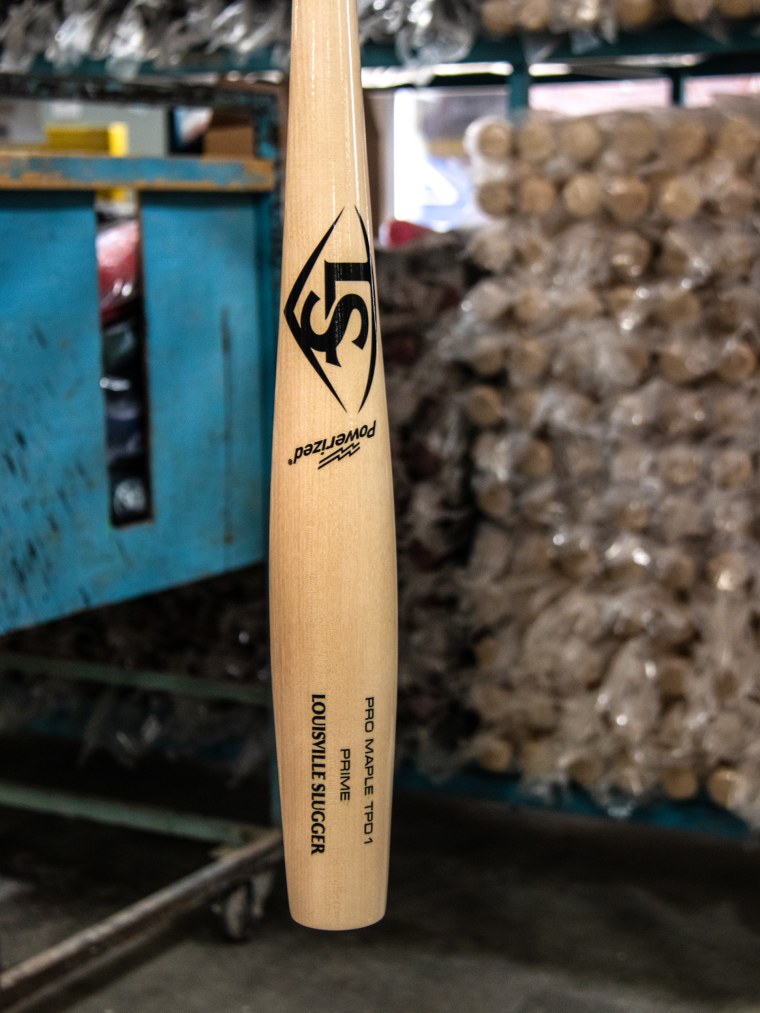
Torpedo bats differ from regular bats because the part of the bat with the widest diameter is lower on the bat. The lower sweet spot is meant to distribute the most mass of the bat to the “sweet spot”. The rationale for this change was very simple: put more wood in the area where the ball usually hits the bat. In the words of MIT physicist Dr. David Pritchard, “When you look at the design of a classic baseball bat, the physics just don’t add up. When the ball comes in and hits the sweet spot, it bends the bat so some of the energy goes into bending the bat.” With more wood in the sweet spot, there will be less energy lost by the bat bending back.

Who Created the Torpedo Bat

Credit for the creation of the torpedo bat goes to another MIT physicist turned baseball coach, Aaron Leanhardt. Leanhardt is currently a field coordinator for the Miami Marlins but previously worked as a Minor League hitting coordinator for the Yankees. Before beginning his career as a coach, Leanhardt earned a PhD in physics from MIT and was a physics professor at the University of Michigan. 

Leanhardt first began designing and testing the torpedo bat while working for the Yankees. In 2024, he first introduced the torpedo bat design to some Yankees players, including star hitter Giancarlo Stanton. There are even pictures of Stanton using a torpedo bat in the 2024 World Series. However, it was not until the opening weekend of the 2025 season, following the Yankees 3-game drubbing of the Milwaukee Brewers, when social media caught wind of the torpedo bats, and their popularity began to soar.

In the two weeks following the introduction of torpedo bats to the mainstream, baseball bat companies received thousands of preorders for torpedo bats. Two notable bat companies, Marucci and Victus, had models of the bats on their websites within a few days, trying to capitalize on the newest trend and had record sales. 

The requests for torpedo bats are also coming from MLB teams themselves. Hillerich & Bradsby, the company that is credited for creating the Yankees’ torpedo bats, received an influx of orders from MLB teams directly asking for torpedo bat models. Within a few days, there were MLB players across the league using torpedo bats, and it will be interesting to see if their popularity continues to grow among players.

Can Torpedo Bats Be Patented

Whenever there is a popular new invention, one of the first questions is whether it is eligible to receive patent protection. Patents offer inventors “the right to exclude others from making, using, offering for sale, or selling” their invention in the United States. The two main types of patents available to inventors are utility patents and design patents. Utility patents are granted to inventors of new and useful processes or machines. Design patents are granted to inventors of new, original, and ornamental designs for an article of manufacturing. 

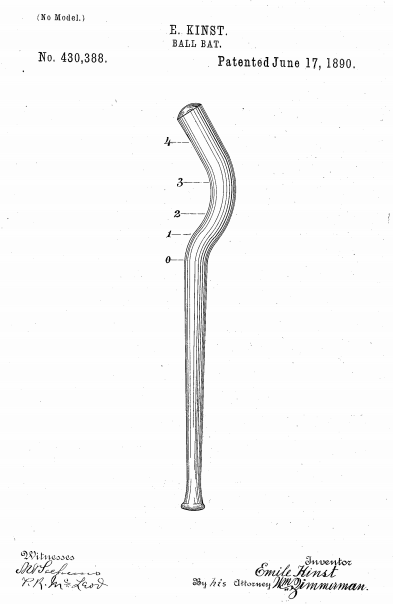
Although the general shape of baseball bats has stayed nearly the same for over 100 years, there have been some modifications that have received patents. The first, and goofiest, example of these was the banana bat. Banana bats, which had a curved barrel, received a patent in 1890, despite not catching on in professional baseball (for obvious reasons).

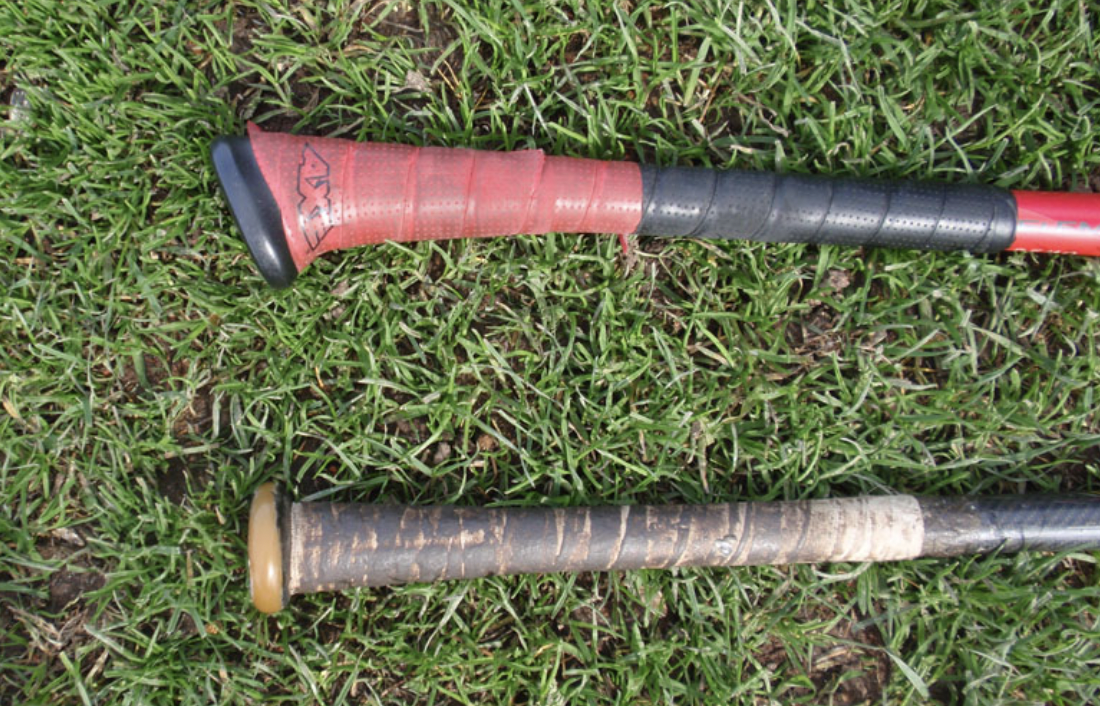
A modern example of a bat modification that received a patent is the “axe handle” bat. Axe bats, which grew in popularity around 2015, featured a bat handle that resembled an axe handle instead of the rounded handle that is usually used on a baseball bat. Axe bats received a design patent in 2013, as an ornamental change to the traditional baseball bat. Today, “axe bats” are sold exclusively by Baden Sports, but the company does license the axe handle design to other bat companies.

Based on the axe bat precedent, it seems like torpedo bats could eventually receive a design patent. Interestingly, Bob Hillercih, the vice president of the aforementioned bat manufacturer Hillerich & Bradley, does not believe that torpedo bats are eligible for a patent because the changed design for the bat is just a change in the shape

However, based on the description of design patents, this does not seem to be true. 

There are two factors in determining whether a design qualifies for a design patent. First, the design must be an integral aspect of the product that cannot be separated. The difference in barrel placement is the integral aspect of the design of torpedo bat, so it appears that this element would be met. Next, the design must have no bearing on the item’s functionality. The torpedo bat design would likely meet this element, because the new design does not alter the  baseball bat’s functionality. Rather, the torpedo bat just changes the amount of wood at the point of contact. Although some Yankee players had early success with the torpedo bats, it does not, on its own, make it easier to hit home runs. Torpedo bats are used just like regular baseball bats, the only difference is that it has a unique ornamentation with the location of the largest part of the ball being moved. 

Design patents also require that the new patent not be obviously derived or resembling other designs. While there may be an argument that the torpedo bat resembles other bats, the same argument could have been used for the axe bat handle resembling a baseball bat handle or an axe handle. When viewing all of these elements, and comparing torpedo bats to the patent that the axe handle received, there is a possibility that torpedo bats could receive a design patent, if Leanhardt chooses to do so. 

Conclusion

Time will tell if torpedo bats are the next big thing in baseball, or if they are just another banana bat. While more players have begun using them, other players tried them but returned to their old bats or refused to use them altogether. Regardless of their long-term impact on baseball, it will be very interesting to track whether the United States Patent and Trademark Office determines that torpedo bats can be patented. While historical precedent makes it seem like torpedo design can be patented, there seem to be concerns from people in the bat manufacturing business, who also may not want the bat design to be patented so they do not have to license the design to use it. 

Reel Rights: Copyright’s Collision With Documentaries

By: Alexander Tranquill

The Rise of Tiger King

Remember the start of the Covid-19 pandemic? Like myself, many Americans turned to TV to find comfort, and, in those first few surreal weeks, many found themselves watching one particularly enthralling, peculiar, and utterly outlandish story: Tiger King. Tiger King is a Netflix documentary series released in March 2020, which details the increasing tensions between rival big cat eccentrics, eventually culminating in Joe Exotic’s arrest in a murder-for-hire plot of rival Carole Baskin. While Tiger King initially generated massive media attention, it has more recently been the subject of intense copyright litigation.

If you are unfamiliar with this story, Joe Exotic was an internet personality long before Tiger King. With a substantial presence on YouTube, the Netflix documentary heavily relied on video footage originally created by Exotic and his employees. The suit now at issue, Whyte Monkee v. Netflix, centers on Netflix’s use of a video that shows Exotic giving an eulogy at his late husband’s funeral. The video was originally shot by Timothy Sepi, an employee and videographer at Exotic’s Gerald Wayne Zoo. However, Sepi now claims he never gave Netflix permission to use his footage, thus forming the basis for his copyright infringement claim.

During litigation, the district court originally found that Netflix’s use of the footage fell under the fair use exception to copyright infringement. This decision was later reversed by the Tenth Circuit, but, after a great deal of consternation and a flurry of amicus briefs, the Tenth Circuit later vacated its ruling and granted a petition for rehearing. Though the final decision is still pending, this case is significant because the decision has  major implications for documentary filmmakers, while also raising important questions about the rights of content creators in our age of smartphones and social media––where personal footage is often reused by others.

Copyright Protections and Fair Use

To understand the legal questions raised in Whyte Monkee, we must explore the interaction between copyright protections and the doctrine of fair use. Overall, copyright is a type of intellectual property that protects original works of authorship (i.e. paintings, photos, writings, movies) against use by others. However, authorship is a fairly low bar, requiring only a minimal level of creativity. If any creativity can be shown, copyright protections immediately attach when the work is fixed (published) in a tangible medium. As a result, recordings, much like Sepi’s home-video, are often considered copyrightable.

The fair use exception to copyright infringement allows a party to use a work without the permission of the creator if the copying is done for a limited or “transformative” purpose. While there are no hard and fast rules, courts will consider four factors in determining fair use: (1) the purpose and character of the use, (2) the nature of the copyrighted work, (3) the amount and substantiality of the portion used, and (4) the effect of the use on the market for the copyrighted work. Recently, courts have taken particular interest in the first factor, considering the significance of any changes made to the original while also assessing the purpose of the work.  

The Supreme Court’s Warhol Decision

Recently, the Supreme Court issued a detailed analysis of this first factor in Warhol v. Goldsmith. Here, Warhol was sued for a series of silkscreen prints he created of Prince, which he based on a copyrighted image captured by Goldsmith. Considering the purpose and character of Warhol’s silkscreens, the Court clarified that it is no longer sufficient for a work to simply add “new expression” to the original; the key question is whether the work serves “a purpose distinct from the original.” While purpose is not necessarily limited, derivative works should comment on, criticize, or provide otherwise unavailable information to the original. Therefore, although Warhol added new artistic expression to the original, his work did not constitute fair use because its purpose and character aligned with Goldsmith’s––both works were licensed to media companies, merely being used “to illustrate a magazine about Prince with a portrait of Prince.” Thus, because Warhol’s work simply used Goldsmith’s image as a template for the same commercial purpose, it failed to seriously comment on, criticize, or add information to the copyrighted image. 

Applying the Warhol Precedent

Following in the footsteps of Warhol, the Tenth Circuit overturned the district court’s decision in Whyte Monkee, relying on the purpose and character of the use. While the district court found Netflix’s use transformative as it incorporated the funeral clip into a broader narrative, the Tenth Circuit, citing Warhol, concluded that fair use requires the derivative work to serve a distinct purpose. Specifically, the court required the derivative work to critically comment “on the substance or style of the original composition.” With this backdrop, the court found that Netflix only used the funeral footage to show Exotic’s purported megalomania and showmanship. Accordingly, Netflix failed to seriously comment on the style of the video clip itself, instead using the video to “target[] a character in the composition.” Therefore, because Netflix used the funeral footage to detail Exotic’s life and not to comment on the style of the footage, the Tenth Circuit found that the first factor weighed against fair use. 

So, what is all the uproar about? The amicus briefs suggest that this decision will have a chilling effect on the documentary industry, confining filmmakers to commenting on the composition of footage itself (i.e. lighting, angles, editing). In the en banc rehearing, the court re-examined Netflix’s intent behind including the funeral clip in the documentary, focusing on Netflix’s use of the video to detail Exotic’s callous attitude. Thus, the court’s review likely reflects an effort to broaden the meaning of transformative purpose.

In its initial decision, the Tenth Circuit severely narrowed Warhol’s definition of distinctive purpose, requiring a derivative work to critically comment “on the substance or style of the original composition.” While this was an important factor in Warhol, it is not the only relevant factor in examining the purpose and character of a new work. First, the Court in Warhol explicitly looks to purposes outside critical commentary to determine fair use. For example, the Court found that Warhol and Goldsmith’s works shared the same commercial purpose—both were used to “illustrate a magazine about Prince with a portrait of Prince.” Furthermore, the Court in Warhol notes that the “degree of difference” between the works is relevant in the fair use analysis, being weighed together with purpose to determine whether the derivative work is transformative. Ultimately, the Tenth Circuit seems poised to consider other factors in its analysis of the purpose and character of the use. Such a decision would better support filmmakers by providing them greater access to material as they attempt to capture many of the compelling narratives in our world today. As a result, Netflix should continue to assert that its use of the video serves to illustrate Exotic’s personality—distinct from Sepi’s purpose of simply commemorating the funeral. Further, Netflix should revive its district court arguments, claiming the documentary is substantially different from Sepi’s video because it continually interrupts this video with comments from the deceased’s mother and ties the video into the broader story arc to highlight Exotic’s character. Ultimately, these arguments mirror the Supreme Court’s focus in Warhol, offering the Tenth Circuit a precedential foundation to recognize a broader interpretation of transformative use.

The Art of Deception: Should Art Forgeries Be Met with Litigation or Leniency?

By: Olivia Bravo

Intro

Art forgery is a crime, but should it be met with such harsh penalties? If some art forgeries are so good that they are never discovered and enjoyed the same as the original work, does this argument deserve a more nuanced approach? More importantly, is the cost of litigation worth the hassle?

Art Forgery Defined   

There are many arguments for and against authenticity in art. Is it the artist that creates a work that gives it its value? Or is a work’s value derived from its innate qualities? Because of the subjectivity of the art world, it has long since been a landmine for conmen and fraudsters to exploit. An art “forgery,” or art “fake” is when an artwork is presented by one artist, despite being created by another. Although used interchangeably, an art fake is a copy or replica made and circulated on the market while the original is hanging in a museum or in a private collection, whereas a forgery is made with the intention to deceive an audience. 

Art forgeries undermine the integrity of the art world, but in order to understand the full scope of the issue, it is important to recognize that a forger’s motivations are often more nuanced. Similarly, while psychological factors drive forgers to create their works, the allure of counterfeit works is not driven by the forger, but by societal demand. This recognition is crucial for transparency and for enforcing authenticity in the art market. 

The Case for Litigation

Art has a universal cultural impact, and as a society, we have placed a high value on the protection and cultivation of art and artists. A harsh reality of today’s art world is that more fakes and forgeries are offered for sale than legitimate works, to the point that 20% of the pieces in the world’s most prestigious museums and galleries could be potential forgeries. Many leading art experts and authenticators are even refusing their services to avoid liability, leaving authentication of works to scientists to use instrumental analysis and imaging to determine age and material composition of works. Art forgeries have had a significant impact on the fine art world: creating an economic burden for private buyers, galleries, and art museums who have the sole responsibility of litigating against forgers. 

Art forgeries also create a significant economic deficit when sold to consumers. It is estimated that counterfeit goods cost the US economy between $200- $250 billion per year. The US government suffers significant tax implications from the presence of counterfeit goods in the marketplace. With respect to art forgeries, an individual buyer suffers economic hardship because they are assumed to have purchased an art piece found to be a forgery at an inflated price, which saturates the art market and affects the valuation of other artist’s price point. 

The United States does not have any federal art forgery laws. Federal prosecutions have been successful under the Racketeer Influence and Corrupt Organizations Act (RICO), and independent federal charges are authorized by the Federal Trade Commission under the FTC Act. Even so, criminal prosecutions are rarely brought due to the high burden of proof, and only pursued in extreme cases. Many states require a high burden of proof of intent to defraud in order to bring criminal charges, and only protect the victims of forgeries through consumer protection statutes. 

An arguably more effective means of litigation, through the application of intellectual property laws, would protect artists rights and fill gaps left by criminal and civil protections due to the lower standard of proof needed to bring an infringement claim. Copyright and trademark law can be advantageous in litigating art forgery, assuming the work is not in the public domain and the copyright has been registered. Both have limited reach due to their specific authorship and publication requirements, but can be attached to federal criminal laws to be more effective. However, overall stricter regulation and harsher punishments in the U.S. and globally might better confront the circulation of fake art and deter future perpetrators.

Is There a Case For Leniency?

Art forgers are the talented creators of their art and own copyright protection to their original works. Should this be considered in the art forgery debate? For example, there is a psychological effect on how we perceive art that is disrupted by the knowledge that a work is a forgery. When the monetary value of a work is assigned according to the art market based on “fair market value,” but that value is tied to the artist and the perceived knowledge of their innate talent, what are we really valuing? Is it the art or the artist?  

Substantial resources are being invested into the prevention of art forgeries to the extent that art experts, authenticators, and foundations—dedicated to preserving the legacy of great artists—are becoming extinct for fear of litigation. This burden of authenticity has led to a situation where prosecution is the only recourse once a forger has already been found guilty. But lawsuits are so expensive that there might be room for a nuanced approach that either includes more protections for all parties involved or for a rethinking of art forgery litigation. 

So, what is the solution to a problem that clearly has many ethical and theoretical considerations? Should forgers be met with harsh punishments that will further shape the legal landscape of art fraud prosecution? Or is there a case for potential leniency depending on the intent of the artist and the subsequent impact their forgery has on the viewer and the world? Authenticity remains an elusive judicial concept, and as courts evaluate how to assign losses for victims as well as fair sentences for art forgers, a critical rethinking on how we view art and art litigation might be in order.