Petty In Pink: Terms of Service Aren’t Always Terms of Certainty

Picture1

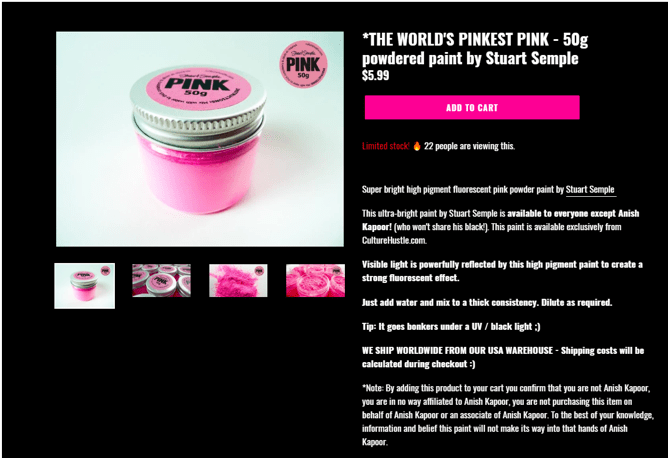
“The World’s Pinkest Pink” from CultureHustle.

By: Kaitlin Miller

In 2014, a UK-based company, Surrey NanoSystems, developed and announced the invention of Vantablack, otherwise known as the blackest black ever made (until September 2019, when MIT scientists accidentally stumbled upon the new blackest black). Surrey NanoSystems has continued to develop their unique technology. Vantablack is now so dark that it “absorbs 99.96 percent of the incident light that it comes into contact with,” and any 3D object coated in Vantablack looks to the naked eye like a 2D object— “a flat, bottomless void in space.”

A very fascinating issue has arisen from the licensing of Vantablack. Surrey Nanosystems granted British artist Anish Kapoor (known for his work “Cloud Gate,” a popular Chicago sight colloquially referred to as “the Bean”) an exclusive license to the artistic use of Vantablack. This has, expectedly, created an uproar in the art community.

Continue reading

Let’s Go Virtual With Shareholder Meetings

top view photo of people having a meeting

Photo by fauxels on Pexels.com

By: Samantha Pelto

Virtual shareholder meetings have not yet become the standard in the United States, but they should be. Virtual shareholder meetings are held online with shareholders attending remotely, and a growing number of companies are holding their annual meetings in this format. In 2009, only four companies held virtual shareholder meetings, but that number increased to 285 by 2018.

State laws require companies to hold annual shareholder meetings to vote for directors or on other matters requiring shareholder approval. The annual meetings are an opportunity for shareholders to raise questions and concerns with the company’s directors and management. Thirty states, including Washington, now permit virtual-only shareholder meetings. Virtual-only meetings are meetings held exclusively online with no physical location.

Continue reading

What if Corporations Process Our Data Without Ever Accessing it?

internet technology computer pc

Photo by Markus Spiske temporausch.com on Pexels.com

By: Samy Danesh

“Is it possible to delegate processing of your data without giving away access to it?” This was the question posed by Craig Gentry in his paper Computing Arbitrary Functions of Encrypted Data, in which he introduced the concept of homomorphic encryption.

Tech companies find the privacy discussion threatening – afraid that broad privacy legislation and high standards of privacy protection will dry up the well of innovation and economic growth.  For example, the Center for Data Innovation and IAPP view the EU’s General Data Protection Regulation as potentially inhibiting European companies’ ability to compete in AI development and the data driven economy. This fear is not completely unfounded since much of today’s technology depends on access to large troves of data. However, innovative solutions like homomorphic encryption create an opportunity for greater data privacy without compromising the industry’s ability to access data and process that information to provide products and services.

Continue reading

The Unresolved Injustices of Nazi-Looted Art: A look at the 2016 HEAR Act

Portrait-Of-The-Artists-Wife

By: Simrit Hans

The ownership of a 1917 watercolor by Austrian painter Egon Schiele is currently being contested in a three-way legal battle. The painting, Portrait of the Artist’s Wife, was purchased by award-winning documentary filmmaker Robert Lehman in 1964 from the Marlborough Gallery in London. In 2016, Mr. Lehman transferred ownership of the work to his family’s foundation to be sold at auction. It was the auction house, Christie’s, that recognized the painting’s potentially questionable provenance and contacted Israelitische Kultusgemeinde Wien (IKG), which represents the Jewish community of Vienna, about the painting’s history. IKG recognized Eva Zirkl as the painting’s true owner. Ms. Zirkl, who has had other works by Egon Schiele returned to her, is the heir of Karl Mayländer, a Jewish businessman and art collector who was killed during the Holocaust. The third party to the dispute over the painting consists of the Robert Reiger Trust and heirs of Heinrich Rieger, Egon Schiele’s dentist and an early collector of his work, who also died during the Holocaust.

Continue reading

FaceApp: Harmless App or Russian Plot?

Screen Shot 2020-02-10 at 1.43.38 PM

Photo from FaceApp

By: Justin Brascher

Lately, chances are you scrolled though social media and came across a picture of someone you know, only they looked about 50 years older. Such technology is the product of FaceApp, an app developed by the Russian company Wireless Lab. The company’s purported AI technology can take a user’s face and alter the image with a number of different filters. The most popular of these filters is the aging filter, which took social media by storm last year, becoming one of the biggest social media trends of 2019. At one point FaceApp was the number one downloaded app in the IOS app store. However, concerns over FaceApp’s privacy policy and its connections to Russia quickly took center stage.

Continue reading