Will FCC Bend Rules for Marijuana Internet Advertising?

Screen Shot 2015-01-07 at 2.06.02 PMBy Cheryl Lee

Marijuana has been legalized for recreational use in Alaska, Colorado, District of Columbia, Oregon, and Washington, while medical marijuana has been legalized in 23 states and the District of Columbia. About a dozen more states are expected to legalize marijuana in some form in the coming years. Industry experts expect annual marijuana sales revenues in Washington and Colorado to hit $2.5 billion by 2015. To help capture this revenue opportunity, many marijuana business owners are exploring Internet advertising. Indeed, the home delivery of marijuana is currently advertised on the Internet through various websites.

But marijuana is still illegal under federal law, and current federal laws make it illegal to advertise the sale of illegal drugs. Violations of those laws can be expensive. In 2011, Google agreed to pay a $500 million settlement to avoid federal prosecution for accepting illegal advertisements from Canadian online pharmacies. Due to these legal restrictions, online giants like Facebook, Google, Yahoo and Twitter have internal policy strictly banning marijuana ads. Continue reading

The Ultramercial Decision: Closing The Door Even Further On 101

Screen Shot 2014-12-16 at 12.09.47 PMBy Vijay Kumar

The Federal Circuit recently issued its opinion for the Ultramercial v. Hulu case, further closing the door on patentees for what business methods qualify as being patent eligible under 35 § U.S.C. 101. Using the two-prong test outlined by the Supreme Court’s 2014 decision in Alice Corp. v. CLS Bank International, the Federal Circuit held that Ultramercial’s ‘545 patent did not claim patent-eligible subject matter. (The ‘545 patent covered a method for distributing copyrighted content over the Internet where the consumer receives the content for free in exchange for viewing an advertisement, and the advertiser pays for the content.) While not completely unexpected, the Ultramercial decision is important because it continues to stir up debate as to what software and Internet related methods are still eligible for patent protection. Following the decision, inventors, patent attorneys, and even patent examiners are still unsure of what type of claim limitations are required to overcome the §101 threshold.

Section 101 has enjoyed substantial debate over the last four years. Including the Bilski decision in 2010, the Supreme Court has taken up four subject matter eligibility challenges, “endeavoring to right the ship and return the nation’s patent system to its constitutional moorings.” Alice, 134 S. Ct. at 2357. The Court’s most recent patent-eligible decision, Alice, used a two-prong test to distinguish business method patents that claim abstract ideas from those that claim patent-eligible applications of those concepts. (We covered the Alice decision last summer.) The first prong of the test determines whether the claims at issue are indeed directed to an abstract idea. If they are, the second prong of the test then asks whether the claims do significantly more than simply describe that abstract idea. In other words, the additional features for the second prong’s analysis must be more than “well-understood, routine, conventional activity.” Alice clearly took away some of the patent-eligible grounds that were previously available to applicants. But more importantly, it also led to some confusion among patent practitioners and examiners at the U.S. Patent and Trademark Office (PTO) as to the patent-eligibility of certain business method patents for software and Internet-based patents. Continue reading

Washington Journal of Law, Technology & Arts Publishes Fall 2014 Issue

The Washington Journal of Law, Technology & Arts (LTA Journal) has published its Fall 2014 Issue. The LTA Journal publishes concise legal analysis aimed at practicing attorneys on a quarterly basis.

The issue’s first article, by Managing Submissions Editor Rachael Wallace, is “Framing the Issue: Avoiding a Substantial Similarity Finding in Reproduced Visual Art.” The article discusses copyright infringement in reproduced visual art, explains how attorneys have avoided substantial similarity findings, and provides attorneys with guidance on avoiding a substantial similarity finding in their clients’ works, focusing specifically on photographs.

Articles Editor Stephen Anson wrote the second article, “Hologram Images and the Entertainment Industry: New Legal Territory?” The article discusses the three main intellectual property issues surrounding the holographic reproduction of a dead artist’s likeness: copyright, trademark, and the right of publicity. The article recommends the steps that a living artist’s or deceased artist’s estate can take to plan for the most robust protection.

Former Articles Editor Megan Haslach contributed the third article, “Consignment Catastrophes: Lessons from New York’s Art Gallery Fraud.” The article explores issues surrounding art consignment statutes and argues that New York’s amended consignment statute provides a model that all states should implement in order to provide a fairer balance in the relationship between artists and art dealers.

The issue’s fourth article was written by Brendon Beheshti and is titled “Getting Beyond Abstract Confusion: How the United Kingdom’s Jurisprudence Can Aid in Developing an Analytic Framework for Patent-Eligibility in Light of Alice v. CLS Bank.” The Article advocates consideration of the United Kingdom’s jurisprudence as persuasive authority for implementation of a new framework for analysis of subject matter eligibility of computer-implemented inventions in light of the United States Supreme Court’s ruling in Alice Corp. v. CLS Bank International.

See the full issue here.

Visit the Washington Journal of Law, Technology & Arts Website: http://www.law.washington.edu/wjlta/

We also have a blog: https://wjlta.wordpress.com/

Police Body Cameras Spark Potential Privacy Issues

Screen Shot 2014-12-05 at 12.16.46 PMBy Naazaneen Hodjat

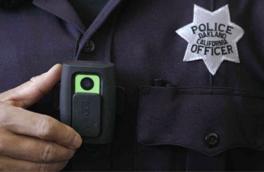
In recent years, law enforcement agencies have been under significant pressure to increase transparency after a host of events have led local communities to lose faith in such agencies’ integrity. Concerns have escalated in recent months, particularly after a white police officer shot and killed Michael Brown, a black, unarmed 18-year old man on August 9, 2014, in Ferguson, Missouri. The circumstances of the shooting are in hot dispute, as witness reports differ as to whether Brown was surrendering before the fatal shots. No video surveillance of the incident is available. In hope of rebuilding its credibility after much criticism from the local community, the Ferguson police department has since added body cameras for its officers. Departments throughout the country are following closely behind.

Police chiefs who have implemented the use of body cameras suggest that there are several benefits and believe that both officers and citizens behave better while being recorded. The Department of Justice recently released a policy report on this issue, stating that “body-worn cameras help police departments ensure events are also captured from an officer’s perspective.” Civil rights advocates maintain that such cameras would prevent police officers from abusing their authority, while law enforcement groups believe that cameras would deter people from falsely accusing officers of abuse. Furthermore, the Police Foundation, an organization committed to law enforcement research, recently completed a study that found that body cameras dramatically lowered complaints of police abuse. The results suggested more than a 50% reduction in the total number of use-of-force incidents, as well as a significant reduction in citizen complaints against police officers. Continue reading

Metadata Collection: Will it Destroy or Save Us?

Screen Shot 2014-12-04 at 7.09.09 AMBy Michael Huggins

Metadata provides a record of a user’s online activity, which includes browsing history, map searches, email activity, and even some account passwords. The NSA can use this information to build a detailed picture of an individual’s life. Opponents of the NSA’s surveillance programs argue that metadata collection programs violate an individual’s constitutional rights. However, some argue that metadata can benefit society and fight human rights violations.

Witness, a human rights group that trains citizens around the world to use video to expose human rights abuse, argues that collecting and preserving metadata can help verify those videos. Citizens and activists in conflict zones document everything on their phones. In Syria, for example, human rights activists have produced over 500,000 videos. Unfortunately, Witness cannot verify those videos without proper metadata, and as a result, the organization cannot use the videos to assist in the prosecution of human rights violations.

Witness is turning to mobile app developers to alleviate the verification problem. Witness currently supports a mobile app in collaboration with the Guardian Project called InformaCam. InformaCam uses a smartphone’s built-in sensors (e.g., wi-fi, Bluetooth, and cell tower information) to create a snapshot of the environment in which an image or video is captured. The app validates the date, time, and location of the image or video. Digital signatures and encryption prevent tampering by others. The app has an opt-in “eyewitness” or “proof” mode that users can select before creating the images or video. After a user creates an image or video, the “eyewitness” mode preserves the metadata, which provides a way to check the file for integrity. Continue reading