
Ninth Circuit Holds Stock Photography Collection Registration Protects Individual Images, Defers to Longstanding Copyright Office Practice

By Amanda BringsImage

In Alaska Stock, LLC v. Houghton Mifflin Harcourt Pub. Co., the Ninth Circuit recently weighed in on the much-contested issue of whether the copyright registration for a photograph collection protects the individual images within the collection. Adopting the approach of the Fourth and Fifth circuits, the court held that when a stock photography agency registers a collection of images and the agency has ownership rights in both the collection and the individual images, the registration covers both the collection as a whole and the individual images.

The case arose when Alaska Stock, a stock photography agency, filed a complaint against the major publisher Houghton Mifflin Harcourt (HMH) alleging that HMH committed copyright infringement when it exceeded its license to use Alaska Stock’s images. HMH moved to dismiss the complaint on the grounds that Alaska Stock did not have valid copyright registrations for the individual images under 17 U.S.C. § 409, and therefore could not bring suit under 17 U.S.C. § 411(a), which makes registration a precondition for an infringement action. Continue reading →
Washington Journal of Law, Technology & Arts Publishes Winter 2014 Issue

The Washington Journal of Law, Technology & Arts (LTA Journal) has published its Winter 2014 Issue. The LTA Journal publishes concise legal analysis aimed at practicing attorneys on a quarterly basis.

In the issue’s first article, “The Internet and the Constitution: A Selective Perspective,” the Honorable M. Margaret McKeown of the United States Court of Appeals for the Ninth Circuit offers her retrospective thoughts on the ways courts have handled constitutional issues in Internet cases. She also discusses some of the challenges currently facing courts and legislators alike as the U.S. legal system incorporates and accommodates Internet-based technologies and the societal, commercial, governmental, and relational changes they spawn.

The issue’s second article was written by John Morgan and Veronica Sandoval and is titled “Pacific Northwest Perspective: The Impact of the America Invents Act on Nonprofit Global Health Organizations.” The article explores the effects of the AIA on nonprofit research organizations dedicated to global health and life sciences, and reports the perspectives of counsel representing such organizations throughout the Pacific Northwest.

Continue reading →

Congress Moves to Remove Child Sex-Trafficking from Online Marketplaces

By Max Burke

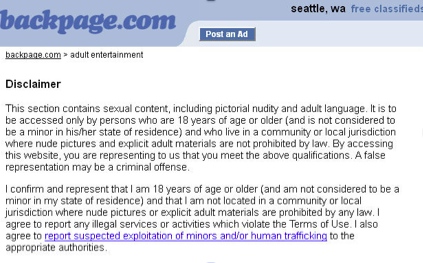
There is a small political movement afoot to combat child sex trafficking online. Representative Ann Wagner of Missouri recently introduced a bill called the Stop Advertising Victims of Exploitation (SAVE) Act, which would make it unlawful to knowingly advertise certain commercial sex acts. The bill has quickly gained co-sponsors, and it joins other bills that are intended to target sex trafficking. Although SAVE does not distinguish between online advertisers and print advertisers (indeed, it does not mention anything Internet-related), its sponsors have stated that the bill is “designed to close Internet marketplaces that host advertisements for the commercial exploitation of minors.”

Prostitution and child sex trafficking in America is an enormous underground industry that has moved from the streets to online marketplaces like Backpage.com, a classified advertising website. Unfortunately, law enforcement and prosecutors are finding it difficult to fully thwart online sex trafficking because Backpage and other websites are hiding behind Section 230 of the Communications Decency Act, which shields Internet service providers (ISPs) from liability for third party postings. Courts have ruled that this section provides immunity to websites that host classified ads, even if there are ads for prostitution or child sex trafficking. This immunity protects ISPs against both state criminal prosecution and civil suits by victims.

Continue reading →

Turkey’s Mystifying Twitter Blockade: #TotalMediumBan

turkey

“We’re Number One!”

By Chris Young

On Thursday, March 20, 2014, the Turkish government, through a court-order, announced that it would block local access to Twitter’s website.. The move came amidst a corruption scandal and nine days before local elections. The initial ban operated at the Domain Name System (“DNS”) level (A domain name may serve as a proxy for a given website’s Internet Protocol (“IP”) resource). Here, the Turkish government has decided that its citizens are not entitled to access a website that provides a communicative network for 200 million folks across the globe.

The following Saturday, March 22, the government acknowledged that regaining control of political expression may have been a possible motive, stating that Twitter has allowed “systematic character assassinations.” Worse yet in the government’s estimation, Twitter has allegedly failed to remove offensive content that the Turkish court order characterized as defamation. But some commentators have suggested that this is actually a clever move meant to signal to Twitter that if it means to do business in Turkey, it must establish a presence in-country, becoming more economically and legally accountable for misuse. The problem with this strategy is that the ban doesn’t seem to be effective.

Continue reading →

THE UNKNOWN PRICE OF FREEDOM: The real cost of Getty Images’ free-for-all evolution

Getty-Images-icon

By Annie Allison

Getty Images recently announced that it will stop charging (and in some cases suing) for non-commercial uses of its copyrighted imagery and will start allowing bloggers and social-media users embed stock pictures in a controllable way. Getty’s new strategy will allow anyone to select an image and copy a code to use that image on their own website. While proponents cheer Getty for adapting to the rapidly evolving online marketplace, others question what the costs of these free images may be on privacy.

Craig Peters, senior vice president of business development, content and marketing at Getty Images explained the reasoning for the company’s shift in approach: “It’s incredibly easy to find content online and simply right-click to utilize it. … The vast majority of infringement in this space happen[s] with self-publishers who typically don’t know anything about copyright.”

Under its new strategy, Getty Images will serve the image much like YouTube currently does with its videos and will include the full copyright information and a link back to the image’s dedicated licensing page. “There’s a value for Getty Images and the content owners,” says Peters. “We’ll have access to the information on who and how that image is being used and viewed, and we’ll… utilize that data to the benefit of our business.”

Continue reading →