Twitter to Begin Balancing Free Expression with Legal Compliance

Staff Writer 


On January 26, Twitter announced that it will remove Tweets on a country-by-country basis.  Recognizing that freedom of expression is a “human right,” Twitter also acknowledged the “responsibilities” and “limits” that accompany such a right, especially in countries such as France or Germany, where pro-Nazi content is banned by law.  Previously, Twitter could only implement global bans – no matter where the Tweet was posted, no one in the world could see the Tweet if it was taken down.  Now, only persons from the originating country will be blocked, while the rest of the world can still see an offending Tweet.  This country-by-country policy would help Twitter comply with laws that vary by country.  The New York Times observed that the majority of Twitter’s 100 million users live overseas, and that Twitter was confronting the complexities of being both a free speech tool and commercial venture.

Unsurprisingly, the revised policy has sparked considerable controversy, resulting in an immediate “Twitter Blackout” on January 28.  But others have remarked that Twitter is balancing the values behind free speech with necessary compliance with foreign and local laws.  One commentator remarked how Twitter was the only company to fight the United States government over the Wikileaks case, and Twitter informed users when it lost.  The policy has also been praised for its transparency, as users are notified when infringing Tweets are removed, and Twitter will post updates relating to notices on the “Chilling Effects” website, http://chillingeffects.org/twitter. Continue reading →
Supreme Court Upholds Fourth Amendment Rights In GPS Tracking Case

Duncan Stark
Blog Editor


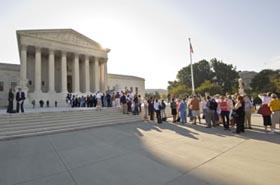
On Monday, the Supreme Court released its highly anticipated decision in the Fourth Amendment case Unites States v. Jones. The decision, unanimous in favor of respondent Jones, upheld the D.C. Circuit’s reversal of his drug-related convictions.

Jones came under suspicion of trafficking in narcotics in 2004. He was made a target of an investigation that included attaching a GPS tracking device to the car he frequently used. As implemented by law enforcement, the use of this tracking device fell outside the scope of any warrant police had obtained. The device was used to track the vehicle’s location for 28 days and collected more than 2,000 pages of data.

The Supreme Court agreed with the D.C. Circuit that this investigative behavior, outside the scope of a search warrant, was a violation of Jones’ Fourth Amendment right to be secure in his effects against unreasonable searches. The majority position, written by Justice Antonin Scalia, stated that the Court had “no doubt that such a physical intrusion would have been considered a ‘search’ within the meaning of the Fourth Amendment when it was adopted,” citing to, among other authorities, an English case from 1765. Continue reading →

Second Chance for Blogger Rights

Staff Writer


In December, the U.S. District Court for the District of Oregon declined blogger Crystal Cox the protection of an Oregon reporter shield law and First Amendment case law, holding that both applied only to institutional media. See Obsidian Finance Group v. Cox, 2011 WL 5999334, CV-11-57-HZ (D. Or. Nov. 30, 2011).  Now she might get a second chance to challenge the defamation claim against her. Cox filed a motion for a new trial Jan. 4, this time with the aid of two attorneys, one of them First Amendment scholar Eugene Volokh – a stark contrast to her previous pro se representation.

The Seattle Weekly provides a concise background of the case, but the gist is that Cox was sued for defamation by investment firm Obsidian Finance Group after writing several blog posts that were critical of the firm and its co-founder. Allegations regarding all but one post were dismissed. Cox admitted that the final post at issue was factual in nature, declining her ability to argue it was protected opinion. But she refused to name the source of the information, claiming Oregon’s Shield Law, Or. Rev. Stat. §44.510 et seq., offered her protection. Cox further asserted that the plaintiff failed to prove negligence or actual malice under the Gertz standard for defamation. See Obsidian Finance, 2011 WL 5999334 at *5 (citing Gertz v. Robert Welch, Inc., 418 U.S. 323, 347 (1974)). While Cox claimed to be an investigative journalist, U.S. District Judge Marco A. Hernandez found her not to be a “journalist” within the parameters of the statute, declining to offer her its protection. He also deemed that Gertz, which requires a showing of negligence when a private speaker is defamed, only applied to journalists, not bloggers. Without these defenses, a jury imposed a $2.5 million verdict against her. Continue reading →

Isolated Transcription Errors and Tax Preparation Software

Staff Writer
 

Last September, the LTA blog discussed a line of Tax Court cases in which taxpayers unsuccessfully attempted to defend themselves from I.R.S. penalties by arguing that their reliance on tax preparation software amounted to reasonable cause and good faith.  After this line of consistent taxpayer defeats, the Tax Court recently ruled in favor of a taxpayer who used tax preparation software to self-prepare his tax return and mistakenly omitted a large amount of trust fund income from his taxable income. See Olsen v. Commissioner. T.C. Summ. Op. 2011-131.  While Olsen is notable because a taxpayer who relied on a tax return preparation program was able to assert a successful defense against I.R.S. penalties, it is especially interesting because the successful taxpayer argument in this case was more nuanced than those in previous cases.

Generally, when a taxpayer substantially understates his tax liability by more than $5,000, the I.R.S. asserts a substantial omission penalty against the taxpayer. I.R.C. §6662(b)(2), I.R.C. §6662(d).  When faced with this substantial omission penalty, a taxpayer may argue that he qualifies for an exception to the penalty because he had a reasonable cause for the understatement and he acted with good faith.  I.R.C. §6664(c).  In determining whether a taxpayer acted with reasonable cause and good faith, a court will look at all the pertinent facts and circumstances. Treas. Reg. § 1.6664-1(b)(1).

In the past, taxpayers who relied on software programs to help them prepare their tax returns had a hard time proving reasonable cause and good faith and the Tax Court upheld the penalty, reasoning that tax return preparation software is only as good as the information a taxpayer puts into it. See e.g. Bunney v. Commissioner, 114 T.C. 259, 267 (2000), Lam v. Commissioner, T.C. Memo 2010-82, Anyika v. Commissioner, T.C. Memo 2011-69.

Continue reading →

Carrier IQ Litigation: Does Data Gathering on Phones violate Federal Wiretapping Laws?

Staff Writer
 

Recently, Carrier IQ has come under scrutiny for the vast amounts of data it gathers from cell phone users.  A cell phone analytics company, Carrier IQ claims it’s software is installed on over 141 million devices. Apparently, the software is mostly on phones from AT&T, Sprint, and T-Mobile. This software has the ability to gather vast amounts of data from users, including logging keystrokes, user location, and telephone calls. For example, the software can track what websites a person visits, as well as the usernames and passwords used on those sites. Since this information is tracked directly from the phone or mobile device, it does not matter if the device is used over wi-fi networks or cellular networks, or if the website itself is encrypted. The potential for invasion of privacy is enormous.

Carrier IQ has responded, saying “While we look at many aspects of a device’s performance, we are counting and summarizing performance, not recording keystrokes or providing tracking tools.” Continue reading →