Taming the Gerry-Mander: How Technology Can Keep Gerrymandering in Check

181213-004-84DEAB79By Joshua Oh

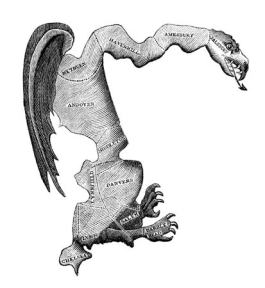
A politician’s dream is to be re-elected over and over with minimal effort, so where might one look to ensure this? The answer, perhaps, is gerrymandering. Gerrymandering was coined after Massachusetts Governor Elbridge Gerry enacted a law in 1812 to redraw legislative districts to benefit his party, which resulted in one of the redrawn districts resembling a salamander—thus the term “gerrymandering.” In fact, it has been gaining a notorious reputation for its widespread use based on its potentially unfair effects on election results. However, the Supreme Court will soon rule on a case, Gill v. Whitford, that will heavily influence future American elections.

Gerrymandering is without a doubt toxic to American democracy. It allows politicians to choose their voters by “packing”—concentrating one party’s supporters in one district to win overwhelmingly. On the other hand, “cracking” splits up supporters of the opposing party into multiple districts in order to dilute their impact, preventing opponents from securing a majority vote. This essentially means that elections are predetermined and one person’s vote is not necessarily equal to someone else’s vote, which could contravene the Equal Protection Clause of the Constitution.

The Supreme Court has always been reluctant to intervene in partisan areas meant for the political branches of government to debate. Thus, a standard or definition of political fairness in the gerrymandering context had never been set. Gill v. Whitford, an extreme example of partisan gerrymandering in Wisconsin, may soon change that. In 2012, Republican elected officials in Wisconsin were able to draw up a districting plan that permitted their party to win 61% of the Wisconsin Assembly, even though they only received 48.6% of the vote. In 2014, they won 64% of the Wisconsin Assembly, despite receiving only 52% of the vote.

The issue in the Whitford case was whether partisan redistricting could be so extreme as to be unconstitutional. The argument goes that Republican efforts to redistrict caused the dilution of Democratic votes, leading to a non-representative government. By packing and cracking districts, the votes of individual Democrats meant less than those of individual Republicans. The nation’s highest court will soon decide whether these arguments are persuasive.

In ruling on the constitutionality of a given redistricting effort, the Supreme Court could receive valuable assistance from recent technological advances that are equipped to detect gerrymandering. Indeed, algorithms are the latest threat to gerrymandering, as computers can now determine whether districts were drawn with political motivations in mind. Down the road, these algorithms could be used in a court of law in order to challenge unconstitutional gerrymandering. Since courts are demanding that districts be drawn more fairly, these algorithms could be the solution in providing the citizenry a fair and representative democracy that it deserves.

Professor Wendy Cho with the National Center for Supercomputing Applications at the University of Illinois is attempting to create such an algorithm to measure whether political parties manipulated a map to gain an unfair advantage, a term described as a “gerrymandering ruler.” This algorithm would identify the criteria—some even required by law—of redistricting: population equity, contiguity, compactness, and traditional districting principles. Based on these criteria, the algorithm would generate billions of maps that are, by definition, nonpartisan maps, since no political information was considered. These artificial, nonpartisan re-districted maps could then be compared to the districts that had been created by politicians. If the real map does not look like any of the billion possibilities generated by the algorithm, that would provide strong evidence of partisanship motivating the alleged gerrymandering. On the other hand, if the algorithm generated a set of one billion maps with partisan information considered, and the map in question looked similar to any of those billion possibilities, a court could then also infer partisan motivation.

This algorithm is but one possible solution to the toxicity that gerrymandering brings into the election system. It may be beneficial for the courts to be more receptive to technological advances like this one that can better detect and prove partisan bias in gerrymandering. Such extraordinary technology could encourage lawyers to introduce algorithmic evidence into a court of law, allowing the court to better assess cases before them in an objective manner as partisan gerrymandering continues to be a problem in American politics. It can also be a useful way to objectively give a voice to those who have felt that their votes did not matter when their district was always won by a particular party. It would no doubt advance the “one person, one vote” principle that the Constitution demands.

Picture Source

What To Do About Russian Facebook Trolls?

Picture1By Hugo Fraga

Once again, Facebook is being prodded by state officials—this time from across the pond. Just one month after revealing to Congress that Russian-linked accounts purchased $150,000 worth of political ads during the US election, Facebook is being asked to provide British lawmakers with information on ads purchased by Russian-linked Facebook accounts during last year’s Brexit referendum and during this year’s general election.

Law makers in both the United States and Britain worry that the social media giant is providing a platform for foreign governments to interfere with the democratic process. Up until now, Facebook has not provided enough information to Congress to assuage this worry. For that reason, Congress—and from the looks of it, Parliament as well —is considering a bill that would require political advertisements on social media platforms to disclose who is paying for the advertisement.

This kind of regulation—at least in the U.S.—isn’t new. The Federal Election Commission is charged with ensuring that political advertisements on television and radio reveal the source of their funds and has a similar regulation for radio and television ads. But as it stands now, political advertisers on social media platforms, like Facebook, escape the FEC’s requirement to disclose the source of their funds because such advertisements are considered merely “small items,” and thus are in the same group as, say, buttons and bumper stickers.

However, Congress has introduced a bill entitled “The Honest Ads Act” that could change that. The Honest Ads Act would require social media companies with more than 50 million monthly users to make public detailed information about any political advertiser who spends over $500 on their platforms. Furthermore, it would require social media platforms to take “reasonable efforts” to ensure that any political advertisements or content they display were not purchased by a foreign national.

But some argue that this isn’t enough. Brendan Fischer, director of the Federal Election Commission reform at the Campaign Legal Center, told Wired Magazine that the kinds of advertisements purchased by Russian-linked accounts wouldn’t fall under campaign finance law because none of them included “expressed advocacy”—i.e., a prompt to vote for this or that candidate. And even if Congress expanded the meaning of a bill to include the kind of ads purchased by Russian-linked accounts, there would still be ways around it, like forming a “fake news” website and then posting the ad as an article instead.

Nonetheless, Congress likely realizes that a single bill won’t fix this problem and that there will be ways around any proposed solutions. However, many members of Congress see this bill more as an attempt to regulate what has seemed impossible to regulate: Facebook. And the advantage of that is that people won’t have to rely on Facebook’s internal efforts to solve the problem. After all, when has a company’s self-legislated efforts ever been in favor of the people.

(Don’t) Say My Name

3581676336_048e8a16fc_b

By Vanessa James

“We’re a company that’s so successful and everywhere you go, you see a scratchy, hairy fastener and you say…

Hey, that’s Velcro.”

So begins the recent Youtube video Velcro released on September 25, 2017. In an effort to protect itself against genericide—an intellectual property term that means the retraction of a trademark because the brand name has become synonymous with the type of product—Velcro released a video pleading with the public to stop saying “Velcro” and start instead saying “hook and loop.”

It may seem innocuous to use brand names to describe products associated with the brand, but this is actually often a red flag that the brand could potentially lose its trademark. For instance, when was the last time you drank from a “vacuum flask,” walked on a “moving staircase,” or went to a “coin laundry shop?”

Velcro, which was first registered as a trademark in 1956, is trying to avoid losing its trademark, as did thermos, escalator, laundromat, yo-yo, aspirin, and pilates. The purpose of a trademark is to uniquely distinguish the goods or services of a company and to help consumers identify the source of a product. When a trademark becomes synonymous with a class of goods, it no longer helps consumers to understand which company made the product. If this happens, the trademark may be cancelled by the U.S. Patent and Trademark Office. Once a trademark is cancelled, the mark can no longer be used to prevent others from using the same mark to describe their products.

One factor courts consider when determining whether a trademark has become generic is whether the owner attempted to educate the public on the proper use of the mark and the generic name for the goods. Enter Velcro’s video. Ad campaigns like Velcro’s have a record of successfully stopping brands from losing their registered trademarks. Campaigns for Xerox (a 2003 advertisement from photocopier firm Xerox read: “When you use ‘Xerox’ the way you use ‘aspirin,’ we get a headache), Jeep, and Band-Aid saved those trademarks from becoming generic.  Johnson & Johnson changed its marketing jingle from “I am stuck on Band-Aids, ’cause Band-Aid’s stuck on me” to “I am stuck on Band-Aids brand ’cause Band-Aid’s stuck on me.”  Chrysler turned to the term “SUV” instead of “Jeep.” The Dow Chemical Company, which makes a well-known “line of extruded polystyrene foam products,” has worked to remind consumers coffee cups are not made of Styrofoam.

Another recent example of a company fighting to save its trademark comes from well-known jewelry chain Tiffany & Co. Tiffany initiated a legal battle with U.S. wholesaler Costco when Tiffany claimed that Costco infringed its trademark by selling “Tiffany” engagement rings. In retaliation, Costco argued that the jewelry firm’s trademark was no longer valid because “Tiffany” had become a generic term for solitaire-style rings. Judge Swain of the United States District Court for the Southern District of New York determined that Costco did in fact infringe on Tiffany’s trademark and awarded Tiffany $11.1 million plus interest in addition to $8.25 million punitive damages. For now, producing a simple, fun Youtube video is far less costly way for Velcro to protect its trademark.

Picture Source

“Errant text messages cost the Buffalo Bills millions”—the Rise of TCPA Litigation

Blog- Phone ImageBy Craig Dammeier

In April of 2014, the Buffalo Bills settled a two-year federal court case in Florida for a cool $3 million dollars. Their mistake? Sending three more text messages over a 14-day period than a fan had agreed to. Mr. Jerry Wojcik visited the Bills’ website in 2012 and opted-in to receiving promotional text messages limited to “…three to five messages per week for a total of 10 to 12 weeks.” Instead, Mr. Wojcik received six text messages the first week and seven the second week. He subsequently filed a class action suit against the sports franchise alleging violations of the Telephone Consumer Protection Act (TCPA). The settlement agreement was as follows: each eligible class member was entitled to a share of $2.5 million worth of debit cards (only redeemable on the Bills’ website, a “win” for the franchise) and $500,000 in attorney’s fees. And it’s not just the Bills (nor the NFL) that faces this menace. The Tampa Bay Buccaneers and the LA-based Chargers, Clippers, and Lakers have all fallen victim to the heartless TCPA. These teams are being mercilessly-abused over a few extra promotional emails or texts—who will help them survive the night?

The TCPA, passed by the Federal Communications Commission in 1991, was originally intended to protect individuals against unsolicited calls and texts sent to wireless devices (and home phones) by “auto-dialers.” Auto-dialers are automatic telephone dialing systems that use prerecorded or artificial voice messages. The 1991 statute arose over complaints regarding the increased use of auto-dialers, specifically because the called parties could incur significant phone bills as a result of the unsolicited calls. In response, the TCPA provides statutory damages of $500 (for an “innocent” violation) and $1,500 for a willful violation of the statute.

In 2012, a subsequent amendment to the TCPA included text messages and other modern technologies into the statute and further precluded companies from making any call without the prior express consent of the consumer. It also required the companies provide an automated, interactive “opt-out” mechanism which would allow the consumer to stop all future messages. It is under this 2012 amendment that TCPA litigation has seen a historic rise in the court system.

While the statute was originally passed to protect consumer privacy and restrict companies from engaging in unwanted telemarketing communication practices, it has quickly become a favorite weapon of plaintiff’s firms as it creates liability for every company from startups to international banks (not just sports franchises). Furthermore, the Act enables mistreated consumers and their lawyers to collect massive class action settlements. Bank of America settled its TCPA class action for $32 million (the culmination of six pending TCPA litigation matters), HSBC was granted judicial approval of a $40 million settlement in 2015, and Western Union agreed to pay $8.5 million the same year. The potential payout has created a frenzy amongst plaintiff’s firms, with several creating sub-groups that specifically handle TCPA class actions. The rise in TCPA litigation has not gone un-noticed by the Judiciary either: “This is the second multi-million-dollar class action settlement this court has reviewed and addressed in the last three weeks in which the plaintiff class has sued credit card companies for violations of the Telephone Consumer Protection Act.”

In short, the sharks are circling and each bite provides larger and larger settlements for Americans whose consumer rights have been violated (along with attorney’s fees, of course).

Antitrust Implications of Amazon’s Purported New Delivery Service

Amazon-Shopping-in-KenyaBy Gardner Reed

Amazon’s recent acquisition of Whole Foods has renewed the debate surrounding the proper role of antitrust regulation. The traditional approach to antitrust law aims to protect consumers by keeping prices down and quality up. The Whole Foods acquisition, along with the growing dominance of large tech firms such as Google, has helped popularize a new approach to antitrust: “hipster antitrust.” Hipster antitrust widens the objectives of traditional antitrust regulation, not only protecting consumers through fostering competition, but also using antitrust enforcement to attack problems such as economic inequality and environmental degradation. While the Federal Trade Commission promptly approved the Whole Foods acquisition, recent reports that Amazon is developing a delivery service to rival FedEX and UPS may raise a new round of competitive questions and continue the debate surrounding the proper role of antitrust regulation.

To begin, it is important to understand why Amazon’s acquisition of Whole Foods was not an antitrust violation. First, Amazon itself only sells a small amount of groceries and Whole Foods only accounts for two percent of the American grocery market. Second, the grocery market contains far larger and more entrenched competitors, such as Walmart with a twenty percent market share and Kroger with a seven percent share. Third, antitrust regulators, applying the traditional approach to antitrust, believe that fostering competition is the best way to promote low prices and high quality. Because this merger accounted for only a small share of the grocery market, consumers were left with plenty of competitive alternatives whether or not it led to lower prices or higher quality services.

However, recent reports indicate that Amazon is planning to launch a new delivery service similar to FedEX and UPS. According to Bloomberg, project “Seller Flex” began a trial run on the West Coast in 2017 with an expansion planned for 2018. The purpose of the system is to decrease the crowding in Amazon’s warehouses and increase the number of products available through two-day delivery. Under this new system, Amazon will directly oversee the pickup and delivery of packages from the warehouses of third-party merchants who market their items on Amazon.com. Traditionally, when delivering to end consumers, merchants had the choice to ship their products directly through Amazon or to use third-party carriers such as FedEX and UPS. Amazon may still elect to use FedEX and UPS to make deliveries, but merchants will no longer be able to make the decision on their own. Amazon expects that its increased control of the shipping process will allow it to save money through volume discounts, avoiding congestion, and increasing its flexibility.

By drawing comparisons with Amazon’s acquisition of Whole Foods it is possible to identify potential competitive concerns implicated by the new delivery system. The key difference is the amount of competitive power Amazon wields in each market. In the grocery market, Amazon is not an antitrust risk because it is a small player with only a two percent market share, which gives it essentially no ability to affect its competitors’ businesses or the market as a whole. In the e-commerce market, however, Amazon provides an essential platform and acts as a gateway for businesses to reach consumers across the United States. In the past, merchants could participate on Amazon’s platform, but retained the option to select their preference of delivery service. By requiring the use of its own delivery service, however, Amazon will be depriving its merchants of choice. Given Amazon’s power in the e-commerce market, merchants have limited alternatives to Amazon’s platform and thus may have no other realistic option outside of using Amazon’s in-house delivery service. This lack of competition in delivery methods could potentially raise end prices for consumers.

Ultimately, it is too early to predict the competitive effects of Amazon’s delivery service, but different schools of antitrust may reach different conclusions. Consistent with its track record, it is likely that Amazon will do everything in its power to lower prices and offer a better service by integrating delivery into its e-commerce platform. Under these circumstances, a traditional antitrust review would not likely find a problem. A review under “hipster antitrust”, however, may find a problem regardless of the cost or quality outcome. As part of a larger policy matter, such as protecting small businesses, Amazon’s acquisition of more power and the reduction of choice for its merchants may simply be unacceptable. Regardless of the outcome, Amazon’s continued expansion of its operations has all but guaranteed that it will remain a focus of antitrust discussions for the foreseeable future.