Whatever Happened to Trust Busting in Sports?

By: Mayel Tapia-Fregoso

Professional sports leagues in the United States (US) have existed since the first professional baseball league emerged in 1858. Since then, Major League Baseball (MLB), the National Football League (NFL), among other leagues, have dominated US sports with little competition from other independent leagues. These sports leagues have, in large part, escaped the comprehensive antitrust regulatory scheme laid out in the Sherman Antitrust Act. Despite the law’s enforcement, sports leagues have nonetheless enjoyed soaring profits because of their monopolies over broadcasting, labor, licensing, and media rights. Recent lawsuits against Major League Baseball and the National Football League are the latest in a series of cases designed to curb these professional leagues’ power and reveal the effects sports league monopolies can have on consumers.

A Brief History of Antitrust Regulation 

In 1890, Congress passed the Sherman Antitrust Act (Sherman Act), the first federal law outlawing monopolistic business practices. Congress designed the Act to combat previously unregulated industries, such as oil. Such industries were dominated by a single company and restricted interstate commerce. The Act empowered private parties to bring lawsuits against monopolist companies to enforce antitrust laws and seek damages for violations of the Sherman Act. Today, the Sherman Act “promotes consumer welfare by enhancing economic efficiency in commerce.”

Before the First Radio, There Was . . . Sports!

Professional sports have been a core part of American culture for more than one hundred years. The National Association of Base Ball Players was founded in 1858, eventually becoming Major League Baseball in 1903. Other major sports leagues, like the National Football League formed in 1920, were founded in the following decades of the twentieth century. These entities are the primary leagues within their respective sports, and have little competition from other leagues. 

How Do Professional Leagues Fit into Antitrust Laws’ Regulatory Scheme? 

Antitrust laws are designed to regulate national sports leagues, however some leagues are structured more like economic monopolies rather than single entities. In most sports leagues, along with its assets like land, player rights, media rights, and intellectual property. These teams collude with one another to control the supply of a product to increase profits, limit competition, and dominate the market.

Leagues with antitrust exemptions and those that have evaded the Sherman Act’s reach have monopolized their respective industry (labor, media rights, region exclusivity, licensing etc.). For example, if an athlete wants to play professional baseball, an MLB team must draft or sign the player, obtaining the rights to that player. Professional baseball athletes have few other options to play professional baseball besides MLB and MLB-affiliated minor league baseball teams (MILB). MILB teams or “farm teams” are teams affiliated with specific MLB clubs whose rosters are composed of players whose rights are owned by an MLB team. MLB teams have agreements with MILB teams to develop players they have signed or drafted, some of whom eventually feed that MLB team’s roster. MILB leagues and teams exist to develop players’ talent and provide MLB teams with a steady supply of players. MILB teams do not compete with any MLB teams—they are often located in small media markets. Currently, there are nine independent leagues composed of teams not affiliated with MLB teams. However, many of these leagues, like the American Association of Professional Baseball, have specific partnerships with MLB and, coincidentally or otherwise, do not have teams in any city where an MLB team plays. 

Other leagues have faced more direct competition. Over the years, a few independent football leagues have challenged the NFL’s foothold in the market. In 1986, the United States Football League (USFL), facing bankruptcy, challenged and defeated the NFL in an antitrust lawsuit. Despite finding that the NFL prevented the USFL from securing a television contract, the jury found the USFL was not damaged “except to the extent of $1.” In 2019, Charlie Ebersol and Bill Polian founded the Alliance of American Football (AAF), which held its season during the NFL’s offseason months. Even with the backing of a billionaire investor, the AAF could not stay afloat and ultimately failed because the NFL refused to partner with the league. In March 2024, a new United Football League will try its luck taking on the NFL this Spring.

The lack of competition from independent leagues has contributed to monumental revenues for these sports leagues. The NBA earns an estimated $12 billion annually, behind MLB’s $14 billion and the NFL’s astounding $25 billion.

Recent Challenges to Sports Leagues’ Anti-Competitive Behaviors

Recently, groups of plaintiffs are wielding antitrust laws to challenge leagues’ anti-competitive behaviors. In 2023, a group of plaintiffs filed a class action lawsuit against the NFL seeking $6.1 billion in damages, alleging that the NFL clubs conspired to suppress out-of-market telecasts of football games with the NFL’s broadcast partners. NFL games are distributed to broadcasters, like Fox and CBS, through regional coverage to only a specific region; for example, each team’s home market can view the games without blackout restrictions. In the NFL, a blackout restriction is when a team’s televised game is only available for viewership in that team’s media market.  To watch their team play, out-of-market fans must subscribe to NFL & DirecTV’s streaming platform called “NFL Sunday Ticket.” However, Sunday Ticket forces subscribers to choose between paying for every out of market game or not watching at all. The plaintiffs allege that the NFL and DirecTV collusion to suppress out-of-market telecasts violate the Sherman Antitrust Act. Judge Philip S. Gutierrez approved the plaintiff’s class-action status to two groups of Sunday Ticket subscribers and denied finding summary judgment for the NFL. In his order, Judge Gutierrez stated that a reasonable jury could find that the NFL conspired with its broadcasting partner to suppress telecasts in violation of the Sherman Act. The case is now heading for trial.

This is one of many lawsuits that has challenged the business model of professional sports leagues. MLB avoided a challenge to its antitrust exemption by settling a lawsuit filed by Tri-City ValleyCats and other non-MLB affiliated minor league teams. The plaintiffs alleged that MLB clubs colluded to cut ties with certain independently owned MILB teams, like the Tri-City ValleyCats, and their MLB affiliation. The aggrieved MILB teams argued that the MLB clubs replaced them with other MILB teams owned by MLB owners. The United States Court of Appeals for the Second affirmed the lower court’s decision to dismiss the case, citing MLB’s antitrust exemption. MLB settled with the plaintiffs before the US Supreme Court had a chance to consider the case.

Professional sports have become a multi-billion-dollar industry because of sports leagues’ successful business practices, which arguably cross the line into anticompetitive behavior. The recent wave of antitrust lawsuits highlights the call by some for tighter regulation of professional sports leagues and the consequences leagues’ anticompetitive behavior can have on consumers.


How FTC’s Proposed Rule Could Eliminate NFL’s Exclusive Franchise Tags

By: Annalyse Harris

FTC’s Proposed Rule 

In January 2023, the United States Federal Trade Commission (“FTC”) released a proposed rule that, if enacted into law, would ban companies from the use of non-compete clauses in employment agreements. Additionally, the rule will require companies to fully rescind all non-competes with current and former employees. 

The rule defines “non-compete clause” as a “contractual term between an employer and a worker that prevents the worker from seeking or accepting employment with a person, or operating a business, after the conclusion of the worker’s employment with the employer.” 

Importantly, the rule clarifies that whether or not a contractual term is considered a “non-compete clause” does not depend on its express terms, but rather on how the term functions. Therefore, if a contractual term has the effect of preventing a worker from seeking or accepting employment subsequent to the worker’s employment with the employer, it will be prohibited. Jackson Lewis, one of the nation’s most prominent labor and employment law firms, effectively labels such term as a “de facto” non-compete

NFL Franchise Tags 

The National Football League (“NFL”) gives each team the right to “franchise tag” one player a year. This means a team can restrict an otherwise unrestricted free agent–a player with at least four seasons accrued whose contract has expired and is free to negotiate and sign with any team—for a year longer than his contract. 

Teams can choose between a non-exclusive and exclusive franchise tag. The former allows a player to further negotiate with other teams, while the latter does not. Additionally, players generally have little to no control over the tagging, and as a result this is not usually a player-friendly practice, as it blocks players from becoming unrestricted free agents. 

NFL Exclusive Franchise Tags as Non-Competes

An exclusive tag gives the team exclusive negotiating rights. This tag comes with a salary of either 120% of the player’s current year’s salary or an average of the top five salaries of players at his position, whichever is greater. While on its face, this may not seem like a bad deal, it is only a one-year contract and eliminates players’ ability to obtain long-term contracts with any other team. Not only are the players barred from negotiating and signing with other teams, but they do not have the option to refuse the tag. If a player refuses the tag, he is then barred from signing with any other team for the entire season. In short, these tags act as an ultimatum with no security.

It should also be noted that the NFL, the most profitable sports league in the world, is the only league that has such restriction. Further, in industries outside of the scope of sports, such restriction would never be enforceable. Indeed, the exclusive tag has been called the “prison tag” by many players in the league, as they maintain other leagues do not have such tags and the tags unfairly control their free agency, earning potential, and ability to be employed by a team of their own choosing. 

Therefore, because the exclusive tag restricts a player’s actions by banning negotiations and employment with other teams, it has the effect of a non-compete clause and will likely be prohibited by the FTC’s proposed rule. 

While it can be argued that the tags are defined and governed by the NFL Players Association (“NFLPA”) Collective Bargaining Agreement (“CBA”) and are therefore organized labor, which has been exempted as non-statutory labor, the FTC’s rule as written does not include any non-statutory labor exemptions. This being said, if the FTC’s proposed rule becomes law and does not exempt the NFL in said capacity, the NFL’s almost three decades of exclusive franchise tagging will come to an end. 

When Could this Happen?

Because the FTC’s proposal is left open for public comment until at least March 10, 2023, and the window teams can tag players for the upcoming season is from February 21 through March 7, 2023, it is likely there will not be any changes for this year/season. Members of the public have the right to ask the FTC be granted additional time to amend the proposal to add and/or omit comments and changes. After this window is closed, the FTC can change, terminate, or make a final rule that must be published by the Federal Register. Then, upon Congressional approval, the rule will become law at least 60 days after the Federal Register’s publication. Accordingly, it could be months before any movement is made in regard to the FTC’s proposed rule on banning non-competes.

“Errant text messages cost the Buffalo Bills millions”—the Rise of TCPA Litigation

Blog- Phone ImageBy Craig Dammeier

In April of 2014, the Buffalo Bills settled a two-year federal court case in Florida for a cool $3 million dollars. Their mistake? Sending three more text messages over a 14-day period than a fan had agreed to. Mr. Jerry Wojcik visited the Bills’ website in 2012 and opted-in to receiving promotional text messages limited to “…three to five messages per week for a total of 10 to 12 weeks.” Instead, Mr. Wojcik received six text messages the first week and seven the second week. He subsequently filed a class action suit against the sports franchise alleging violations of the Telephone Consumer Protection Act (TCPA). The settlement agreement was as follows: each eligible class member was entitled to a share of $2.5 million worth of debit cards (only redeemable on the Bills’ website, a “win” for the franchise) and $500,000 in attorney’s fees. And it’s not just the Bills (nor the NFL) that faces this menace. The Tampa Bay Buccaneers and the LA-based Chargers, Clippers, and Lakers have all fallen victim to the heartless TCPA. These teams are being mercilessly-abused over a few extra promotional emails or texts—who will help them survive the night?

The TCPA, passed by the Federal Communications Commission in 1991, was originally intended to protect individuals against unsolicited calls and texts sent to wireless devices (and home phones) by “auto-dialers.” Auto-dialers are automatic telephone dialing systems that use prerecorded or artificial voice messages. The 1991 statute arose over complaints regarding the increased use of auto-dialers, specifically because the called parties could incur significant phone bills as a result of the unsolicited calls. In response, the TCPA provides statutory damages of $500 (for an “innocent” violation) and $1,500 for a willful violation of the statute.

In 2012, a subsequent amendment to the TCPA included text messages and other modern technologies into the statute and further precluded companies from making any call without the prior express consent of the consumer. It also required the companies provide an automated, interactive “opt-out” mechanism which would allow the consumer to stop all future messages. It is under this 2012 amendment that TCPA litigation has seen a historic rise in the court system.

While the statute was originally passed to protect consumer privacy and restrict companies from engaging in unwanted telemarketing communication practices, it has quickly become a favorite weapon of plaintiff’s firms as it creates liability for every company from startups to international banks (not just sports franchises). Furthermore, the Act enables mistreated consumers and their lawyers to collect massive class action settlements. Bank of America settled its TCPA class action for $32 million (the culmination of six pending TCPA litigation matters), HSBC was granted judicial approval of a $40 million settlement in 2015, and Western Union agreed to pay $8.5 million the same year. The potential payout has created a frenzy amongst plaintiff’s firms, with several creating sub-groups that specifically handle TCPA class actions. The rise in TCPA litigation has not gone un-noticed by the Judiciary either: “This is the second multi-million-dollar class action settlement this court has reviewed and addressed in the last three weeks in which the plaintiff class has sued credit card companies for violations of the Telephone Consumer Protection Act.”

In short, the sharks are circling and each bite provides larger and larger settlements for Americans whose consumer rights have been violated (along with attorney’s fees, of course).

Marshawn Lynch: Return of the Beast

MarshawnBy Tyler Quillin

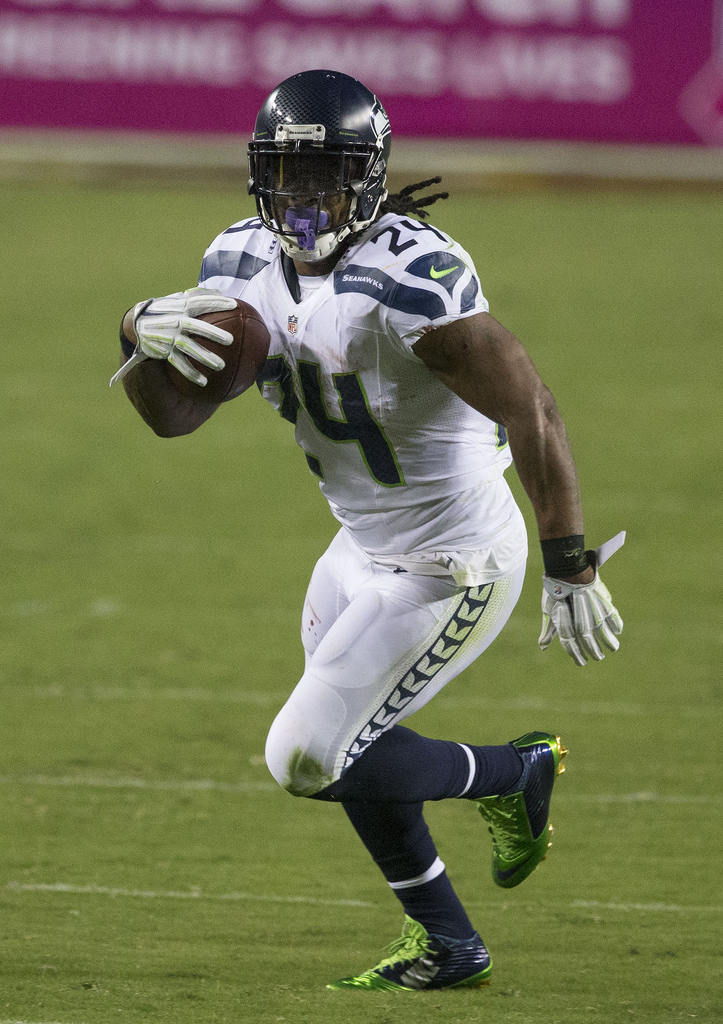
Retired Seahawks legend, Marshawn Lynch, is rumored to be interested in coming out of retirement. But in a curious turn of events, the veteran running back is not interested in returning to play for his former team, the Seattle Seahawks, where he won an NFL championship in 2014. Rather, after meetings with his hometown team, the Oakland Raiders, Lynch may be interested in returning to the gridiron to don the silver and black. Continue reading

SCOTUS to Weigh in On Constitutionality of Offensive Trademarks

wa-redskins

Another Controversial Trademark: The Washington Redskins

By Adam Roberts

Simon Shao Tam named his band ‘The Slants,’ to make a statement.  He wanted to address cultural issues and discussions regarding race in society.  This type of free speech is generally considered foundational to the protections of the First Amendment.  But, Tam was denied this right.

In In Re Tam, the U.S. Patent and Trademark Office (USPTO) denied Tam’s registration for ‘The Slants,’ finding that a “substantial composite of persons of Asian descent would find the term offensive.”  Tam appealed his case to the Federal Circuit Court of Appeals who overturned the decision.  In her opinion, Judge Kimberly Moore expressed that the statute on which the Government relied – Section 2(a) of the Lanham Act – was unconstitutional under the First Amendment.  The court held that discrimination against content-based private speech is subject to strict scrutiny, which means the Government must present a compelling interest to restrict this kind of speech.  The Government’s interest in excluding speech they determined offensive was considered illegitimate to the court, and a judgment was entered in favor of Tam.

Continue reading