The Strippers’ Bill of Rights: a Revolution in Adult Entertainment

By: Karina Paup Byrnes

On March 24, 2024, Washington’s State Governor, Jay Inslee, signed into law the “Strippers’ Bill of Rights” (SB 6105/ HB 2036), which provides adult dancers with increased safety protections in the workplace. Adult entertainers employed at strip clubs across Washington state are now legally entitled to safeguards such as keypad entrances to dressing rooms, panic buttons in private room where employees are alone with customers, mandatory sexual harassment training for all employees, and security guard staffing on site. However, this bill represents more than just a win for workers’ safety and financial security. The legislation importantly recognizes that adult entertainers should be afforded the same rights and protections as any other employee, allowing dancers to more freely and safely participate in the creative expression of their profession.

Strippers Are Workers

The Strippers’ Bill of Rights movement was spearheaded by the dancer-led organization known as Strippers are Workers (“SAW”). SAW “fights to empower the dancers of Washington state so that they can strip safely, positively, and lucratively.” Established in 2018, the organization has been a leader in calling for greater regulation of the adult entertainer industry in Washington. SAW has successfully advocated for reductions in industry practices that are harmful to dancers. Its work has enabled dancers to gain protective measures that are both essential for maintaining a safe work environment and crucial for reducing stigmas and other barriers that adult entertainers face.

The SAW’s work has enabled more financial freedom for dancers, seen best in one critical aspect of the Strippers’ Bill of Rights. Currently, dancers must pay a set club fee for every shift they work, whether or not they make money during the shift. Thus, unpaid fees carry over from previous shifts. After its passage, the bill caps these fees at $150 or 30% of the total amount the employee earned during their shift, whichever is less. Additionally, the legislation bars clubs from carrying over unpaid fees. Impeding clubs from imposing predatory financial constraints over their employees will lessen dancers’ burdens to work with potentially hazardous clients and give them greater financial independence.

Increased Revenue, Safety, and Freedom

A key component of the legislation involved repealing the prohibition of alcohol sales in strip clubs. Prior to the bill’s passage, Washington was the only state that imposed an absolute ban on alcohol sales in strip clubs. This restriction limited the revenue of dancers and clubs and put pressure on dancers to engage with guests, even when such guests arrived at the club highly intoxicated or were known to be violent. The purpose behind allowing strip clubs to apply for alcohol licenses is to prevent abuse of dancers and to enable greater financial mobility for employers and employees. Additionally, with the increased revenue generated through alcohol sales, clubs should be able to afford the safety protections as required by the Act.

The Strippers’ Bill of Rights signals that mandated safety measures in strip clubs are long overdue. Proponents of the legislation are celebrating the reform of adult entertainer establishments not just for the increased physical safety and potential positive financial effects, but also for the validation of dancers as employees who deserve respect and autonomy in the workplace. These protective measures empower dancers and enable them to retain the self-expression that is an important element of their work.On a larger scale, the bill also demonstrates the growing movement towards the decriminalization of sex work. SAW’s campaign manager stated that “there needs to be more of a national push for a more radical and revolutionary way of establishing labor rights, because, you know, it is 2024 and it’s time to do things differently.” As the Washington State Department of Labor and Industries starts drafting and implementing the new rules and guidelines for adult entertainment clubs over the next year, many will be looking at how the work environment for dancers will begin to change for the better. Protecting the rights and interests of dancers participating in sex work has garnered more attention by lawmakers, and advocates hope that other states will follow in Washington’s steps.

Emulation or Piracy for Profit? Nintendo Says No.

By: Kevin Vu

Nintendo, the developer of various beloved video games and consoles, was recently in the news for its lawsuit against, and subsequent settlement with, Tropic Haze, the developers of the Nintendo Switch emulator “Yuzu.” In the initial complaint, Nintendo alleged that “[w]ith Yuzu in hand, nothing stops a user from obtaining and playing unlawful copies of virtually any game made for the Nintendo Switch, all without paying a dime to Nintendo or any of the hundreds of other game developers and publishers making and selling games for the Nintendo Switch. In effect, Yuzu turns general computing devices into tools for massive intellectual property infringement of Nintendo and others’ copyrighted works.” In essence, Nintendo alleged that Tropic Haze “facilitate[d] piracy at a colossal scale.

Nintendo’s battles against piracy are nothing new. The company has a storied history of filing lawsuits against various forms of piracy – including individuals who sold Nintendo Switch-hacking devices and international cases against Nintendo game copy-holding websites. But some commentators argue that emulation is not piracy – which might explain why Nintendo has yet not filed similar lawsuits against other emulators like “Dolphin” (which emulates the Nintendo Wii). 

Emulation or Piracy?

Emulation, as commonly referred to in this context, means a computer program that “imitates a video game console.” At first blush, it is easy to see why such programs would be an issue for first-party developers like Nintendo. Emulation programs might disincentivize consumers from buying the latest video game console to play their video games for example.  The historic answer to criticisms like that is that emulation falls under fair use

For example, in Sony Computer Entertainment v. Connectix Corp., 203 F.3d 596, 609 (9th Cir. 2000), the Ninth Circuit determined that an emulator for Sony’s PlayStation did not infringe on Sony’s copyright because that emulator fell under fair use. Courts typically consider four factors for determining whether fair use applies: (1) the purpose and character of the use, (2) the nature of the copyrighted work, (3) the amount and substantiality of the portion used in relation to the copyrighted work as a whole, and (4) the effect of the use upon the potential market value of the copyrighted work. 17 U.S.C. § 107. Under the Ninth Circuit’s precedence at the time, fair use preserved the public’s access to elements in copyrighted computer codes. Sony Comput. Ent., 203 F.3d at 603. The court determined that the second factor weighed in favor of fair use because Sony’s program was not publicly available such that the defendant’s process of reverse engineering Sony’s program was necessary to replicate the program. Id. at 603-04. As to the first and fourth factors, the court concluded that the defendant’s emulation program was transformative because it “afford[ed] opportunities for game play in new environments” such that “the [emulator was] a legitimate competitor in the market for platforms on which Sony and Sony-licensed games [could] be played.” Id. at 606-07. Accordingly, the court concluded that the emulation of Sony’s PlayStation was protected under fair use. Id. at 609.

That reverse engineering approach was codified by the Digital Millennium Copyright Act (DMCA) as 17 U.S.C. § 1201(f), which generally allows for reverse engineering of a computer program “for the sole purpose of . . . achiev[ing] interoperability of an independently created program[.]” 

In contrast, piracy is understood as “[t]he illegal reproduction and distribution of copyrighted material on the Web.” That definition is distinguishable from the situation in the Sony Computer Entertainment case because there, the emulator was essentially a reverse engineered PlayStation that did not wholly copy Sony’s program. But, as some proponents have argued, emulation naturally leads to piracy because emulators do not have anti-piracy safeguards. The idea behind this is that a video game console, like the Nintendo Switch, will have safeguards that disallow someone from using a pirated copy of a game, but emulators do not have that same protection. Because emulators can run on pirated games, the argument is that emulators support piracy by doing so, resulting in lost profits for the developers of both games and consoles. In contrast, however, some argue that emulation is necessary to preserve the history of video games, along with letting people enjoy games or video game systems that are no longer produced or supported.

Why Yuzu was Targeted.

Many individuals have theorized that Yuzu was targeted because the program emulated a current-generation console in the Nintendo Switch, as opposed to other emulators which are focused on older consoles that are no longer supported. Others have pointed out that Nintendo’s original complaint did not explicitly argue that the Yuzu emulator was illegal, but rather because Yuzu’s developers showed how to break into Nintendo’s game files or even a Nintendo Switch. Additionally, the complaint also noted that Yuzu had a Patreon page (a website that allows people to support creators by donating on a monthly subscription basis) that provided subscribers with early access and unreleased features to the public – in short, that Tropic Haze was profiting from Yuzu. 

Whatever the reason, Nintendo’s actions have already had wide effects on other emulators. For example, Tropic Haze was also developing “Citra,” a 3DS emulator, but under their settlement agreement with Nintendo, Citra has also been discontinued. Another Nintendo console emulator, “DraStic” (for the Nintendo DS), used to be a paid app on Google Play but has since been free to download

All of this is a signal that Nintendo, and perhaps other companies, may seek to be more litigious with emulators. Although the DMCA and case law may allow certain forms of emulation, clearly Nintendo is looking at other strategies to fight emulators. For example, when the Dolphin emulator was seeking to be added to the Steam storefront, Nintendo told Steam that Dolphin did not comply with the DMCA because Dolphin used Nintendo’s encryption keys. Dolphin disputed that determination, but Steam refused to allow Dolphin on its storefront until Dolphin and Nintendo could reach an agreement. Currently, Dolphin is still available on the Internet for download and use. Whatever the case, individuals and emulators should be wary about Nintendo’s – and other video game company’s – recent efforts in combating emulation and privacy.

Shelving the dream of an online library? Hachette v. Internet Archive goes to the Second Circuit

Photo by Perfecto Capucine on Pexels.com

By: Zachary Blinkinsop

The opening chapter: COVID-19 and the National Emergency Library.

With the COVID-19 lockdowns of early 2020 slamming library doors shut, students and researchers found themselves struggling to access critical educational materials. Libraries, like many institutions, scrambled to adapt to the unprecedented challenges posed by the pandemic. Many librarians responded by espousing the use of copyrighted materials in remote education and research. They cited the doctrine of fair use which protects certain unlicensed uses of copyrighted materials without permission from the rightsholder. Fair use can protect the use of copyrighted materials in a range of contexts, including in research, education, news reporting, and criticism.

The main character in today’s story, an online library, may have pushed the limits of fair use too far. Even before the pandemic, the Internet Archive ran a digital library in compliance with the principles of controlled digital lending. Controlled digital lending (CDL) is a novel legal framework that would permit libraries to digitize their physical books and to lend those digital copies in a manner analogous to traditional lending practices. Under the CDL framework, a library needs to maintain an “owned to loaned” ratio, lending only as many digital copies of an item as it legally owns. The legal theory of CDL had been largely untested, and legal scholars held a wide range of opinions about whether courts would broadly hold CDL to comport with fair use.

In March of 2020, the Internet Archive launched its National Emergency Library to support “emergency remote teaching, research activities, independent scholarship, and intellectual stimulation” while schools and libraries were closed due to the pandemic. It temporarily allowed multiple users to check out the same digital copy simultaneously, disregarding the “owned to loaned” ratio prescribed by the CDL framework. This sparked controversy.

The plot thickens: a lawsuit filed.

Publishers had already been taking aim at controlled digital lending programs. The Authors Guild argued that “copyright law does not support the practice of even true, traditional libraries offering unauthorized scans of books to its users on an e-lending basis…” The National Emergency Library’s flouting of CDL’s permissive framework crossed an implicit redline for publishers. In June of 2020, Hachette, HarperCollins, Wiley, and Penguin Random House sued the Internet Archive in the Southern District of New York for “willful mass copyright infringement.” In their complaint, publishers eviscerated the underpinnings of CDL, “the rules of which”, they wrote, “have been concocted from wholecloth and continue to get worse.”

In its response, the Internet Archive insisted that the National Emergency Library qualified under fair use as it offered a noncommercial, educational service to the public during a national emergency. It further maintained that a digital library should be treated like a traditional library: “Contrary to the publishers’ accusations, the Internet Archive and the hundreds of libraries and archives that support it are not pirates or thieves. They are librarians, striving to serve their patrons online just as they have done for centuries in the brick-and-mortar world.”

The future of controlled digital lending and the viability of online libraries was at stake in the case.

How does fair use apply to controlled digital lending?

Section 107 of the Copyright Act directs courts to consider four factors when evaluating a fair use defense to a claim of copyright infringement. A court must balance (1) the purpose of and character of the use, including whether it innovates in any way and whether it is for a commercial or non-profit purpose; (2) the nature of the copyrighted work; (3) the amount of the portion used in relation to the copyrighted work as a whole; and (4) the effect of the use upon the market value of the copyrighted work. Courts adjudicate fair use claims on a case-by-case basis; an activity that qualifies as fair use in one set of circumstances may not qualify under a different set of facts.

Capitol Records v. ReDigi, a case decided in 2013, foreshadowed the outcome of Hachette v. Internet Archive. ReDigi was a service that facilitated the resale of digital files originally purchased from the iTunes store. In that case, the court held that ReDigi’s resale of digital music files fell “well outside the fair use defense.” Running through the four-step test, the court found that (1) uploading and distributing digital files for sale does not add anything new to a copyrighted work; (2) copyright protections are intended to protect musical recordings; (3) transmitting a work in its entirety usually negates a fair use defense; and (4) ReDigi’s sales obviously undercut Capitol Records’ profits.

Although ReDigi’s marketplace was commercial in nature, an obvious difference from the nonprofit intent of the National Emergency Library, the other facts broadly aligned. The National Emergency Library arguably did not innovate the use of copyrighted books. Copyright protections clearly protect rightsholders’ interests in published books. The books offered through the National Emergency Library were transmitted in whole, and this arguably undercut the publishers’ profits from ebook sales.

An open-and-shut case? The Second Circuit enters the plot.

Judge John G. Koeltl held that the Internet Archive’s National Emergency Library failed all four factors of the fair use test. He wrote in his opinion that “IA’s fair use defense rests on the notion that lawfully acquiring a copyrighted print book entitles the recipient to make an unauthorized copy and distribute it in place of the print book, so long as it does not simultaneously lend the print book. But no case or legal principle supports that notion. Every authority points the other direction.” The opinion was a resounding victory for publishers.

The Internet Archive promised to continue fighting. The founder of the Internet Archive, Brewster Kahle, framed the case as a battle for free access to information within a wider war for global democracy: “Libraries are more than the customer service departments for corporate database products. For democracy to thrive at global scale, libraries must be able to sustain their historic role in society—owning, preserving, and lending books.”

On December 15, 2023, the Internet Archive filed its opening brief to the U.S. Court of Appeals for the Second Circuit. In the brief, the Internet Archive asks the Court to reverse the lower court’s decision and to hold that its controlled digital lending is fair use. The Internet Archive is arguing that the lower court erred in applying the four-factor test because the court “failed to grasp the key feature of controlled digital lending: the digital copy is available only to the one person entitled to borrow it at a time, just like lending a print book.” The Internet Archive says that the court’s misunderstanding particularly tainted its analysis of the first and fourth factors. For example, it argues that the court’s analysis of the fourth factor did not take into account expert testimony indicating that “lending is not a substitute for Publishers’ ebooks and has no effect on Publishers’ markets.”

The Second Circuit’s decision in this case will shape the future of controlled digital lending and the ongoing debate surrounding fair use and access to information in the digital era. Librarians, publishers, and legal scholars will be watching closely, waiting for the next major development in the application of free use to a rapidly evolving digital world.

Stay tuned for the next chapter in this story.

Gene Editing and IP Battles: The Fight for CRISPR/Cas-9 Patent Rights

By: Bethany Butler

Gene editing technologies have the potential to greatly influence medicine and impact future therapies to treat debilitating conditions. Gene editing research seeks to “modify genes of living organisms to improve our understanding of gene function and develop ways to use it to treat genetic or acquired diseases.” One gene editing tool is the CRISPR/Cas-9 system, which allows for precision genome editing by cutting DNA in targeted locations for replacement. The first gene editing therapy utilizing CRISPR/Cas-9, called Casgevy, was approved by the Food and Drug Administration (FDA) in December of 2023. Casgevy is a treatment for patients with sickle cell disease, an inherited blood disorder that may cause painful symptoms and require lifelong interventions.

The emergence of CRISPR/Cas-9 Technology

The history of the CRISPR/Cas-9 system’s discovery and application largely involves two prominent research teams battling for its intellectual property rights. One team (“the Broad Institute”) hails from molecular biologist Feng Zhang of the Broad Institute, Harvard University, and the Massachusetts Institute of Technology; the other (“Charpentier and Doudna”) represents researcher Emmanuelle Charpentier of the Max Planck Institute for Infection Biology, Jennifer Doudna of the University of California, Berkeley, and the University of Vienna. Both teams have found success with their CRISPR/Cas-9 systems. In 2020, Emmanuelle Charpentier and Jennifer Doudna won the Nobel Prize in chemistry for the team’s 2012 discovery of the Cas-9 enzyme’s role in the CRISPR process. 

The two groups have not existed in harmony though, as patent battles between them stem from each groups’ 2012 US Patent and Trademark Office (“USPTO”) filings. Both teams filed applications to protect their respective gene editing tools, and unless the teams claimed distinct inventions regarding the use of the CRISPR/Cas-9 technology in human genomes, the USPTO would not allow patent protection to extend to both. 

Patent Protections of Gene Editing Technology

There are three types of patents that an inventor may file with the USPTO: utility, design, and plant. Gene editing technologies, like the CRISPR/Cas-9 system, often fall under the utility patent category. Utility patents are useful, new, and non-obvious. The non-obvious requirement refers to if a person of ordinary skill in the art would likely predict the invention by combining prior art references. CRISPR/Cas-9 patent rights come with limited monopolies, the potential for patent royalties, access to license the technology for future therapies in human cells, like the newly approved sickle cell therapy. 

Charpentier and Doudna’s May 2012 patent application demonstrated the use of this technology but did not go so far as to claim its use in eukaryotic cells (i.e. CRISPR/Cas-9 gene editing in human cells). Conversely, the Broad Institute demonstrated the use of this technology specifically in eukaryotic cells in their December 2012 patent application. The Broad Institute’s patent application was approved on April 15, 2014, and the team received the first patent for a method of altering eukaryotic cells using the technology. 

The CRISPR/Cas-9 Patent Fight

The Broad Institute, led by molecular biologist Feng Zhang, prevailed over Doudna and Charpentier regarding patent rights related to the CRISPR/Cas-9 technology. The main issue over these rights is which team developed the use of the CRISPR/Cas-9 gene editing in the modification of eukaryotic genomes.

Over the last 10 years, the two research teams have appealed various patent decisions, with the Patent Trials and Appeals Board (PTAB) and the Federal Circuit continually ruling in favor of the Broad Institute. For example, in a 2017 appeal, the Federal Circuit confirmed the PTAB’s finding that the Broad Institute’s claims were non-obvious regarding “the extent to which the art provided instructions for applying the CRISPRCas9 technology in a new environment”. The latest decision was on February 28, 2022, confirming the Broad Institute’s team was the first to invent the technology for modifying genomes in human cells. The decision stemmed from earlier interference claims holding that the Broad Institute’s patents claimed distinct subject matter compared to Doudna and Charpentier’s claims. Currently, the Broad Institute and Zhang’s team has prevailed in the patent space for the rights to CRISPR/Cas-9 gene editing technology in eukaryotic cells and now are able to license this technology for therapeutic applications. 

The CRISPR/Cas-9 Technology In Action Today

The Broad Institute licensed its technology to Editas Medicine in 2014. Vertex Pharmaceuticals, the pharmaceutical company that developed the sickle cell therapy, Casgevy, reached a licensing deal with Editas Medicine in December 2023. This deal pertains to the use of the CRISPR/Cas-9 technology in the Casgevy treatment and other sickle cell therapies. Individuals with sickle cell disease inherit genes that encode for abnormal hemoglobin production resulting in abnormal red blood cells. The Casgevy treatment uses the CRISPR/Cas-9 technology to edit patients’ blood stem cells to increase the production of fetal hemoglobin, which is not affected by the sickle cell mutation, thereby diluting the affected sickled blood cells. The edited cells are then infused back into the patient and have the potential to treat the disease. For the use of this technology, Vertex Pharmaceuticals agreed to pay Editas Medicine $50 million dollars upfront and licensing fees through 2034 ranging from $10 million to $40 million dollars annually. 

The far reaches of gene editing technologies have the potential to transform medicine and better the lives of many. CRISPR/Cas-9 editing technology is a vital therapeutic tool in this space and the fight for its patent rights continues. With the rollout of novel therapies, U.S. patent law is the key to lucrative licensing deals for the victors in these CRISPR/Cas-9 patent wars.

Plot Twist: Understanding the Authors Guild v. OpenAI Inc Complaint

By: Stella Haynes Kiehn

While George R.R. Martin remains hard at work on the final installments in the critically acclaimed A Song of Ice and Fire series; in July 2023, one tenacious fan used ChatGPT to finish the series in a fraction of the time. For fans who don’t feel the urge to read speculations, ChatGPT can also write entirely new stories set in the style and world of any author whose work exists on the internet. These AI-generated novels are only part of a growing issue about the use of copyrighted works to train Large Language Models (LLM) such as ChatGPT. Now, the authors are looking to reverse the narrative. In a complaint filed on Sept. 19, 2023, in the Southern District of New York, the Author’s Guild, the nation’s oldest and largest organization of writers, is suing Open.AI, the maker of ChatGPT, in a class action lawsuit.

The complaint alleges that OpenAI used the authors’ voices, characters, stories, etc. to train ChatGPT, which in turn allowed users to create unauthorized sequels and derivatives of their copyrighted works. Plaintiffs argue that OpenAI should have first obtained a licensing agreement to use their copyrighted works. Plaintiffs also seek a permanent injunction against OpenAI to prevent the alleged harms from reoccurring. All authors seek damages for the lost opportunity to license their works, and for the “market usurpation defendants have enabled by making Plaintiffs unwilling accomplices in their own replacement.” The named plaintiffs include David Baldacci, Mary Bly, Michael Connelly, Sylvia Day, Jonathan Franzen, John Grisham, Elin Hilderbrand, Christina Baker Kline, Maya Shanbhag Lang, Victor LaValle, George R.R. Martin, Jodi Picoult, Douglas Preston, Roxana Robinson, George Saunders, Scott Turow, and Rachel Vail.

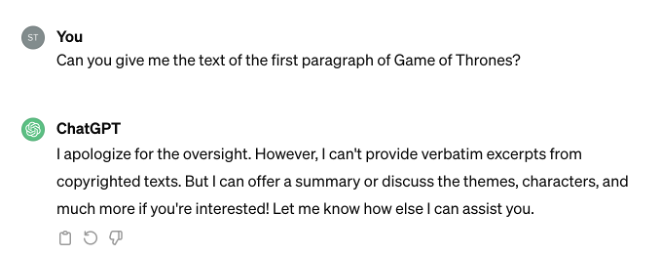
At issue legally is Title 17 of the United States Code. The complaint brings claims under 17 U.S.C. §501 for direct, vicarious, and contributory copyright infringement. 17 U.S.C. §501 allows for copyright owners to sue for enforcement of their exclusive rights and 17 U.S.C. §106 sets forth a list of exclusive rights for copyright owners. Different plaintiffs allege different infringements upon the §106 rights, but all plaintiffs commonly allege ChatGPT’s ability to provide derivative works infringed on their copyrighted materials. Under 17 U.S.C. §101, “a ‘derivative work’ is a work based upon one or more preexisting works, such as a translation, musical arrangement, dramatization, fictionalization, motion picture version, sound recording, art reproduction, abridgment, condensation, or any other form in which a work may be recast, transformed, or adapted.” For instance, Plaintiff Martin alleges that “when prompted, ChatGPT generated an infringing, unauthorized, and detailed outline for an alternate sequel to A Clash of Kings, one of the Martin Infringed Works, and titled the infringing and unauthorized derivative “A Dance With Shadows,” using the same characters from Martin’s existing books in the series A Song of Ice and Fire.” Under U.S. Copyright Law, only a copyright owner may prepare, or authorize someone else to prepare, a derivative work from the copyrighted material. All plaintiffs also commonly allege ChatGPT’s ability to recite verbatim passages from the copyrighted works. Under 17 U.S.C 106, only copyright owners can create, or license the ability to create, direct copies of their work. However, it should be noted that at the time the complaint was filed, ChatGPT will no longer provide direct excerpts from copyrighted works.

Screen capture of the blog author’s attempt to engage ChatGPT with copyrighted content.

Although it is certain that ChatGPT has produced infringing work, how do we know that OpenAI knowingly trained ChatGPT on copyrighted materials? The complaint provides multiple reasons. First, until very recently, “ChatGPT could be prompted to return quotations of text from copyrighted books with a good degree of accuracy, suggesting that the underlying LLM must have ingested these books in their entirety during its ‘training.’” Second, the presence of derivative works on the internet created by ChatGPT suggests that it had access to the source materials. For example, author Jane Friedman discovered “a cache of garbage books” written under her name for sale on Amazon that were created by ChatGPT. Third, it is likely that OpenAI trained ChatGPT on copyrighted items because, as one group of AI researchers have observed, books are essential for chatbot development; “[b]ooks are a rich source of both fine-grained information, how a character, an object or a scene evolve through a story.” Finally, OpenAI has essentially confirmed this to be true, stating that their  “training” data is “derived from existing publicly accessible ‘corpora’ … of data that include copyrighted works.”

Open AI maintains that its actions were lawful. In a blog post responding to the filing of The New York Times v. OpenAI, a suit about using New York Times copyrighted materials to train ChatGPT, OpenAI argues that “based on well-established precedent, the ingestion of copyrighted works to create large language models or other AI training databases generally is a fair use.” The Library Copyright Alliance (LCA) also supports a fair use argument, pointing to the history of courts applying the US Copyright Act to AI. Fair use is a legal doctrine that permits the unlicensed use of copyright-protected works in certain circumstances, such as for parody, comment, or criticism. The LCA focuses on “the precedent established in Authors Guild v. HathiTrust and upheld in Authors Guild v. Google.” Notably, in Authors Guild v. Google, the US Court of Appeals for the Second Circuit held that Google’s mass digitization of a large volume of in-copyright books to distill and reveal new information about them was a fair use. The LCA argues that “while these cases did not concern generative AI, they did involve machine learning” and the fair use precedents could summarily be applied.

Despite the plaintiff’s complaints about how AI is currently being used, the complaint specifically states that the “plaintiffs don’t object to the development of generative AI”.The complaint simply asserts that “defendants had no right to develop their AI technologies with unpermitted use of the authors’ copyrighted works. Defendants could have “‘trained’ their large language models on works in the public domain or paid a reasonable licensing fee to use copyrighted works.” In fact, the complaint specifically recognizes that OpenAI’s chief executive Sam Altman has told Congress that he shares Plaintiffs’ concerns. According to Altman, “Ensuring that the creator economy continues to be vibrant is an important priority for OpenAI. … OpenAI does not want to replace creators.”

Unfortunately for any curious Game of Thrones fans out there, the ChatGPT produced novels have been removed due to the pending lawsuit. However, as AI Chatbots grow more powerful, and users grow more adept, it is undoubtedly true that further lawsuits similar to this one will occur. Open AI amended the complaint in December 2023 to include Microsoft, an investor of OpenAI. The complaint now alleges that “OpenAI’s ‘training’ its LLMs could not have happened without Microsoft’s financial and technical support arising from OpenAI’s use of their copyrighted works to train ChatGPT.” The inclusion of Microsoft, a powerful defendant, against the Author’s Guild, a prominent litigant, creates the potential for this case to have far-reaching ramifications for both copyright holders and AI developers.