
Stock Split and the Failure of a Shareholder Democracy

underarmourBy Joe Davison

Background: Since its founding, Under Armour has maintained a dual-class stock structure consisting of Class A Stock, which has been entitled to one vote per share, and Class B Stock, which has been entitled to ten votes per share. Founder and CEO, Kevin Plank, beneficially owns all of the company’s Class B Stock and also owned a small portion of the Class A Stock. As of June, this provided Mr. Plank with 65.5% of the company’s total voting power, but only 16.6% of the total number of outstanding shares. Under the terms of Under Armour’s charter, if the aggregate number of shares of Class A Stock and Class B Stock owned by Mr. Plank is less than 15% of the total number of shares, the dual-class structure will unwind and all Class B Stock would be automatically converted in to Class A stock. This would result in Mr. Plank effectively losing control of Under Armour.

In November 2014, Mr. Plank reviewed his current ownership of Class B Stock with Under Armour’s Board of Directors and requested that the Board evaluate the creation and issuance of a class of non-voting common stock. The Board authorized a Special Committee to consider such a class of non-voting common stock, and to evaluate and make a recommendation to the Board as to whether and on what terms to proceed. The Special Committee recognized that the Company has been well-served by allowing Mr. Plank and management to focus on long-term value creation without distraction. Accordingly, the Special Committee informed Mr. Plank that it would recommend the creation of a Class C Stock and a Class C Dividend. The Dividend would distribute one new share of the non-voting stock for every existing share of Class A and Class B stock. This would allow shareholders to sell the Class C stock without losing any of their voting power. Continue reading

Will Google’s Patent Purchase Promotion Foster Innovation?

patent By Cheryl Lee

Some believe the US patent system is being used to curb innovation, handicap inventors and drain corporate resources in lengthy litigation that cripples competition rather than being used to drive innovation. Many US legislators believe that patent ‘trolls,’ the non-practicing entities that purchase patents and pursue infringement litigation, threaten America’s economy and ability to innovate. In response to the patent trolls, Representative Bob Goodlatte (R-VA), along with 27 cosponsors, introduced the anti-troll legislation, H.R. 9 – Innovation Act in February, 2015.

However, the US Congress is not the only entity that wishes to solve the problems within the patent system. On April 27, 2015, Google announced the ‘Patent Purchase Promotion,’ an experimental marketplace inviting owners to directly sell their patents. Google stated that bad things such as lawsuits and wasted efforts happen when smaller participants sometimes end up working with patent trolls. Therefore, the Patent Purchase Promotion is Google’s attempt to “remove friction from the patent market” and “help improve the patent landscape and make the patent system work better for everyone.” The Patent Opportunity Submission Portal opened from May 8 – 22, 2015 for patent holders to submit information to Google about the patents they wanted to sell and at what price. Continue reading

Go Fund Yourself: The SEC finalizes Regulation A+

blog_6_26 By Christian Kaiser

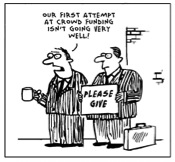
In March, the Securities and Exchange Commission (SEC) approved final rules of Title IV of the JOBS Act, changing Regulation A into “Regulation A+.” Entrepreneurs selling securities to private investors are no longer limited to using Regulation D or the old Regulation A. Entrepreneurs can now crowdfund their startup online through a “mini IPO.” Many believe these new rules show that the government has embraced technological changes. Some are optimistic about what they see as an opening of the crowdfunding floodgates, but the rules’ restrictions and requirements suggest such sweeping optimism may be misplaced.  Continue reading

Just Add Sugar: Home Brewing Morphine Using New Process

Red PoppiesBy Sam Hampton

On May 18, a group of researchers published an article describing a method for the conversion of simple sugar to opioids including morphine. Proponents believe this could change the way many useful drugs are manufactured, while others are calling for regulation that limits access to the required DNA. The process is not currently feasible outside of a laboratory, but commentators worry that refinement of the technique could lead to people creating morphine with the same equipment used to craft home brewed beer. Such a streamlined process could be developed within a year.

Morphine and other opioids are historically produced from the poppy plant. The cultivation of the crop is common in Latin America, as well as Southwest and Southeast Asia. Farmers in countries with weak drug enforcement, such as Afghanistan, Myanmar, and Mexico, supply the crop to drug cartels, who smuggle and distribute heroin throughout the world. In Afghanistan, which produces much of the world’s heroin, the value of trafficking of opium is estimated to be $8 billion dollars a year. The wide spread use of this new process could disrupt these established supply routes.

The DEA does not presently consider the development to be “an imminent threat.” However, commentators, such as Kenneth A. Oye, have voiced concerns over the implications of this new process. He is particularly concerned with the reaction of drug cartels. These cartels could adopt the technology and manufacture heroin domestically, without the need to smuggle drugs across borders. The loss of exclusive control over the supply could also lead to a violent reaction as it has in other drug markets; Mexican gangs have taken over farms growing marijuana in the United States. Moreover, the capacity to create the opioids could lead to widespread domestic manufacture, as in the case of methamphetamine, resulting in increased availability.

Heroin is extremely dangerous and addictive. According to a 2014 DEA report, both use and availability are actually on the rise in the United States. In recent years, heroin and opioid abuse have ravaged regions of the country, particularly the Northeast. In 2014 in Connecticut alone, there were around 500 deaths involving overdoses of heroin and other opioids. Widespread availability resulting from the new process could exacerbate these trends.

Yet proponents of the process think these concerns are overblown. Christina D. Smolke believes that the required skills for this sort of manufacture are beyond those without training. Furthermore, Robert H. Carlson argues that these prohibitions would simply fail to work, just as Prohibition failed to abolish illegal alcohol manufacture. This may be a practical reality, but the consequences of wide spread heroin availability are a far more dangerous proposition that may warrant tight control of this process.

Image Source: http://7-themes.com/6921476-red-poppies-field.html.

Securing Dr. Robot

unnamed By Brooks Lindsay

Medical device robots present a number of cybersecurity, privacy, and safety challenges that regulation and industry standards must address in order to safely and rapidly advance innovation in the field.

The University of Washington’s Computer Science Department recently highlighted the problem. Computer Science Researchers hacked a teleoperated surgical robot called the Raven II during a mock surgery. The hack involved moving pegs on a pegboard, launching a denial-of-service attack that stopped the robot, and making it impossible for a surgeon to remotely operate. The researchers maliciously controlled a wide range of the Raven II’s functions and overrode command inputs from the surgeon. The researchers designed the test to show how a malicious attack could easily hijack the operations of a medical device robot. The researchers concluded that established and readily available security mechanisms, like encryption and authentication, could have prevented some of these attacks.  Continue reading