“Don’t Copy My Style!” Exxon’s Trademark “Style” Infringement Claim Against Fox

exxonBy Chike Eze

Consumers associate a trademark with a familiar experience associated with a specific source. For example, consumers associate the “golden arches” symbol with McDonald’s cheeseburgers and fries. To protect such profitable associations, an owner of a well-known trademark may file for federal registration with the United States Patent and Trademark Office (“USPTO”). USPTO requires the trademark owner, among other things, to police its mark by challenging others who impermissibly copy and use the mark. Therefore, it is not particularly newsworthy that Exxon Mobil Corporation (“Exxon”), an owner of several federally-registered trademarks, brought a complaint against 21st Century Fox et. al. (“Fox”) alleging federal trademark infringement, inter alia. However, Exxon makes an unusual argument that Fox infringed Exxon’s marks by copying the marks’ common “style.” Continue reading

“Back Doors” in Encrypted Technology for the Government Will Harm National Security and Privacy

Screen Shot 2015-08-10 at 8.32.43 AMBy Michael Huggins

In the wake of an international controversy over government surveillance, U.S. technology companies have developed end-to-end encryption for users who want to send information. End-to-end encryption gives the sender and the recipient decryption keys for a piece of data or a message. Without these decryption keys, law enforcement officials cannot access the data or the message. Even with lawfully authorized access to the information, end-to-end encryption may allow criminals to keep their communications secret from the government. Additionally, the United States and other nations have expressed concerns that encryption will provide secure communications to terrorist organizations.  Continue reading

“Oxygen OS” and the Future of the OnePlus Two

Screen shot 2015-08-03 at 8.07.20 PMBy Yayi Ding

On July 27th, 2015, Chinese smartphone manufacturer OnePlus unveiled its second-generation smartphone, the “OnePlus Two.” This was a highly anticipated launch, because OnePlus’ first device, the OnePlus One, took the smartphone industry by storm just over a year ago. The OnePlus One offered the kind of high-end specs found in today’s elite smartphones, but for just a fraction of the price. Consequently, OnePlus has sold over 1 million OnePlus One smartphones thus far – no small feat for a new start-up based out of southern China. But, due to a series of behind-the-scenes legal issues, the OnePlus Two will not offer the popular operating system found in its predecessor, Cyanogen OS, but instead will feature OnePlus’ own operating system: Oxygen OS. This difference may be critical to the OnePlus Two’s future success. Continue reading

SCOTUS Teva Ruling: Big Splash with Little Impact

bookBy Miriam Swedlow

Despite overruling the Federal Circuit’s prior practice of reviewing all aspects of patent claim construction de novo, the Supreme Court’s ruling in Teva Pharmaceuticals USA, Inc. v. Sandoz, Inc. has not dramatically changed the standard of review for patent claims. Instead, it imparts a sub-category of analysis in cases where the district court relies upon extrinsic evidence to clarify ambiguous or complicated facts needed for proper claim construction. The court first considers whether the district court relied upon extrinsic evidence and if so, whether it needed to in order to properly construe the claim. As predicted by the Supreme Court, only a small number of cases have required clear error review of fact finding in the months following the Teva decision. Ultimately, clear error review of fact-finding from extrinsic evidence simply adds one step prior to the traditional de novo review applied to patent claim construction.  Continue reading

Online Retailers Beware: Amazon Search Results Might Violate Watchmaker’s Trademark

Untitled2 By Brennen Johnson

Last week, the Ninth Circuit Court of Appeals handed down its decision in Multi Time Machine, Inc. v. Amazon.com, Inc.. Although the case doesn’t deal with time travel like the name might suggest (so disappointing!), the Court’s decision on whether the behemoth online retailer’s search results could have violated the watch manufacturer’s trademark certainly is interesting. In a two to one decision, the panel of three judges decided that Amazon might have violated Multi Time Machine’s (“MTM”) trademark by displaying competitors’ watches when online customers searched for a particular MTM model.

So how is this interesting? Let’s paint this case in the terms used by Judge Silverman in his dissent against the other two judges—If a patron walks into a restaurant and orders a “coke” and the waiter responds, “We carry Pepsi,” has the restaurant infringed on Coca Cola’s trademark? The majority’s decision suggests that the restaurant might have infringed, but that it is a question for a jury. Similar to the restaurant’s actions, Amazon, who is unable to carry MTM watches, displays the similar products of MTM’s competitors when the customer searched for MTM watches.

It seems absurd that Amazon could be liable for simply responding to requests for an unavailable product by suggesting other similar products. However, things get a bit more murky when you consider the root question that results in liability for this type of trademark infringement: could a reasonable person be initially confused by the search results and believe that the watches displayed on Amazon’s page were somehow affiliated with MTM? If so, then customers might consider buying the competitors’ watches based on the reputation of MTM’s trademark, and both Amazon and the competitor would unfairly profit from MTM’s hard work in building a well-respected business.

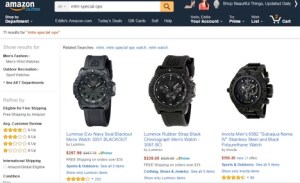
So, how might Amazon’s search results confuse a customer? Well, in this author’s opinion, only by being a pretty thick dunce. The law requires that the results be confusing to a “reasonably prudent consumer,” and in my book, the poor dunce who gets confused by these search results doesn’t quite make the cut. Like the district court that first considered the case and Judge Silverman (who dissented from the majority’s opinion), I believe that the results are so clearly labelled that no reasonable mind would think that they were somehow affiliated with or originated from MTM. But you don’t have to take my word for it. You can check out the image in the thumbnail above or click here to see for yourself.

The majority opinion reaches a different opinion by determining that the text “MTM special ops” which remains displayed in the search box at the top is sufficient to confuse customers about who manufactured the products. The majority explained in its opinion that, although the displayed results were each clearly labeled as the product of a different company, the clarity of the page’s layout as a whole created a legitimate question of whether or not it might confuse a customer about the origins/maker of the displayed products.

As an additional note that online retailers should consider taking to heart, the majority said when reaching its conclusion, “A jury could infer that the labeling of the search results, and Amazon’s failure to notify customers that it does not have results that match MTM’s mark, give rise to initial interest confusion.” If an online retailer wants to avoid this whole debacle, the cleanest method would be to spell it out when none of the products it provides meet the exact product description typed into the search bar.