Anti-Mafia Laws Make Their Presence Known Once Again

Screen Shot 2014-07-16 at 9.33.37 AMBy Eric Siebert

When we think about the word “mobster,” we often recall names such as Al Capone, and think of the time period of the early 20th century. We generally don’t associate the word “mobster” with hackers or the computer age. Recently, however, the Racketeering Influenced Corrupt Organizations Act (or RICO) has made such an association. Originally envisioned as a tool to target gang leaders who avoided direct liability by ordering subordinates to commit crimes, RICO has recently been used to target cybercriminals engaged in racketeering offenses. Rather than being used to target leaders of mafia-type activities, the law is now being used to prosecute and impose stiffer penalties on online criminals who engage in organized crime through various virtual networks.

RICO, passed in 1970, allows for the imposition of criminal penalties of up to 20 years imprisonment (or more if the underlying crime carries a higher maximum penalty), or civil penalties amounting to triple the actual damages incurred. Private individuals may also bring claims against anyone who has participated, directly or indirectly, in racketeering activities. To establish a claim under RICO, according to one Supreme Court case, a defendant must have “conduct[ed] or participat[ed] in the conduct of an enterprise ‘through a pattern of racketeering activity.’” Put simply, a defendant must have acted as part of a group that commits a series of at least two acts that qualify as racketeering activities. A useful breakdown of these elements can be found here. Continue reading

USPTO Cancels NFL’s Trademark Registration For Washington Redskins’ Nickname (Again)

Screen Shot 2014-07-07 at 2.00.56 PMBy Craig Henson

Once again, the United States Patent and Trademark Office has cancelled the National Football League’s trademark registrations for the nickname ‘Redskins,’ in association with the Washington Redskins football team, on the grounds that the name disparages Native Americans, and this time the decision could actually stick.

On June 18, 2014, the USPTO’s Trademark Trial and Appeal Board cancelled six trademark registrations for variations of the name ‘Redskins’ registered under the Lanham Act by respondent Pro-Football, Inc. (owner and operator of the Redskins). The Board held that, pursuant to Section 14(3) of the Lanham Act, the trademarks had been registered in violation of Section 2(a), which prohibits trademarks consisting of “matter which may disparage . . . persons, living or dead, institutions, beliefs, or national symbols, or bring them into contempt, or disrepute.” After an exhaustive review of the record, the Board concluded that the petitioners—five Native Americans—had sufficiently demonstrated that a “substantial composite of Native Americans” found the name to be disparaging in connection with Pro-Football’s services. The Board noted that a ‘substantial composite’ of a group did not necessarily mean a majority of that group, and it rejected any argument that a ‘substantial composite’ of a group required homogenous opinions within that group. Interestingly, while the Board’s decision cancelled registrations pertaining to the name ‘Redskins’ and several variations of the name that occur in combination with logos, the plain Washington Redskins team logo itself was not cancelled because it was not at issue in the case. Continue reading

Clarified or Confused? SCOTUS Decision in Alice v. CLS Bank and Continued Mystification of Abstract Ideas

Screen Shot 2014-07-03 at 9.02.46 PM

By Chris Ferrell

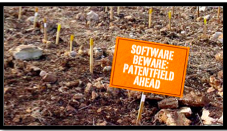
On June 19th, the Supreme Court ruled on its sixth and final patent law case of this term, Alice Corp. v. CLS Bank. The case concerned the patentability of claims covering a computerized trading platform for exchanging financial obligations. The business method patents at issue in Alice were directed to a computer-implemented scheme for mitigating settlement risk in certain financial transactions. The claims included a method, a computer-readable medium, and a system. The key issue for the Court was to identify an appropriate test for determining whether a computer-related invention is an application of an abstract idea. In a unanimous decision authored by Justice Thomas, the Court held that Alice’s claims were not patent eligible under 35 U.S.C. § 101 because they were directed at an abstract idea of intermediated settlement. While the decision was not a surprise to some in the industry, others waited on baited breath to see just how far the Court would go in analyzing these software claims, and to what extent patent analysis would be moving forward. In previous cases, including Mayo Collaborative Services v. Prometheus Labs, Bowman v. Monsanto and Association for Molecular Pathology v. Myriad Genetics, the Court took the opportunity to reign in overbroad positions in patent law and define the outer-boundaries of patentability; Alice was no different. However, in trying to contain patent law, the Court may have muddied the waters even more for those trying to decipher what may be patentable, especially in the realm of computer software. Continue reading

DIY Teslas With Open Sourced Patents

Screen Shot 2014-06-23 at 9.38.34 PMBy Amy Wang

Good news, environmentalists and car enthusiasts alike! Tesla Motors is opening up its patents to the public! Okay, so it may not be as simple as a how-to guide on building your own zero emissions electric vehicle, but, this is a huge step for the open source movement and the advancement of EV technology.

CEO, Elon Musk, announced via blog post on the Tesla website that the company hopes to “accelerate the advent of sustainable transport” by pledging that they “will not initiate patent lawsuits against anyone who, in good faith, wants to use [their] technology.”

Musk followed up his written announcement with a conference call to shareholders and the press. He explained that the convoluted patent system inhibits innovation in an especially tough market. Electric cars make up less than 1% of total vehicle sales in the United States. “Our true competition is not the small trickle of non-Tesla electric cars being produced, but rather the enormous flood of gasoline cars pouring out of the world’s factories every day.” By sharing its technology, Tesla hopes to incentivize other motor companies to help develop the infrastructure needed to make electric vehicles appeal to consumers. For example, potential drivers need to be persuaded that charging stations are as readily available to accommodate their electric cars as gas stations are for other vehicles. Continue reading

Washington Journal of Law, Technology & Arts Publishes Spring 2014 Issue

The Washington Journal of Law, Technology & Arts (LTA Journal) has published its Spring 2014 Issue. The LTA Journal publishes concise legal analysis aimed at practicing attorneys on a quarterly basis.

Scott Kennedy, an associate attorney at Reinisch Wilson Weier, P.C. and a former member of the LTA Journal, wrote the first article, “Who Knew? Refining the ‘Knowability’ Standard for the Future of Potentially Hazardous Technologies.” The article surveys U.S. products liability law pertaining to the duty to warn and analyzes the Ninth Circuit’s decision in Rosa v. Taser International, Inc. to illustrate the problems involved in assessing knowability.

In the issue’s second article, “Are Courts Phoning It In? Resolving Problematic Reasoning in the Debate over Warrantless Searches of Cell Phones Incident to Arrest,” Northwest Justice Project legal fellow Derek Scheurer surveys the courts’ application of the search-incident-to-arrest doctrine to cellphones. He analyzes four problematic arguments that courts often rely on to limit warrantless searches of cell phones incident to arrest, and recommends two possible solutions for restricting police authority to search.

Incoming Editor-in-Chief Peter Montine wrote the third article, “Forced Turnovers: Using Eminent Domain to Build Professional Sports Venues.” The article discusses the application of eminent domain law in sports venue cases and suggests strategies for challenging a city’s use of eminent domain to develop a professional sports venue.

Articles Editor Matthew Fredrickson contributed the fourth article, “Sentencing Court Discretion and the Confused Ban on Internet Bans.” The article discusses the circuit split on judicial sentencing discretion and the imposition of Internet bans as a condition of supervised release.