The Rise of Fractional General Counsel in the Modern Legal Industry

By Thomas Oatridge

What Is a Fractional General Counsel?

The concept of fractional general counsel has emerged as a response to the rising costs of legal services and the evolving needs of modern businesses. A fractional general counsel is a senior lawyer who works with a company on a part-time, temporary, or project basis, rather than as a full-time employee. Unlike traditional general counsel, who are employed in-house, fractional general counsel operate as independent contractors and provide legal support on an as-needed basis. Despite this difference in employment structure, fractional general counsel perform many of the same functions as full-time general counsel. They advise corporate leadership, including boards of directors and executives, on legal and strategic issues. Their role often includes identifying risks, addressing emerging legal challenges, and determining when additional legal support is necessary.

Fractional general counsel typically handle a wide range of responsibilities. These include drafting and negotiating contracts, advising on employment law matters, ensuring regulatory compliance, and managing corporate governance. They may also oversee outside counsel, assist with mergers and acquisitions, and provide guidance on intellectual property, data privacy, and litigation strategy. Importantly, fractional general counsel are not limited to routine legal tasks. They act as strategic partners within the business, combining legal knowledge with an understanding of business operations. Many have prior experience in Big Law firms or as in-house counsel, which allows them to bring both technical expertise and practical judgment to their role. In short, fractional general counsel function like traditional general counsel, but on a more flexible, part-time basis. This allows companies to access high-level legal advice without committing to a full-time hire.

Why the Fractional Model Is Gaining Traction?

The fractional general counsel model is growing largely because it offers a practical solution to a common problem: many businesses need consistent legal guidance but cannot justify the cost of a full-time general counsel. Hiring an in-house attorney often involves a significant salary, benefits, and long-term commitment. At the same time, relying solely on outside law firms can be expensive and inefficient. Fractional general counsel provide a middle ground between these two options. One of the most significant benefits of this model is cost efficiency. Companies can access experienced legal professionals at a predictable cost, often through fixed fees or retainers, without the overhead associated with a full-time employee.

Flexibility is another key advantage. Businesses can scale legal support up or down depending on their needs. For example, a company may require more legal guidance during a period of growth, such as a merger or expansion, and less support during more stable periods. In addition, fractional general counsel offer a more proactive approach to legal issues. Instead of addressing problems only after they arise, they help identify risks early and implement systems to prevent future legal challenges. This can reduce the likelihood of costly disputes or regulatory violations.

Another benefit is that fractional general counsel become integrated members of a company’s leadership team. Unlike outside counsel, who may only engage on specific matters, fractional general counsel develop a deeper understanding of the business and align legal strategies with business goals. Overall, this model aligns cost, flexibility, and strategic legal support, making it an attractive option for many organizations.

Who Uses Fractional General Counsel?

Fractional general counsel are most commonly used by companies that need high-level legal expertise but are not in a position to hire a full-time general counsel. This often includes small and mid-sized businesses, startups, and companies in periods of transition or growth. Startups are a primary example. As these companies scale, they face increasingly complex legal issues, such as contract negotiations, employment matters, and regulatory compliance. However, they may not yet have the financial resources to support a full-time legal department. In these situations, a fractional general counsel can provide essential guidance while allowing the company to manage costs.

Similarly, small and mid-sized businesses benefit from having ongoing legal support without the expense of a permanent hire. These companies often require more than occasional legal advice but do not need a full-time attorney. A fractional general counsel can fill this gap by offering consistent, strategic input. Companies undergoing major changes, such as mergers, acquisitions, or fundraising efforts, also frequently turn to fractional general counsel. These events create complex legal challenges that require experienced oversight. A fractional general counsel can provide this expertise on a temporary basis without long-term commitment. More broadly, the model is appealing to businesses seeking an alternative to traditional law firms. Fractional general counsel offer similar expertise but with faster response times and greater integration into the company’s operations. As a result, the use of fractional general counsel is expanding across industries and stages of business development.

Industry Impact and Future Trends

The rise of fractional general counsel reflects a broader shift in how legal services are delivered. Traditionally, companies relied on either in-house counsel or outside law firms. However, both options can be costly and may not provide the flexibility that modern businesses require. The fractional model offers an alternative that addresses these limitations.

One major impact of this model is the increased focus on cost efficiency. The compensation for full-time general counsel can be extremely high, making it inaccessible for many companies. Fractional general counsel allow businesses to access similar expertise without incurring these significant costs. The model also changes the relationship between businesses and legal professionals. Instead of engaging lawyers only when issues arise, companies can integrate legal advice into their daily operations. This leads to more proactive decision-making and better risk management. Additionally, the growth of fractional general counsel reflects changing work patterns in the legal profession. Many experienced attorneys are seeking more flexible work arrangements, and the fractional model allows them to work with multiple clients while maintaining autonomy.

Looking ahead, the demand for fractional general counsel is likely to continue growing. As businesses face increasing legal complexity, particularly in areas such as compliance, employment, and data privacy, the need for accessible and strategic legal guidance will only increase. At the same time, companies will continue to prioritize cost-effective and flexible solutions. In conclusion, fractional general counsel represent a significant development in the legal industry. By providing high-level legal expertise in a flexible and cost-effective format, they are reshaping how businesses access legal services and are likely to play an increasingly important role in the future of legal practice.

#FractionalGC #LegalInnovation #WJLTA


Art as a Tool to Process Trauma: A Framework for Repair and Reflection

By: Claire Kenneally

What Is Trauma? 

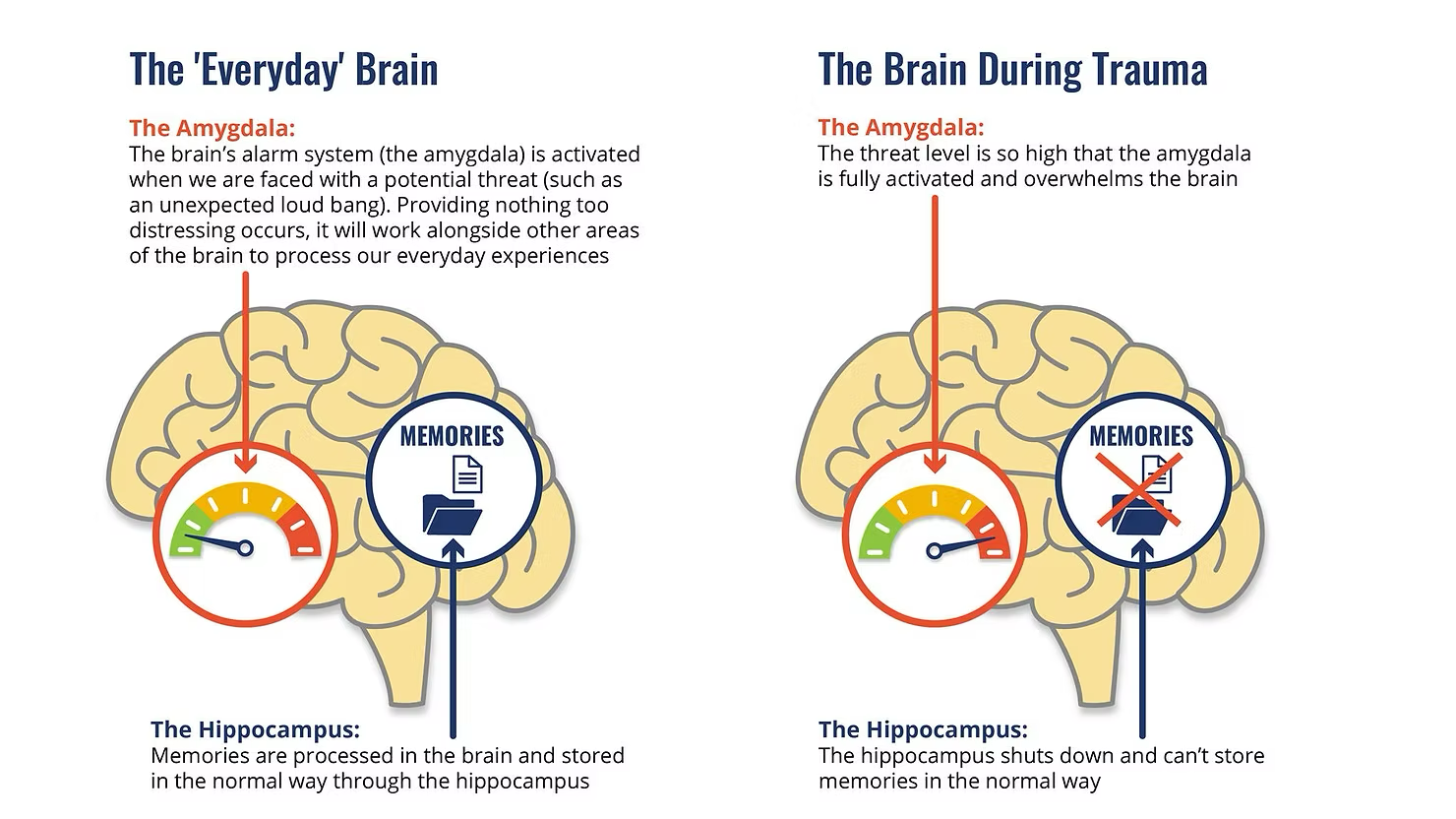
During trauma, rational processing systems like the hippocampus shut down, causing the emotional and survival-focused amygdala to go into overdrive.

As a result, traumatic experiences are stored differently than ordinary memories. Coded by the somatic nervous system rather than the brain, emotional and traumatic memories are held and recalled through bodily sensations rather than conscious thought. As a result, recollections of trauma tend to fragment into images, physical sensations, and emotions that don’t directly translate to words or cognizable narratives. 

Blog Post: Understanding How Traumatic Memory is Stored in the Brain by Sally Edwards, 2/4/2024.

Art Therapy as an Effective Intervention 

Art therapy is a therapeutic approach that helps individuals heal from trauma by expressing memories and emotions through creative processing. Drawing, painting, and sculpture allow survivors to communicate what they feel without relying solely on verbal expression, which can be especially helpful for those struggling to discern or articulate what happened to them and what they are feeling in response. 

Art therapy provides patients with three primary benefits:  

(1) it engages the physical body through the manipulation of art materials. The physicality of drawing, painting, sculpting, or otherwise manipulating physical materials can serve as a grounding technique, a self-soothing tool that reorients the nervous system to the here-and-now, helping a survivor feel rooted in the present instead of pulled back into the traumatic memory. One veteran suffering from PTSD described “when I feel so overwhelmed by feelings I cannot control, I just start painting. I pour everything I am feeling in what I am creating.” 

(2) Art therapy allows the patient to engage in a personalized introspective exercise in which the process and finished product become the “symbolic container of traumatic memories.” Trauma can symbolically live on the page or in the art, separating it from the artist’s brain and body. 

(3) it allows for cognitive reflection through discussion of the artwork, giving therapists and family a greater understanding of the artist, and serves as a noninvasive conversation-starter between patient and provider. 

Source: Combat Veteran’s art therapy response to PTSD; from collection of C. Malchiodi, PhD, ©2016

Source: Sculptural masks created by Iraq and Afghanistan war veterans hang in the Southwestern University art gallery. (Photo Credit: U.S. Army)

Art Therapy and the Legal Field 

Art therapy appears to be an effective approach for supporting people who have experienced trauma. One meta-analysis published in 2018 found that art therapy significantly reduced trauma-related symptoms in survivors of sexual abuse, war, and domestic violence. 

But importantly, art therapy can improve outcomes not just for the victims and survivors of violent crimes, but also the vast majority of people incarcerated. According to some estimates, more than 90% of incarcerated people have suffered from traumatic experiences, often starting in childhood. Because trauma is so deeply intertwined with the carceral system, art therapy has become increasingly relevant across multiple points of contact with that system. 

Prevention

Art therapy and arts‑based programs have shown promising outcomes for youth in under‑resourced communities, cultivating supportive relationships and opportunities for teens to build skills such as self‑expression and confidence. Group art has also been proven to foster a sense of community, which research has shown can reduce isolation and generate a sense of belonging and acceptance while also building an adolescent’s social support network.

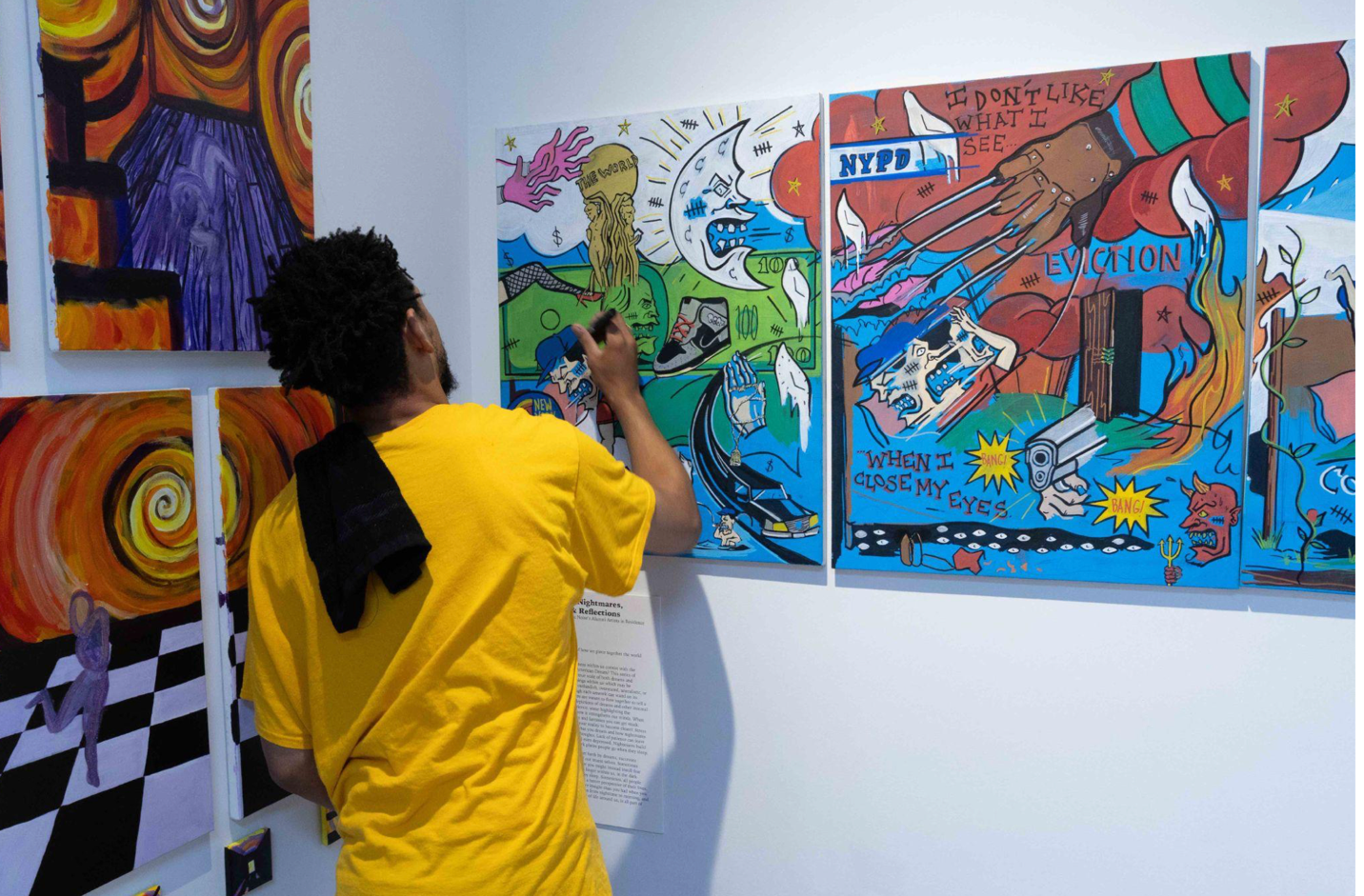
Photo from Artistic Noise’s 2025 “Symphony” Show.

Art Therapy for Those Currently Detained 

In a 2020 research article, Danielle Maude Littman and Shannon M. Silva published a review of 25 research studies regarding the effectiveness of the arts to those who are incarcerated, finding “statistically significant improvements in self-confidence, self-esteem, task completion, social competence, emotional stability and control and well-being, and decreased hopelessness and anger.”

There are multiple examples of successful programs that bring arts-based projects and art therapy interventions into prisons and detention centers. Artistic Noise, a Harlem-based nonprofit offers programming for system-involved youth. The program includes licensed art therapists, artists, and educators, who use art as a tool for self-expression, guiding incarcerated youth through projects designed to explore their emotions, experiences, and identities, while also developing better methods to regulate their emotions. Another successful program is the Art Therapy in Prisons Program, funded through the Individuals with Disabilities Education Act and implemented in partnership between the Department of Corrections and various State Universities. . 

Scott McKinstry, currently incarcerated at San Quentin, described the process of painting a 16-panel mural through California’s Arts in Corrections program. Scott shared that along with anger management classes, his project has helped him understand “why things bug me and why I ended up here. . . “

Incarcerated people in a mural class at Salinas Valley State Prison in Soledad, Calif. The class is part of an initiative to bring the arts to all 35 California state prisons for adults. Credit: Jim Wilson/The New York Times

Art Therapy to Reduce Recidivism 

The 2023 prison-drama Sing Sing highlights the real-life Rehabilitation Through the Arts (RTA) program at Sing Sing Maximum Security Prison. Grounded in values of dignity, creativity, commitment, and collaboration, RTA offers incarcerated participants opportunities to build life skills through the performing arts that support them both during their sentence and as they reenter their communities. The program also reports a remarkable recidivism rate of under 3%, in contrast to the national average of roughly 60% as participants leave prison to reconnect with their families and strengthen their communities, breaking the cycle of incarceration.

Photo from Rehabilitation Through the Arts’ website

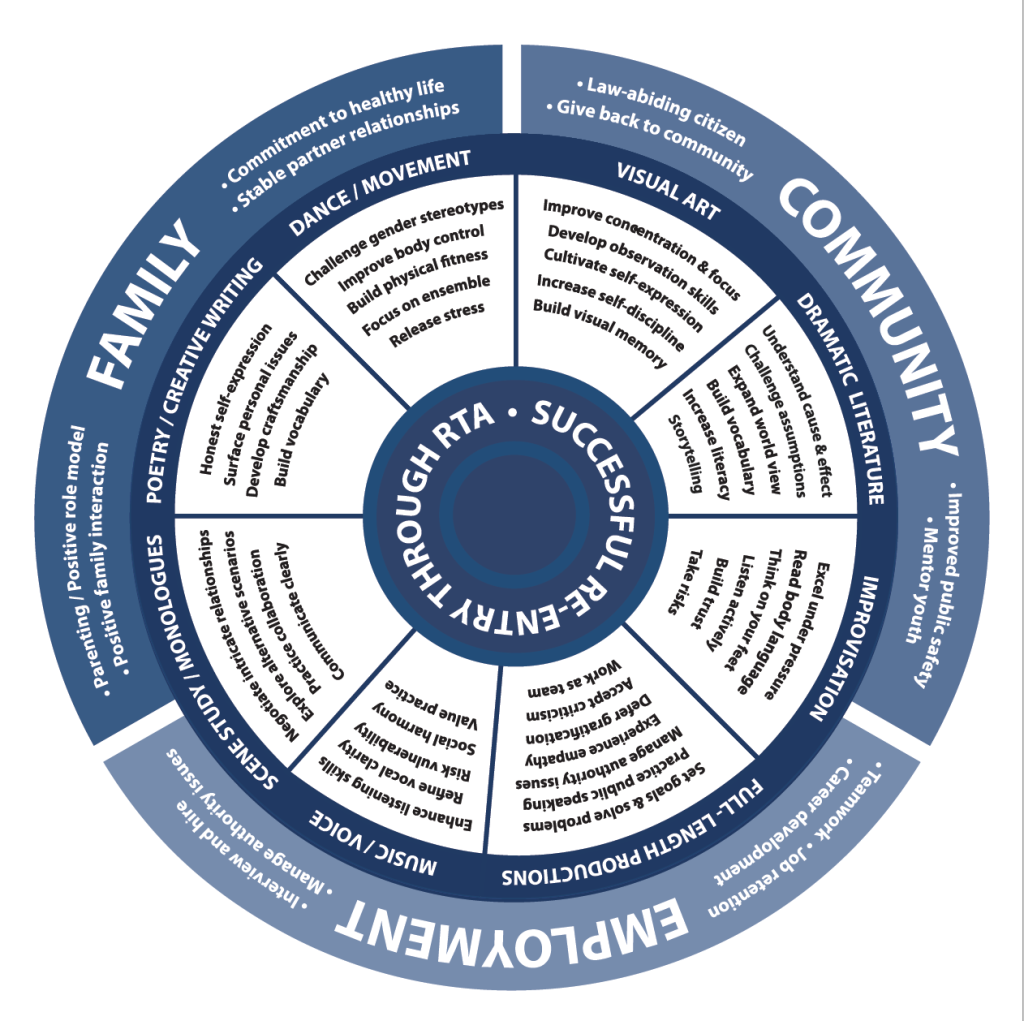
RTA believes that the arts serve as an important pathway for personal growth, particularly for individuals who enter prison with limited formal education—as over 40% of incarcerated people in New York State lack a high school diploma. RTA helps participants build foundational skills such as communication, goal-setting, problem-solving, and collaboration, which support both educational advancement and future workplace success. Through its Skill Wheel framework, RTA illustrates how different art forms cultivate abilities and how they translate into stronger community, employment, and family outcomes.

Rehabilitation Through the Arts’ “Skills Wheel” connecting different art forms to skills that reduce recidivism

Conclusion

Art therapy offers a powerful framework for repair, reflection, and reconnection. Its impact extends far beyond clinical settings, and more research is being dedicated to studying its impact on supporting individuals at every stage of involvement with the legal system. As this research continues to affirm its effectiveness, integrating art-based interventions into legal and carceral environments represents not only a therapeutic opportunity for anyone who has experienced trauma, but a broader commitment to dignity, humanity, and the transformation of community.

#ArtTherapy #TraumaInformedCare #WJLTA

From Private Jets to Prison: Art as Collateral and the Limits of Article 9

By: Matt Unutzer

For a time, Inigo Philbrick was a rising star in the contemporary art world, dealing in blue-chip artwork and brokering deals worth millions of dollars. Behind the champagne and private jets, however, was a web of fraud that ended in a Hollywood-worthy capture on the remote South Pacific Island of Vanuatu and a missing $86,000,000. Inigo’s scheme was straightforward. He acquired valuable paintings and resold fractional shares in them to multiple owners, often selling more than 100% ownership of the same paintings. To keep cash flowing and cover payments to fractional owners, he pledged the same paintings as unencumbered collateral for loans, representing to lenders that he owned the paintings outright. When the scheme unraveled, both lenders and fractional owners were left empty-handed, raising the question of whether existing lending laws are adequate for the murky world of private art transactions.

How Was the Fraud Possible Under Existing Lending Law?

Modern secured lending is governed by Article 9 of the Uniform Commercial Code (UCC). Under UCC § 9-203(b), a security interest is enforceable only if three conditions are met: (1) value has been given, (2) the debtor has rights in the collateral or the power to transfer such rights, and (3) the debtor has authenticated a security agreement describing the collateral.

UCC § 9-202 further provides that Article 9 applies regardless of “whether title to collateral is in the secured party or the debtor.” Attachment of the lender’s security interest, therefore, turns not on formal title allocation between lender and debtor, but on whether the debtor has rights in the collateral, with no independent requirement the lender take title to the collateral.

In Inigo’s case, unwitting lenders believed they were entering into valid secured transactions: Inigo received cash, provided falsified documents purporting to establish his outright ownership of the collateral paintings, and signed security agreements purporting to grant lenders rights in those paintings in the event of default. Under UCC § 9-202, no formal title transfer was required. The problem was that in many cases, Inigo held no ownership interest in the paintings at all. When lenders attempted to enforce their security interest after default, they found themselves in fruitless legal battles with fractional owners who had acquired interests in the same paintings before the loans were made.

Why Article 9 Works in Other Markets.

Article 9’s framework is not inherently flawed. In most asset classes, a debtor’s “rights in the collateral” are independently verifiable because ownership is recorded or registered in a public accessible system. In the case of a mortgage, the quintessential secured lending transaction, title to the real property, and any competing claims or encumbrances, are recorded in public land records. A lender can search those records to confirm ownership and identify competing interests before extending credit. Similar systems exist for many other assets. Vehicles, for example, are governed by registration systems accessible to third parties. In each of these contexts, lenders can independently verify whether the debtor has sufficient rights in the asset before extending credit.

Why Article 9 Struggles in the Art Market.

The art market lacks the verification infrastructure Article 9 presupposes. Although some private registries, such as the Art Loss Register exist, there is no centralized registry of art ownership. Instead, high-value art transactions typically occur through private deals, often with purchasers’ true identities obscured behind holding corporations. Compounding the problem, art has become increasingly financialized, with investors hoping to profit by buying and selling fractional shares of blue-chip artworks, further contributing to the uncertainty surrounding debtor ownership interests in a given artwork.

The result of this system is a patchwork of private transactions. A lender cannot easily determine whether a borrower owns a work outright, holds only a partial interest, or has already conveyed their rights to others. This renders § 9-203(b)(2)’s requirement that the debtor have rights in the collateral difficult to verify with certainty and potentially leaves lenders without legal recourse in the event of default.

Where to Next for Art-Based Lending?

In the absence of a centralized ownership registry, lenders bear a substantial credit risk when accepting art as collateral. Allowing lenders to assert claims against prior owners with undisclosed interests would merely shift that risk to those owners and could, in turn, create perverse incentives that facilitate frauds like those perpetrated by Inigo. 

While high-profile frauds like Inigo’s will likely prompt more rigorous risk management and due diligence by art lenders, they do not appear to be slowing the market. Sotheby’s, a leading market participant, recently announced its latest $900 million art-backed debt security, aimed at  qualified or accredited investors such as pension funds and banks. Perhaps the future of art-based lending may therefore be shaped more by the informal risk controls already employed by major auction houses like Sotheby’s or Christie’s: requiring possession or control of the artwork, maintaining conservative loan-to-value ratios, and insisting on robust provenance documentation.

The LLM Public Offering: Why One S-1 Filing Will Reshape AI’s Governance

By: Joyce Jia

Photo by Beyzaa Yurtkuran on Pexels.com

In early December 2025, the Financial Times reported that Anthropic retained the Palo Alto-based law firm Wilson Sonsini to help facilitate a public offering as early as 2026. The move may signal a strategic effort to outpace rival OpenAI, which had also been eyeing a 2026 listing. Following the report, OpenAI executives privately expressed concern about being beaten to market. Regardless of who lists first, 2026 is shaping up to be a landmark year for AI in public markets, and a long-awaited opportunity for investors and observers to lift the veil on the economics of the generative AI giants driving the Fourth Industrial Revolution.

More than an IPO: A Governance Blueprint for the AI Era

As AI systems increasingly power healthcare systems, financial markets, communications, and public services, they are functionally becoming part of the nation’s core infrastructure. Unlike pharmaceuticals subject to FDA approval, financial intermediaries registered with the SEC, or telecommunications providers licensed by the FCC, frontier AI developers operate without a comparable, unified regulatory gatekeeper. Existing oversight has been fragmented across state privacy regimes and FTC consumer protection authority, leaving the public with significant gaps in understanding how these companies operate, what their models optimize for, and how deeply they depend on cloud infrastructure, semiconductor supply chains, and energy capacity. Moreover, propelled by unprecedented growth trajectories, they have financed their expansion almost entirely through venture capital and private placements, without being subject to public disclosure obligations and public accountability that securities registration demands. 

When Anthropic or OpenAI files for its initial public offering, it will become the first frontier AI company to submit its business model to the full discipline of SEC disclosure. The filing will not merely determine one company’s market valuation. It will likely shape the disclosure template and regulatory precedent governing how artificial intelligence integrates into public capital markets, compelling for the first time a legally enforceable accounting of how frontier AI companies actually operate, what system risks they pose, and whether traditional corporate governance frameworks are adequate to contain them. 

Tip of the Iceberg: What SEC Disclosure Will Finally Force Frontier AI to Reveal

The S-1 registration statement must include all information specifically required by Form S-1, as well as any material information needed to prevent the included statements from being misleading. Current SEC disclosure requirements do not specifically address modern AI risks, though the SEC’s Division of Examinations has identified AI as a priority focus area. Under established materiality doctrine, disclosure is required for any matter to which a reasonable investor would attach importance in deciding whether to purchase a security. Furthermore, Item 105 of Regulation S-K requires a “Risk Factors” section discussing material factors that make an investment speculative or risky, with a concise explanation of how each risk affects the registrant.

Under this framework, investors will likely see for the first time the size of an LLM company’s accumulated deficit and its projected path to profitability. They will also gain visibility into the terms of related-party contracts and material agreements with cloud and semiconductor suppliers who serve as both vendors and strategic investors. Disclosure will additionally include training data liabilities such as the Bartz v. Anthropic settlement. Finally, “Business” and “Management’s Discussion and Analysis” sections may provide a first-of–its-kind monetization narrative, explaining what these companies’ algorithms are optimized for, what commercial incentives are encoded in model training, and how ecosystem allocation decisions generate indirect value. Together, these disclosures will expose the structural economics of frontier AI development in a way that no private financing round has ever required.

Disclosure priorities will also differ across companies. Anthropic’s Long-Term Benefit Trust grants outside directors veto power over decisions conflicting with the company’s safety mission, even where those decisions would maximize shareholder value. This structure directly challenges the shareholder primacy doctrine established in Dodge v. Ford, the 1919 Michigan Supreme Court decision holding that corporate directors must prioritize shareholder returns over broader social objectives. The arrangement raises a critical question: Can mission-driven governance survive activist investors and proxy battles once the company goes public? 

OpenAI, having completed its conversion to a Delaware public benefit corporation in October 2025, faces a structurally distinct set of disclosures: the terms of its nonprofit’s retained equity stake, the scope and exclusivity of its Microsoft dependency, and the resolution of Elon Musk’s active litigation challenging the conversion will each require disclosure under existing SEC frameworks in configurations not previously tested at this scale.

Materiality Standards for the AI Future

Much of what frontier AI companies should disclose is already compelled by existing SEC rules. What is needed is rigorous application of the comment process to establish materiality standards specific to the AI sector. Anthropic published a new model Constitution last month articulating how its AI systems should reason and prioritize competing values. OpenAI, for its part, has committed to a governance structure that retains a nonprofit equity stake precisely to preserve the primacy of safety and security obligations even after its corporate restructuring. Both are well positioned to lead on disclosure voluntarily, setting best practices that regulators and competitors will be compelled to follow. That makes these securities filings as consequential as any AI safety research. Markets, no less than models, need alignment.

When Proof Becomes Partisan: How AI Is Fracturing Our Shared Reality

By: Claire Kenneally

What’s Happening? 

Note: This post contains photos of weapons and discusses violence that may be triggering. 

The shootings of Renee Good and Alex Pretti incited the nation, as viewers across the country tuned in to the violence in Minneapolis, Minnesota. Both Good and Pretti were protestors killed by U.S. Immigration and Customs Enforcement (ICE) agents employed in Operation Metro Surge– a large scale immigration raid that resulted in the detention over 4,000 documented and undocumented Minnesotans. 

But instead of prompting collective grief, the country’s varied reactions only deepened the sense that Americans now inhabit entirely different moral and political universes. In part, this stems from media coverage surrounding the shootings. AI-generated media is accelerating political polarization by reshaping public perception of violent events before facts can stabilize.

Where Does Our News Get Our News? 

News networks have always had biases. But the internet and social media have shifted networks’ priorities from well-researched and fact-based journalism to punchy pieces aimed at generating clicks. A study by UCLA Professor Arash Amini described the media’s perpetuation of misinformation as an “arms race in which mainstream media outlets struggle to stand out amid a flood of content.” 

When Renee Good was shot by ICE on January 7th, 2026, online sleuths were quick to create and point to video footage of the moments leading up to the shooting. One X user, a self-proclaimed “Trump Loyalist Parody Account” shared an aerial-view photo of Good’s car that quickly gained traction online. The original post did not disclose that the photo was AI, nor that it was generated only to show why the X user personally believed agents should be allowed to use lethal force. A later post admitted the photo was AI-generated, after Snopes and Lead Stories debunked it (in part because the falsified photo included imagery like car doors open that were actually closed, and bystanders in different outfits than they had on in verified video footage). But the original photo, without the subsequent post’s clarification, had already spread across the internet. 

Image taken from Twitter user @ScummyMummy511/Max Nesterak/Snopes Illustration

In the wake of Alex Pretti’s death a few weeks later, social media users flooded the internet with AI-generated images of him holding a gun, while video footage of the shooting later revealed him to be holding his cell phone.  Other doctored footage circulated inaccurately showed an agent holding a gun to the back of Pretti’s head while he lay prone on the ground. 

Photo taken from the January 25th, 2026 New York Times article “False Posts and Altered Images Distort Views of Minnesota Shooting”

Ironically, the AI-enhancement of media to justify a singular political narrative is not a partisan issue. Viewers across the political spectrum suffer when the news they consume is riddled with inaccuracies, even if those inaccuracies confirm their biases. This, in turn, only serves to widen the gap between Americans- how can you converse about an important social issue when you’re each convinced you have the concrete evidence, and that it supports your opinion? 

Long-Reaching Implications

In the cases of Good, Pretti, and countless other victims of violence, another troubling aspect in the coverage of their deaths is how their images are reshaped posthumously to fit familiar narratives and biases. 

Altered photos of Good were circulated in the wake of her death, claiming she’d posted in celebration of Charlie Kirk’s shooting earlier this year. This led to some Conservative-leaning viewers calling her death “karma”- stoking animosity against her even after the photo’s authenticity was fact-checked and disproven. 

In Pretti’s case, multiple stations accidentally used an AI-doctored photo of him in their initial coverage. Some speculate the edited photo was created to make him appear “less Jewish”. Others suggested it was to make him “. . . a more appealing ‘poster boy’ for the anti-ICE movement.” MSNBC, who used the altered photo, claimed that they merely pulled it from the internet after searching Pretti’s name. Knowing AI’s predilection for generating images that favor whiteness, conventional beaty standards, and imbedded racial biases, it’s unsurprising, but disturbing, how mundane Google Image searches further subtle whitewashing and stereotyping under the guise of algorithmic neutrality.

Photo taken from the January 28th, 2026 New York Post article “AI-altered pic of Alex Pretti is being widely circulated after his killing by Border Patrol” 

The Legal Implications

Currently there are few legal protections in place to counteract AI “enhanced” media. The current administration has taken a strong stance against AI regulation, passing Executive Order 14179 in  January 23, 2025 (“Removing Barriers to American Leadership in Artificial Intelligence”) and Executive Order 14365 of December 11, 2025 (“Ensuring a National Policy Framework for Artificial Intelligence”). Both orders removed barriers like state-wide AI regulations to “encourage adoption of AI applications across sectors.”  

The legislative branch has taken a different approach than the executive. The TAKE IT DOWN Act was signed into law in May 2025 and prohibits the nonconsensual online publication of intimate visual depictions of individuals, both authentic and computer-generated. However, the act focuses on sexual imagery and would not apply to Good or Pretti.  

The 2025 proposed NO FAKES Act holds more promise, as it would make individuals and entities legally responsible for creating unauthorized digital copies of a person. The Act is focused on establishing intellectual property rights against AI-generated deepfakes and creating a legal recourse for individuals whose likeness is used without consent. If this bill passes, it could create a way for members of Good and Pretti’s families to sue in civil court for damages. 

So What Am I Supposed to Do?  

The 24-hour news cycle is not slowing down. But with minimal legal recourse and an executive office that happily generates AI misinformation as freely as fringe conspiracy theorists, sometimes it feels that there’s not much to do but hope Congress acts quickly. However, one intermediate solution is turning to local, community journalism instead of national pundits. In the realm of immigration crackdowns, protest coverage, and updates on Minneapolis, consider:  

In the emerging age of AI narratives and de-regulation, staying truly informed now means choosing intention over speed, resisting easy narratives, and doing the critical thinking ourselves. 

This article acknowledges and honors all individuals who have been murdered by ICE and the Department of Homeland Security in 2026: Keith Porter, Parady La, Heber Sanchaz Domínguez, Victor Manuel Diaz, Luis Beltran Yanez-Cruz, Luis Gustavo Nunez Caceres, and Geraldo Lunas Campos, Renee Good, and Alex Pretti. Learn more about their stories here

#Deepfakes #A.I.Misinformation #WJLTA